
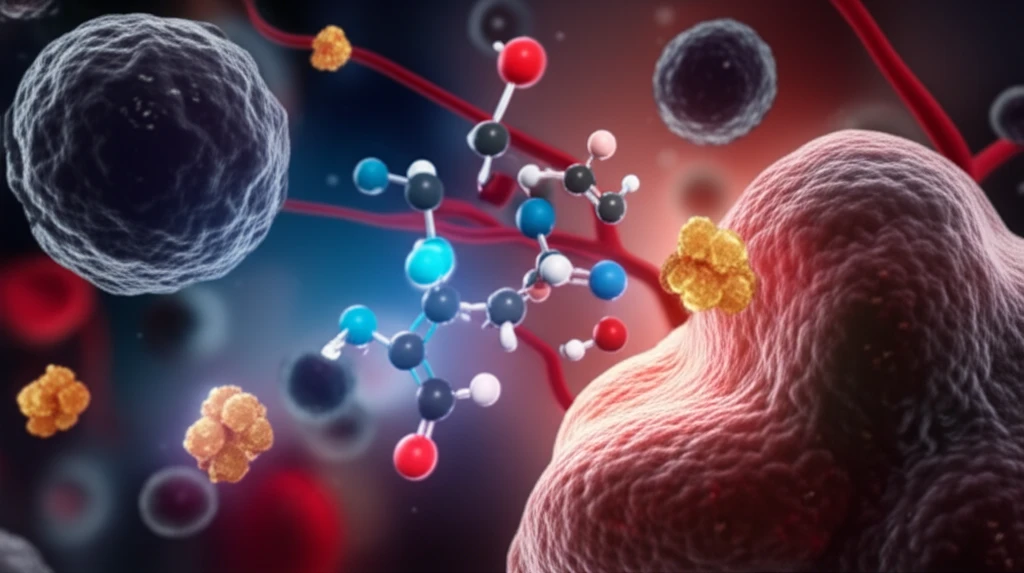
Cryptotanshinone attacking colon cancer cells

Can Cryptotanshinone Stop Colon Cancer in Its Tracks? New Hope for Inflammation and Angiogenesis Control

"Unlocking the potential of cryptotanshinone: A natural compound's impact on colon cancer growth, invasion, and its effects on inflammation and angiogenesis."


Colorectal cancer remains a significant health challenge worldwide, demanding innovative and effective treatment strategies. While advancements have been made in understanding the disease, progress in treatment has been slow, and existing therapies often come with limitations and adverse effects. This is why the search for new therapeutic agents is crucial.

Two critical processes in colon cancer progression are tumor angiogenesis (the formation of new blood vessels that feed the tumor) and inflammation. Angiogenesis plays a vital role in invasion and metastasis, while inflammation can promote cancer development from its early stages. Targeting these processes could offer a powerful approach to combatting colon cancer.

Now, exciting research is shedding light on the potential of cryptotanshinone (CPT), a natural compound isolated from Salvia miltiorrhiza Bunge, to inhibit colon cancer growth and invasion. This article dives deep into how CPT works, exploring its impact on inflammation, angiogenesis, and key molecular pathways involved in cancer progression. Get ready to discover a promising new avenue for colon cancer treatment.

How Cryptotanshinone Tames Colon Cancer: Targeting MMP/TIMP, PI3K/Akt/mTOR, and HIF-1α

Cryptotanshinone attacking colon cancer cells

This research investigates the pharmacological effects of CPT on CT26 colon cancer cells, both in vitro (in the lab) and in vivo (in living organisms), to understand its potential mechanisms of action. The study reveals that CPT effectively suppresses the proliferation and growth of CT26 colon cancer cells.

A key aspect of CPT's effectiveness lies in its ability to inhibit the invasion of CT26 cells. This involves:

  • Decreasing MMP-2 and MMP-9: CPT reduces the protein expression of matrix metalloproteinase-2 (MMP-2) and MMP-9, enzymes that break down the extracellular matrix, allowing cancer cells to invade surrounding tissues.
  • Increasing TIMP-1 and TIMP-2: Simultaneously, CPT increases the expression of tissue inhibitor of metallopeptidase-1 (TIMP-1) and TIMP-2, which inhibit MMPs, further hindering cancer cell invasion.
These actions suggest that CPT can modify the tumor microenvironment, making it less conducive to cancer cell invasion. The study further demonstrates that CPT inhibits tumor cell-induced angiogenesis, potentially by suppressing angiogenesis-associated factors. This is crucial, as angiogenesis provides the necessary blood supply for tumor growth and metastasis.

The Future of Colon Cancer Treatment: A Natural Compound with Promising Potential

Cryptotanshinone presents a promising avenue for colon cancer treatment, demonstrating the ability to inhibit growth, invasion, inflammation, and angiogenesis. By modulating key signaling pathways and factors involved in these processes, CPT offers a multi-targeted approach to combatting colon cancer. While further research is needed, these findings suggest that CPT could play a significant role in future colon cancer therapies, potentially improving outcomes and quality of life for patients.

About this Article -

This article was crafted using a human-AI hybrid and collaborative approach. AI assisted our team with initial drafting, research insights, identifying key questions, and image generation. Our human editors guided topic selection, defined the angle, structured the content, ensured factual accuracy and relevance, refined the tone, and conducted thorough editing to deliver helpful, high-quality information.See our About page for more information.

Everything You Need To Know

1

What is cryptotanshinone and where does it come from?

Cryptotanshinone (CPT) is a natural compound. It is isolated from *Salvia miltiorrhiza Bunge*. This compound has shown promise in inhibiting colon cancer growth and invasion, making it a potential therapeutic agent for future treatments.

2

How does cryptotanshinone work against colon cancer?

Cryptotanshinone (CPT) works by targeting several key processes involved in colon cancer progression. It effectively suppresses the proliferation and growth of CT26 colon cancer cells. CPT decreases the expression of MMP-2 and MMP-9, enzymes that help cancer cells invade tissues. Simultaneously, it increases TIMP-1 and TIMP-2, which inhibit the MMPs, thus hindering cancer cell invasion. Moreover, CPT inhibits tumor cell-induced angiogenesis, which is crucial for preventing the necessary blood supply for tumor growth and metastasis.

3

What are MMP-2, MMP-9, TIMP-1, and TIMP-2, and why are they important in the context of colon cancer?

MMP-2 and MMP-9 are matrix metalloproteinases, enzymes that break down the extracellular matrix, allowing cancer cells to invade and spread. TIMP-1 and TIMP-2 are tissue inhibitors of metallopeptidases, which inhibit MMPs. In colon cancer, CPT modulates the balance of these factors. By decreasing MMPs and increasing TIMPs, CPT hinders the invasion of cancer cells, a critical step in metastasis. This modulation of the tumor microenvironment is key to CPT's anti-cancer effects.

4

What is angiogenesis, and how does cryptotanshinone affect it in the context of colon cancer?

Angiogenesis is the formation of new blood vessels that feed a tumor. These new blood vessels are essential for tumor growth and metastasis. Cryptotanshinone (CPT) inhibits tumor cell-induced angiogenesis by suppressing angiogenesis-associated factors. By cutting off the blood supply, CPT restricts the tumor's ability to grow and spread, representing a vital mechanism in its fight against colon cancer progression.

5

What are the implications of using cryptotanshinone in future colon cancer therapies?

Cryptotanshinone (CPT) presents a promising avenue for future colon cancer therapies. It has shown the ability to inhibit growth, invasion, inflammation, and angiogenesis by modulating key signaling pathways. This multi-targeted approach suggests that CPT could improve outcomes and the quality of life for patients. However, further research is needed to fully understand its potential and efficacy in clinical settings, making it a valuable area for ongoing investigation in the fight against colon cancer.

Newsletter Subscribe

Subscribe to get the latest articles and insights directly in your inbox.