
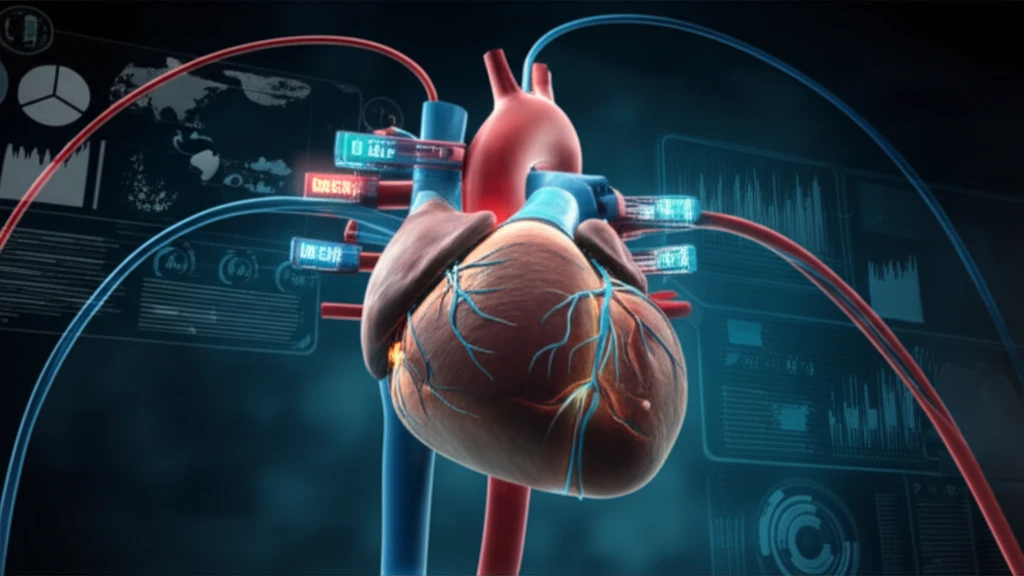
Human heart intertwined with fiber optic cables, symbolizing blood vessels. The cables glow with varying intensities of light, representing different levels of blood speckle intensity.

Can AI Predict Heart Health? New IVUS Study Offers Hope

"Revolutionary research explores how blood speckle intensity could forecast target vessel revascularization after stent placement."


Coronary artery disease (CAD) remains a significant health challenge, often requiring percutaneous coronary intervention (PCI) with stents to restore blood flow. While drug-eluting stents (DES) have greatly reduced complications like restenosis, a considerable number of patients still require target vessel revascularization (TVR) – a repeat procedure to address new blockages.

Traditional methods for assessing the success of PCI, such as fractional flow reserve (FFR), have limitations. Intravascular ultrasound (IVUS) offers a detailed look inside the arteries, but standard gray-scale IVUS has its own set of challenges in predicting which patients will need future interventions.

Now, a new study is exploring a novel approach: analyzing the intraluminal intensity of blood speckle (IBS) using integrated backscatter-IVUS (IB-IVUS). This technique, which measures the difference in IBS across a stenosis (AIBS), could provide an earlier, more accurate prediction of TVR, ultimately improving patient outcomes and reducing the need for repeat procedures.

Decoding AIBS: How Blood Speckle Intensity Predicts TVR

Human heart intertwined with fiber optic cables, symbolizing blood vessels. The cables glow with varying intensities of light, representing different levels of blood speckle intensity.

The recent study, published in Catheter Cardiovasc Interv, delved into the predictive power of AIBS in patients undergoing PCI. Researchers at Chiba University Graduate School of Medicine screened 703 vessels, ultimately focusing on 393 vessels that met specific criteria, including IVUS imaging and follow-up angiography.

Here's how the study worked:

  • Patient Selection: Patients undergoing PCI with stent implantation were included, with careful exclusion of those lacking IVUS data or follow-up information.
  • IVUS Imaging: IB-IVUS was used to measure intraluminal IBS values at the ostium (opening) of the target vessel and at the distal reference point of the implanted stent.
  • AIBS Calculation: AIBS was calculated as the difference between the distal IBS and the IBS at the ostium.
  • Follow-up: Patients were followed for an average of 11.2 months to determine the occurrence of TVR.
The study revealed a significant association between AIBS and TVR. Vessels that required revascularization had significantly greater AIBS values compared to those that did not (11.10 ± 5.93 vs. 5.90 ± 5.49, P <0.001). Further analysis, including ROC curve analysis, identified a cut-off value of 8.24 for AIBS, which significantly predicted TVR. The use of drug-eluting stents and AIBS values above this threshold emerged as independent predictors of TVR.

The Future of Heart Health: AIBS and Personalized PCI

This study offers a promising glimpse into the future of heart health monitoring. By incorporating AIBS measurements into routine IVUS assessments, clinicians may be able to identify patients at higher risk of TVR early on. This could lead to more personalized PCI strategies, including optimized stent placement, further dilation, or even the use of additional stents to address residual lesions.

About this Article -

This article was crafted using a human-AI hybrid and collaborative approach. AI assisted our team with initial drafting, research insights, identifying key questions, and image generation. Our human editors guided topic selection, defined the angle, structured the content, ensured factual accuracy and relevance, refined the tone, and conducted thorough editing to deliver helpful, high-quality information.See our About page for more information.

Everything You Need To Know

1

What is Intraluminal Blood Speckle (IBS) and how does it relate to heart health?

Intraluminal blood speckle (IBS) refers to the patterns of backscattered ultrasound waves within the blood. This is measured by integrated backscatter-IVUS (IB-IVUS). The study focused on measuring the difference in IBS across a stenosis, called AIBS. The AIBS measurement can predict the need for Target Vessel Revascularization (TVR) after stent placement, which helps in assessing heart health. This is because changes in blood flow and vessel characteristics, which contribute to higher AIBS values, can indicate a higher risk of needing repeat procedures.

2

How does the use of AIBS measured by IB-IVUS improve upon traditional methods like Fractional Flow Reserve (FFR) in assessing heart health?

Traditional methods like Fractional Flow Reserve (FFR) have limitations. Intravascular ultrasound (IVUS) offers a detailed look inside the arteries. Standard gray-scale IVUS has its own set of challenges in predicting which patients will need future interventions. The study focuses on AIBS, which measures the difference in IBS across a stenosis (AIBS), using integrated backscatter-IVUS (IB-IVUS). This technique could provide an earlier, more accurate prediction of TVR. This is achieved by measuring the intraluminal intensity of blood speckle (IBS). By using AIBS, clinicians may identify patients at higher risk of TVR early on, potentially leading to better patient outcomes.

3

What specific steps did the Chiba University study take to investigate the predictive power of AIBS?

The study involved several key steps. First, patients undergoing Percutaneous Coronary Intervention (PCI) with stent implantation were selected, carefully excluding those lacking necessary data. Then, IB-IVUS was used to measure intraluminal IBS at the ostium of the target vessel and the distal reference point. AIBS was then calculated as the difference between these two IBS values. Finally, patients were followed for an average of 11.2 months to track the occurrence of Target Vessel Revascularization (TVR). The study found a significant association between AIBS and TVR, identifying an AIBS cut-off value that predicted the need for revascularization.

4

What were the key findings of the AIBS study, and how do they impact the future of heart health monitoring?

The study revealed a significant association between AIBS values and the need for Target Vessel Revascularization (TVR). Vessels requiring revascularization had considerably higher AIBS values. A cut-off value of 8.24 for AIBS was identified as a significant predictor of TVR. The use of drug-eluting stents and AIBS values above this threshold emerged as independent predictors of TVR. These findings suggest that incorporating AIBS measurements into routine IVUS assessments could help clinicians identify patients at a higher risk of TVR early on. This could lead to more personalized Percutaneous Coronary Intervention (PCI) strategies and improved patient outcomes.

5

How can the use of AIBS lead to more personalized Percutaneous Coronary Intervention (PCI) strategies, and what are the potential benefits for patients?

By incorporating AIBS measurements into routine IVUS assessments, clinicians can potentially identify patients at higher risk of needing Target Vessel Revascularization (TVR). This could allow for the development of more personalized Percutaneous Coronary Intervention (PCI) strategies. Potential strategies include optimizing stent placement, further dilation of the vessel, or even the use of additional stents to address residual lesions. The benefits for patients include the possibility of fewer repeat procedures, improved long-term outcomes, and a more tailored approach to their heart health management, which will ultimately improve their quality of life.

Newsletter Subscribe

Subscribe to get the latest articles and insights directly in your inbox.