
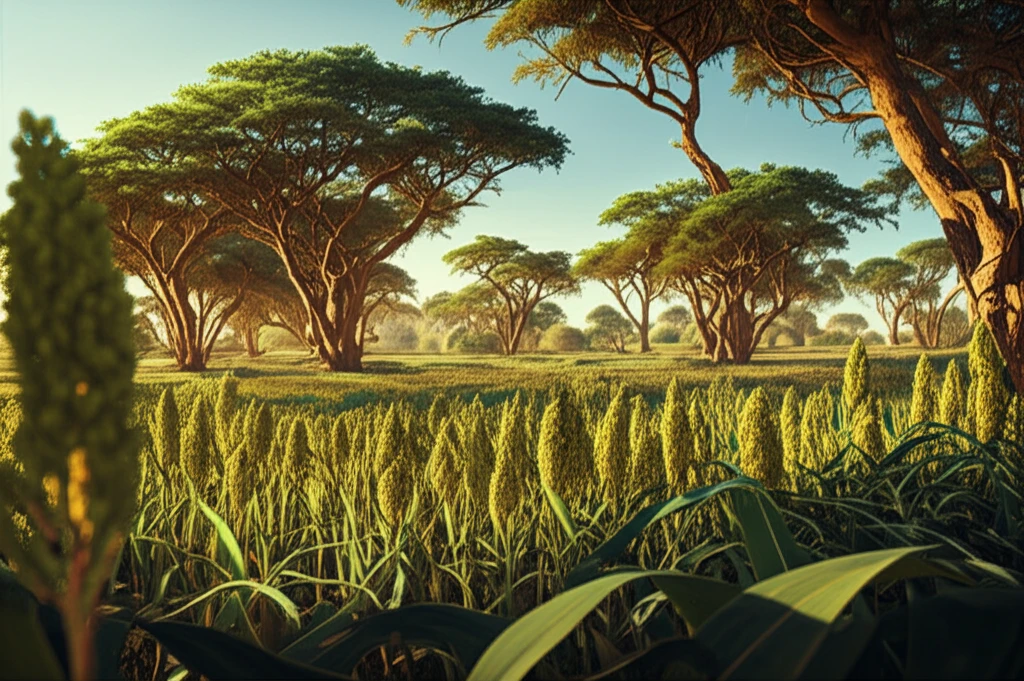
Sorghum field growing under *Acacia senegal* trees.

Can Agroforestry Boost Sorghum Yields? The Acacia Senegal Secret

"Discover how integrating Acacia senegal trees with sorghum crops can improve soil fertility and increase productivity, offering a sustainable solution for farmers."


In many parts of the world, particularly in Sub-Saharan Africa, sorghum is a crucial cereal crop that forms the backbone of food security. However, sorghum production faces significant challenges, especially in regions with poor soil fertility. Traditional methods of improving soil quality, such as applying organic manure or artificial fertilizers, are often limited by economic constraints, making them inaccessible to many farmers.

The need for sustainable and cost-effective solutions has led to increased interest in agroforestry—the integration of trees and shrubs into agricultural systems. One promising approach involves the use of Acacia senegal, a tree species well-adapted to arid and semi-arid environments. Acacia senegal is known for its ability to improve soil fertility and provide various other benefits, making it an ideal candidate for integration with sorghum cultivation.

A recent study published in the Journal of Applied Biosciences investigated the productivity of sorghum (Sorghum bicolor) when grown in an agroforestry system with Acacia senegal in Niger. The research aimed to assess how the presence of Acacia senegal influences sorghum yield and overall agricultural productivity, offering insights into a more sustainable farming approach.

How Does Acacia Senegal Improve Sorghum Production?

Sorghum field growing under *Acacia senegal* trees.

The study, conducted in the Torodi area of Niger, focused on a natural Acacia senegal forest where researchers examined sorghum growth in concentric zones around the trees. These zones included areas under the tree canopy and areas outside the canopy, allowing for a comparison of growth conditions and crop yields. The local sorghum variety was planted, and measurements were taken to assess plant height, leaf count, and yield components.

Researchers divided the planting area into three zones:

  • Zone 1 (P1): Under the canopy, covering half the radius.
  • Zone 2 (P2): Under the canopy, covering the remaining radius.
  • Zone 3 (P3): Outside the canopy, serving as a control.
The results showed that sorghum plants grown under the Acacia senegal canopy exhibited significant differences in productivity compared to those grown outside the canopy. Specifically, the yield of both panicles and grains was statistically higher under the tree canopy. The presence of Acacia senegal created a favorable agro-ecological environment, boosting sorghum production.

Embracing Agroforestry for a Sustainable Future

The findings highlight the potential of agroforestry practices, particularly the integration of Acacia senegal, to enhance sorghum production in challenging environments. By creating a symbiotic relationship between trees and crops, farmers can improve soil fertility, increase yields, and reduce their dependence on costly chemical inputs. This approach not only promotes sustainable agriculture but also contributes to the resilience of farming communities in the face of environmental and economic pressures.

About this Article -

This article was crafted using a human-AI hybrid and collaborative approach. AI assisted our team with initial drafting, research insights, identifying key questions, and image generation. Our human editors guided topic selection, defined the angle, structured the content, ensured factual accuracy and relevance, refined the tone, and conducted thorough editing to deliver helpful, high-quality information.See our About page for more information.

Everything You Need To Know

1

What is agroforestry, and how does integrating *Acacia senegal* trees into sorghum cultivation qualify as such?

Agroforestry is the integration of trees and shrubs into agricultural systems. Integrating *Acacia senegal* trees into sorghum cultivation qualifies as agroforestry because it involves deliberately combining woody plants (*Acacia senegal*) with the cultivation of a cereal crop (sorghum) on the same land. This system aims to leverage the beneficial interactions between the trees and crops, improving soil fertility and overall agricultural productivity, offering a more sustainable farming approach than monoculture.

2

How does *Acacia senegal* improve soil fertility to benefit sorghum crops, and what are the implications for farmers in Sub-Saharan Africa?

*Acacia senegal* improves soil fertility through several mechanisms, including nitrogen fixation (converting atmospheric nitrogen into a form usable by plants), increasing organic matter in the soil, and improving soil structure. For farmers in Sub-Saharan Africa, this means reduced reliance on expensive chemical fertilizers, which are often economically inaccessible. The improved soil fertility leads to increased sorghum yields, enhancing food security and providing a more sustainable and cost-effective farming system. A missing element not discussed is water conservation. *Acacia senegal* can help reduce soil erosion and improve water infiltration, further benefiting sorghum crops, especially in arid and semi-arid regions.

3

Can you describe the experimental design used to evaluate the impact of *Acacia senegal* on sorghum yield in the Torodi area of Niger, and why were different zones established?

The study in Torodi, Niger, examined sorghum growth in a natural *Acacia senegal* forest. Researchers divided the planting area into three concentric zones around the trees: Zone 1 (P1) under the canopy covering half the radius, Zone 2 (P2) under the canopy covering the remaining radius, and Zone 3 (P3) outside the canopy as a control. These zones were established to compare sorghum growth and yield under different levels of *Acacia senegal* influence. By comparing Zones 1 and 2 (under the canopy) with Zone 3 (outside the canopy), researchers could assess how the presence of *Acacia senegal* affected sorghum productivity, plant height, leaf count, and yield components. A controlled comparison highlights the benefits of agroforestry.

4

What were the key findings regarding sorghum yield under the *Acacia senegal* canopy versus outside the canopy, and what do these results suggest about the potential of agroforestry?

The key finding was that sorghum plants grown under the *Acacia senegal* canopy exhibited significantly higher yields of both panicles and grains compared to those grown outside the canopy. This suggests that *Acacia senegal* creates a favorable agro-ecological environment that boosts sorghum production. These results highlight the potential of agroforestry, specifically the integration of *Acacia senegal*, to enhance sorghum production in challenging environments by improving soil fertility and providing a symbiotic relationship between trees and crops. It reduces the dependence on costly chemical inputs and promotes sustainable agriculture. Further research could explore the optimal density and arrangement of *Acacia senegal* trees to maximize sorghum yields.

5

What are the broader implications of adopting agroforestry practices with *Acacia senegal* for farming communities facing environmental and economic pressures, and what other benefits might this system provide?

Adopting agroforestry practices with *Acacia senegal* can enhance sorghum production in challenging environments. It reduces dependence on costly chemical inputs, and promotes sustainable agriculture. It contributes to the resilience of farming communities. Other benefits include improved carbon sequestration, biodiversity conservation, and the provision of additional products such as gum arabic (from *Acacia senegal*), which can provide farmers with an additional income stream. Furthermore, *Acacia senegal*'s ability to thrive in arid conditions makes it a valuable tool for combating desertification and land degradation, offering long-term ecological and economic benefits to farming communities.

Newsletter Subscribe

Subscribe to get the latest articles and insights directly in your inbox.