
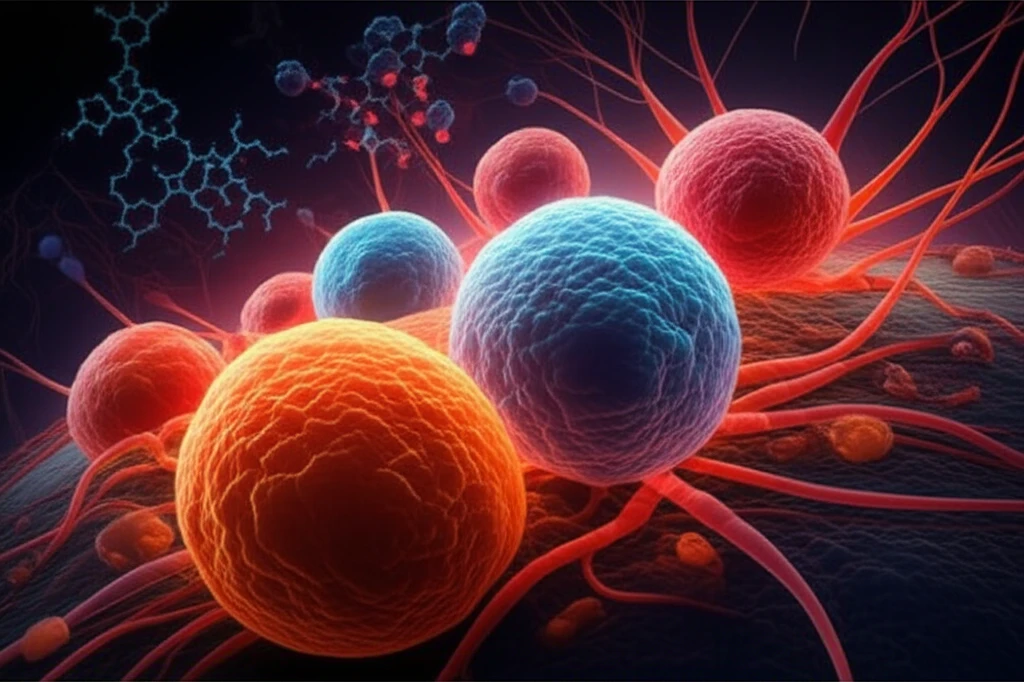
Cancer cells undergoing immunological death with EY-6.

Can a New Compound EY-6 Trigger Cancer Cell Death?

"Discover how scientists are exploring EY-6 as a potential game-changer in cancer treatment, focusing on its ability to induce immunological cell death and improve anti-tumor immunity."


In the ongoing quest to combat cancer, researchers are constantly exploring new avenues for treatment. Among these, a recent study has focused on a promising compound known as EY-6. This chemotherapeutic candidate has shown potential in inducing immunological death in human tumor cell lines, marking a significant step forward in cancer research.

Immunological cell death is a process where dying tumor cells trigger an immune response, alerting the body's defense mechanisms to attack the remaining cancer cells. This approach differs significantly from traditional chemotherapy, which often suppresses the immune system. EY-6's ability to stimulate the immune system while selectively killing tumor cells makes it a unique and promising candidate.

The original study, published in 'Immune Network' in April 2012, details the initial findings on EY-6. Scientists are enthusiastic about its potential, but more research is needed to fully understand its mechanisms and confirm its efficacy in in-vivo studies.

How Does EY-6 Induce Immunological Cell Death?

Cancer cells undergoing immunological death with EY-6.

The study published in Immune Network, examined the effects of EY-6 on several human tumor cell lines, including colon carcinoma (HCT15, HCT116), gastric carcinoma (MKN74, SNU668), and myeloma (KMS20, KMS26, KMS34) cells. The results indicated that EY-6 effectively killed these cells in a dose-dependent manner, meaning the higher the concentration of EY-6, the more cancer cells died.

One of the key markers of immunological cell death is the expression of calreticulin (CRT) on the surface of tumor cells. CRT is an "eat-me" signal that attracts immune cells to engulf and destroy the dying cancer cells. The study found that EY-6 treatment increased CRT expression in colorectal and gastric cancer cells, suggesting that it was indeed inducing immunological cell death.

Here are the key findings of the study:
  • Dose-Dependent Cell Death: EY-6 effectively killed human tumor cells from various origins in a dose-dependent manner.
  • CRT Expression: The expression of calreticulin (CRT), a key marker for immunological death, increased on the surface of treated colorectal and gastric cancer cells.
  • Cytokine Secretion: EY-6 modulated the secretion of cytokines, signaling molecules that can enhance anti-tumor immunity.
Cytokines play a crucial role in the immune response. The study revealed that EY-6 treatment led to increased secretion of IFN-γ and IL-12 in most treated cells. IFN-γ is known for its role in immune-angiogenic switch, promoting anti-tumor effects, while IL-12 is vital for stimulating cytotoxic T cells that can directly kill cancer cells. However, the effects varied among different cell lines, indicating that EY-6's impact is cell-dependent.

Future Implications and Research

EY-6 shows promise as a new type of immuno-chemotherapeutic agent, potentially inducing tumor-specific cell death while enhancing anti-tumor immunity. Although these initial findings are encouraging, further research, including in-vivo studies, is necessary to confirm its efficacy and safety. Understanding the specific mechanisms by which EY-6 interacts with different cancer cell types will also be crucial for optimizing its use in cancer treatment.

About this Article -

This article was crafted using a human-AI hybrid and collaborative approach. AI assisted our team with initial drafting, research insights, identifying key questions, and image generation. Our human editors guided topic selection, defined the angle, structured the content, ensured factual accuracy and relevance, refined the tone, and conducted thorough editing to deliver helpful, high-quality information.See our About page for more information.

Everything You Need To Know

1

What is EY-6, and how does it differ from traditional chemotherapy?

EY-6 is a novel chemotherapeutic candidate currently being investigated for its potential in cancer treatment. Unlike traditional chemotherapy, which often suppresses the immune system, EY-6 is designed to induce immunological cell death. This means EY-6 works by stimulating the body's immune system to recognize and attack cancer cells, offering a potentially more targeted and effective approach.

2

How does EY-6 induce immunological cell death?

EY-6 induces immunological cell death through several mechanisms. It has been shown to kill human tumor cells in a dose-dependent manner. EY-6 increases the expression of calreticulin (CRT) on the surface of treated colorectal and gastric cancer cells. CRT acts as an "eat-me" signal, attracting immune cells to engulf and destroy the dying cancer cells. Additionally, EY-6 modulates the secretion of cytokines, specifically increasing IFN-γ and IL-12, which enhance anti-tumor immunity.

3

What role do cytokines like IFN-γ and IL-12 play in the context of EY-6 treatment?

Cytokines, such as IFN-γ and IL-12, are critical signaling molecules in the immune response. In the context of EY-6 treatment, the increased secretion of these cytokines is a key factor in enhancing anti-tumor immunity. IFN-γ promotes anti-tumor effects, and IL-12 stimulates cytotoxic T cells that directly kill cancer cells. The modulation of cytokines by EY-6 highlights its potential to not only kill cancer cells directly but also to boost the immune system's ability to fight cancer.

4

Which types of cancer cells have been tested with EY-6, and what were the results?

The study on EY-6 examined its effects on several human tumor cell lines, including colon carcinoma (HCT15, HCT116), gastric carcinoma (MKN74, SNU668), and myeloma (KMS20, KMS26, KMS34) cells. The results indicated that EY-6 effectively killed these cells in a dose-dependent manner. Furthermore, the expression of calreticulin (CRT) increased in colorectal and gastric cancer cells. The secretion of cytokines like IFN-γ and IL-12 was also modulated, indicating the potential of EY-6 across various cancer types.

5

What are the next steps for research on EY-6, and what are the implications for future cancer treatments?

The initial findings on EY-6 are promising, but further research is necessary to confirm its efficacy and safety. Future studies will include in-vivo studies to assess EY-6's effects in a living organism. Understanding the specific mechanisms by which EY-6 interacts with different cancer cell types is also crucial for optimizing its use. EY-6 holds the potential to become a new type of immuno-chemotherapeutic agent, inducing tumor-specific cell death while enhancing anti-tumor immunity, which could represent a significant advancement in cancer treatment strategies.

Newsletter Subscribe

Subscribe to get the latest articles and insights directly in your inbox.