
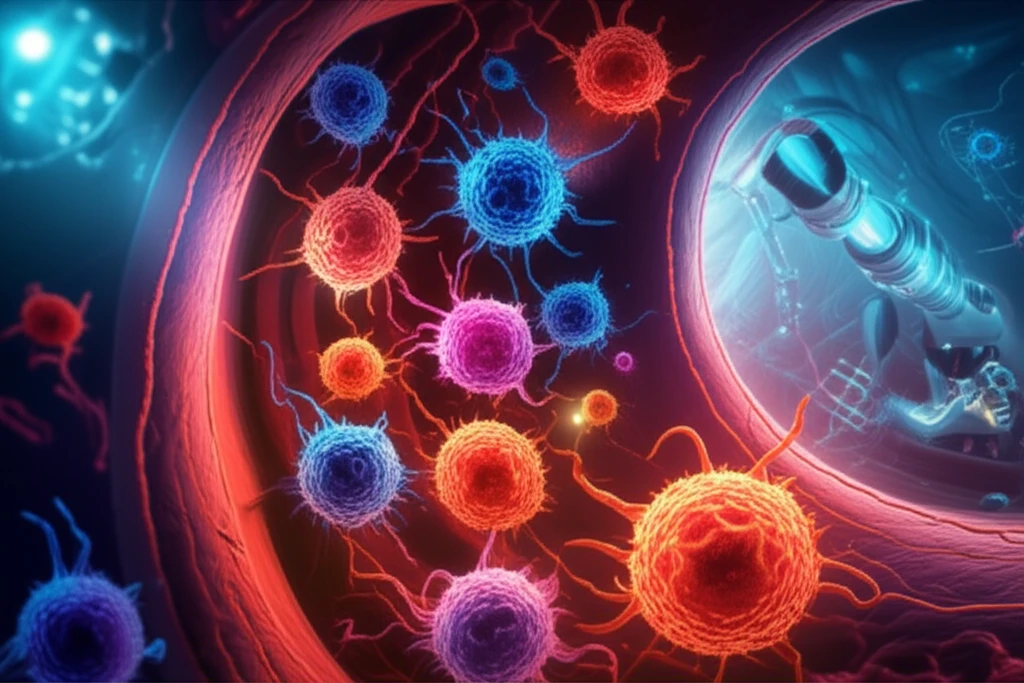
Illustration of cancer cells undergoing apoptosis detected through in vivo flow cytometry.

Can a New Blood Test Revolutionize Cancer Treatment?

"Scientists Develop Innovative Method for Detecting Apoptotic Circulating Tumor Cells, Promising Earlier Insights into Treatment Effectiveness."


Cancer remains one of the most formidable health challenges globally, with metastasis—the spread of cancer cells from the primary tumor to distant sites—being a primary cause of cancer-related deaths. The ability to monitor and understand the behavior of circulating tumor cells (CTCs) is vital in assessing cancer progression and treatment effectiveness.

Circulating tumor cells (CTCs) hold immense potential as prognostic markers for metastatic development and therapeutic efficacy. However, only viable CTCs that survive in the bloodstream can initiate distant metastases. Monitoring the proportion of CTCs undergoing apoptosis (programmed cell death) is critical.

A new study introduces an innovative approach using multicolor in vivo flow cytometry (FFC) to characterize the apoptosis status of CTCs. This method enables real-time identification and enumeration of apoptotic CTCs directly in the bloodstream, promising more effective cancer treatment monitoring and personalized therapies.

Unlocking the Potential of In Vivo Fluorescence Flow Cytometry

Illustration of cancer cells undergoing apoptosis detected through in vivo flow cytometry.

In vivo fluorescence flow cytometry (FFC) is emerging as a powerful tool for real-time monitoring of cellular dynamics in living organisms. Unlike traditional methods that require removing cells from their natural environment, FFC allows for the direct observation and quantification of cells within the bloodstream. This capability is particularly valuable for studying circulating tumor cells (CTCs), which play a crucial role in cancer metastasis.

The new study leverages FFC to detect and characterize apoptotic CTCs, offering insights into the effectiveness of cancer therapies. The researchers used a two-color fluorescence technique to differentiate between viable and apoptotic CTCs in real-time. By tracking the proportion of CTCs undergoing apoptosis, clinicians can gain a more accurate assessment of treatment response and adjust therapeutic strategies accordingly.

  • Real-Time Monitoring: Offers continuous observation of CTC behavior in their natural environment.
  • Improved Accuracy: Provides a more precise assessment of treatment effectiveness by quantifying apoptotic CTCs.
  • Personalized Therapy: Enables tailored treatment strategies based on individual patient responses.
  • Reduced Artifacts: Minimizes the risk of altering CTC characteristics during sample preparation.
This innovative approach could transform cancer treatment monitoring, providing clinicians with timely information to optimize patient outcomes. By understanding the dynamics of CTC apoptosis, healthcare professionals can make more informed decisions about treatment selection and adjustment, ultimately improving the quality of life for cancer patients.

The Future of Cancer Monitoring

The introduction of multicolor FFC marks a significant advancement in cancer monitoring. By providing real-time data on apoptotic CTCs, this technology paves the way for more personalized and effective cancer treatments. As research progresses, integrating additional markers and photoacoustic modules could further enhance the capabilities of FFC, making it an indispensable tool in the fight against cancer.

About this Article -

This article was crafted using a human-AI hybrid and collaborative approach. AI assisted our team with initial drafting, research insights, identifying key questions, and image generation. Our human editors guided topic selection, defined the angle, structured the content, ensured factual accuracy and relevance, refined the tone, and conducted thorough editing to deliver helpful, high-quality information.See our About page for more information.

Everything You Need To Know

1

What are circulating tumor cells, or CTCs, and why is monitoring them important in cancer treatment?

Circulating Tumor Cells or CTCs are cancer cells that have detached from the primary tumor and are circulating in the bloodstream. Monitoring CTCs is significant because they can serve as prognostic markers for metastatic development and therapeutic efficacy. Understanding the behavior of CTCs helps in assessing cancer progression and how effective a treatment is. If scientists can measure the proportion of CTCs undergoing apoptosis, or programmed cell death, they can better assess a treatment's effectiveness.

2

What is in vivo fluorescence flow cytometry, or FFC, and how does it help in monitoring cancer?

In vivo fluorescence flow cytometry, or FFC, is a method that allows the real-time monitoring of cellular dynamics in living organisms. FFC enables direct observation and quantification of cells within the bloodstream, which is particularly valuable for studying CTCs. Traditional methods require removing cells from their natural environment, which could alter the cells. FFC minimizes the risk of altering CTC characteristics during sample preparation.

3

What does apoptosis mean, and why is it important to monitor apoptosis in circulating tumor cells, or CTCs?

Apoptosis is programmed cell death, a natural process that occurs in cells. In the context of cancer, monitoring apoptosis in circulating tumor cells, or CTCs, is crucial because it indicates whether cancer treatments are effectively killing cancer cells. Tracking the proportion of CTCs undergoing apoptosis allows clinicians to gain a more accurate assessment of treatment response. If a treatment is working, a higher proportion of CTCs should be undergoing apoptosis.

4

How does multicolor in vivo flow cytometry, or FFC, help in monitoring the apoptosis status of circulating tumor cells, or CTCs?

Multicolor in vivo flow cytometry, or FFC, is used to characterize the apoptosis status of circulating tumor cells, or CTCs. This method enables the real-time identification and enumeration of apoptotic CTCs directly in the bloodstream. By using a two-color fluorescence technique, scientists can differentiate between viable and apoptotic CTCs in real-time. This method is significant because it promises more effective cancer treatment monitoring and personalized therapies.

5

How can monitoring apoptotic circulating tumor cells, or CTCs, using multicolor in vivo fluorescence flow cytometry, or FFC, improve cancer treatment?

Using multicolor in vivo fluorescence flow cytometry, or FFC, to monitor apoptotic circulating tumor cells, or CTCs, can significantly improve cancer treatment. It allows for real-time monitoring of CTCs, which provides a continuous observation of CTC behavior in their natural environment. By quantifying apoptotic CTCs, it offers a more precise assessment of treatment effectiveness, enabling tailored treatment strategies based on individual patient responses. This approach minimizes the risk of altering CTC characteristics during sample preparation, leading to more accurate results and better patient outcomes.

Newsletter Subscribe

Subscribe to get the latest articles and insights directly in your inbox.