
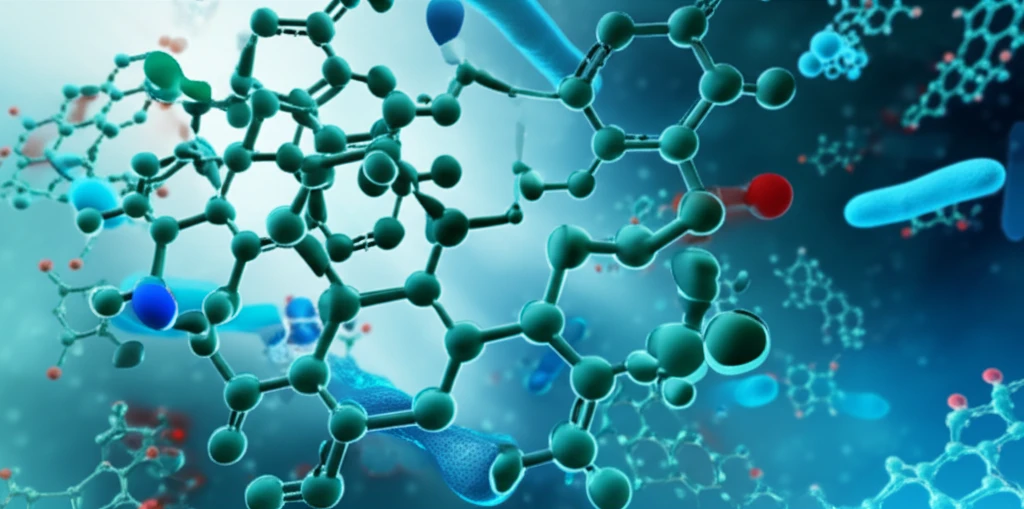
Molecular structure battling antibiotic resistant bacteria

Can a Lab-Made Molecule Fight Superbugs? The Promising Potential of Novel Oxadiazole Compounds

"Scientists synthesize and test new variations of a complex molecule, offering a potential breakthrough in the fight against antibiotic-resistant bacteria and the urgent threat of superbugs. "


The rise of antibiotic-resistant bacteria, often called "superbugs," poses a significant threat to global health. As common infections become harder to treat, scientists are urgently seeking new ways to combat these evolving threats. One promising avenue involves the synthesis and study of novel chemical compounds with antibacterial properties.

One class of molecules drawing increasing attention is the 1,3,4-oxadiazole, a structure known for its diverse biological activities. Researchers are exploring variations of this molecule, modifying its structure to enhance its ability to fight bacteria and overcome resistance mechanisms.

This article delves into a recent study focused on synthesizing and testing a series of novel S-substituted aliphatic analogues of 2-mercapto-5-(1-(4-toluenesulfonyl) piperidin-4-yl)-1,3,4-oxadiazole. We'll explore how these lab-made molecules were created, how their antibacterial activity was evaluated, and what the findings suggest about their potential in the ongoing fight against superbugs.

Decoding the Design: How Novel Oxadiazoles are Synthesized and Evaluated

Molecular structure battling antibiotic resistant bacteria

The research team embarked on a multi-step synthesis process to create the novel oxadiazole compounds. Starting with ethyl piperidin-4-carboxylate, they introduced various chemical modifications, including reactions with 4-toluenesulfonyl chloride and carbon disulfide, to build the core oxadiazole structure. The final step involved S-substitution, where different alkyl halides were attached to the molecule, creating a library of unique variations.

Once synthesized, the compounds underwent rigorous testing to assess their antibacterial activity. Researchers evaluated their effectiveness against a panel of five bacterial strains, including both Gram-positive (Staphylococcus aureus and Bacillus subtilis) and Gram-negative species (Salmonella typhi, Escherichia coli, and Pseudomonas aeruginosa). Ciprofloxacin, a commonly used antibiotic, served as a standard for comparison.

The antibacterial activity was determined by measuring the minimum inhibitory concentration (MIC), which represents the lowest concentration of the compound needed to inhibit bacterial growth. Key steps in the process included:
  • Culturing bacteria in a nutrient-rich broth.
  • Diluting test compounds to create a range of concentrations.
  • Mixing bacteria with the diluted compounds in microplates.
  • Incubating the microplates and measuring bacterial growth.
  • Comparing the MIC values of the novel compounds to that of ciprofloxacin.
The structures of all synthesized molecules were confirmed using various spectroscopic techniques, including Fourier transform infrared (FTIR) spectroscopy, proton nuclear magnetic resonance (¹H-NMR), and electron impact mass spectrometry (EI-MS). These techniques provided detailed information about the molecular structure, ensuring the correct compounds were created.

The Fight Against Superbugs: What Does This Mean for the Future?

The study's results revealed that several of the synthesized oxadiazole derivatives exhibited promising antibacterial activity. Notably, compound 7a demonstrated the highest potency against three bacterial strains: S. typhi, E. coli, and P. aeruginosa. While compound 7a’s MIC values were slightly higher than ciprofloxacin, its activity suggests a potential avenue for developing new antibacterial agents.

Furthermore, the research indicated that S-substituted derivatives, in general, showed enhanced antibacterial activity compared to the parent compound. This highlights the importance of specific structural modifications in optimizing the molecule's effectiveness. Some molecules possess a therapeutic potential [12]. They have been employed to control insulin & glucose levels, cocaine abuse treatment, and as anesthetics [13].

While further research is needed, these findings offer a glimmer of hope in the ongoing battle against antibiotic resistance. By exploring and refining novel compounds like these oxadiazole derivatives, scientists can potentially develop new treatments to combat superbugs and safeguard public health. The next steps involve a deeper understanding of the mechanism of action, toxicity profiling, and in vivo studies to confirm efficacy and safety.

About this Article -

This article was crafted using a human-AI hybrid and collaborative approach. AI assisted our team with initial drafting, research insights, identifying key questions, and image generation. Our human editors guided topic selection, defined the angle, structured the content, ensured factual accuracy and relevance, refined the tone, and conducted thorough editing to deliver helpful, high-quality information.See our About page for more information.

This article is based on research published under:

DOI-LINK: 10.4314/tjpr.v15i6.20, Alternate LINK

Title: Synthesis And Antibacterial Study Of Some S-Substituted Aliphatic Analogues Of 2-Mercapto-5-(1-(4-Toluenesulfonyl) Piperidin-4-Yl)-1,3,4-Oxadiazole

Subject: Pharmacology (medical)

Journal: Tropical Journal of Pharmaceutical Research

Publisher: African Journals Online (AJOL)

Authors: A Sattar, Aziz-Ur-Rehman Rehman, Ma Abbasi, Sz Siddiqi, K Nafeesa, I Ahmad

Published: 2016-07-11

Everything You Need To Know

1

What is the role of the 1,3,4-oxadiazole in this research?

The 1,3,4-oxadiazole is a specific type of molecule with a particular structure. The article highlights its importance because it shows diverse biological activities, which includes the potential to fight bacteria. Researchers are modifying this core structure to enhance its antibacterial capabilities, making it a key focus in the search for new ways to combat antibiotic resistance.

2

How were the novel oxadiazole compounds created?

The scientists synthesized a series of compounds based on the 2-mercapto-5-(1-(4-toluenesulfonyl) piperidin-4-yl)-1,3,4-oxadiazole structure. They started with ethyl piperidin-4-carboxylate and introduced modifications, including reactions with 4-toluenesulfonyl chloride and carbon disulfide. The final step involved S-substitution, where different alkyl halides were attached, creating various derivatives. This multi-step process allows for the creation of a library of similar yet distinct compounds.

3

How was the antibacterial activity of the compounds tested?

The antibacterial activity of the novel compounds was evaluated by measuring the minimum inhibitory concentration (MIC). This value represents the lowest concentration of the compound needed to stop bacterial growth. The process involved culturing bacteria, diluting the test compounds, mixing them with bacteria in microplates, incubating the microplates, and then measuring bacterial growth. Ciprofloxacin, a common antibiotic, was used as a standard for comparison to assess the effectiveness of the new compounds. The lower the MIC, the more effective the compound is at inhibiting bacterial growth.

4

What were the key findings about the effectiveness of the oxadiazole derivatives?

The study's findings indicated that several oxadiazole derivatives showed promising antibacterial activity. Compound 7a displayed the highest potency against S. typhi, E. coli, and P. aeruginosa. The MIC values for this compound were slightly higher than ciprofloxacin, suggesting it may be slightly less effective. However, the promising activity suggests potential for developing new antibacterial agents to combat superbugs, indicating these molecules could become useful in medicine.

5

Why is this research important in the context of superbugs?

Superbugs are antibiotic-resistant bacteria, which pose a significant threat to global health. The implications of this are serious because common infections become increasingly difficult to treat. This study is significant because it provides a pathway for scientists to create new molecules like the 1,3,4-oxadiazole derivatives, that can potentially overcome the resistance mechanisms of superbugs. By developing new antibacterial agents, the ability to treat life-threatening infections can be preserved.

Newsletter Subscribe

Subscribe to get the latest articles and insights directly in your inbox.