
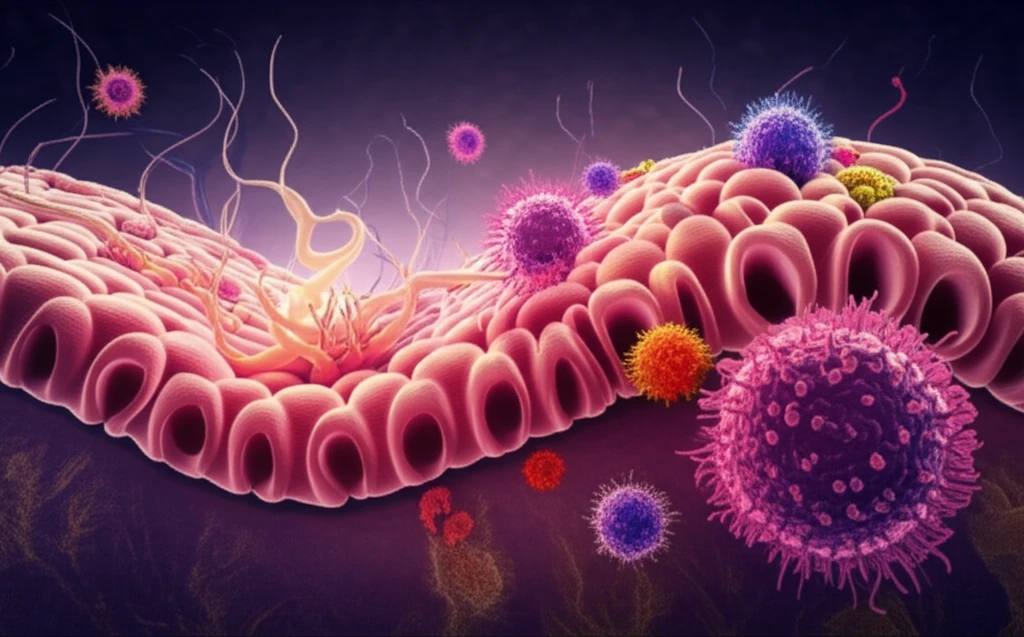
Candida albicans transitioning from pathogen to protector.

Can a Deadly Fungus Become Our Protector? How Scientists are Repurposing Candida

"Turning a Pathogen into a Shield: Exploring the potential of Candida albicans to boost immunity and fight infections"


Candida albicans, a common yeast found in the human body, usually lives peacefully as part of our microbiota. While it typically doesn't cause problems, it's also a major fungal pathogen, responsible for both superficial and life-threatening disseminated infections. Scientists have primarily focused on understanding its harmful aspects, but a new perspective is emerging: could C. albicans be harnessed for beneficial purposes?

One challenge in studying the potential benefits of C. albicans is that it doesn't naturally colonize most laboratory animals, like mice, unless their gut microbiota is disrupted by antibiotics. However, when C. albicans enters the bloodstream of mice, it becomes highly virulent. This duality has made it difficult to study the commensal (harmless) state of the fungus and any potential mutualistic interactions with a healthy host.

Now, researchers have ingeniously used this dichotomy to their advantage. By serially passaging C. albicans in the GI tracts of antibiotic-treated mice, they've successfully evolved the fungus into a genuine commensal organism. This modified C. albicans not only coexists peacefully within the host but also provides protection against other dangerous pathogens, potentially opening doors to universal vaccines.

From Foe to Friend: Evolving Candida for Commensalism and Protection

Candida albicans transitioning from pathogen to protector.

The key to this transformation lies in the yeast-to-hypha transition, a crucial aspect of C. albicans virulence. This fungus can switch between a yeast form, which aids in bloodstream dissemination and tissue adhesion, and a filamentous hyphal form, which promotes tissue invasion and escape from immune cells. The researchers found that the evolved C. albicans variants exhibited defects in this transition, favoring the yeast form.

Interestingly, previous research had shown that C. albicans strains with impaired yeast-to-hypha transition were better at colonizing the GI tracts of antibiotic-treated mice. However, it wasn't clear if this was a consistent evolutionary outcome. The new study demonstrates that repeated passage through the GI tract of mice does indeed lead to the selection of hypha-defective variants with enhanced fitness in that specific environment.

  • Enhanced Gut Colonization: Evolved C. albicans variants thrive in the GI tract, even without antibiotic-induced dysbiosis.
  • Reduced Virulence: These variants show decreased ability to cause blood-borne infections.
  • Cross-Protection: Colonization or injection of these variants protects mice against virulent C. albicans, as well as other pathogens like Aspergillus fumigatus, Pseudomonas aeruginosa, and Staphylococcus aureus.
One surprising finding was that many of the evolved variants had loss-of-function mutations in the FLO8 gene, which encodes a transcription factor essential for the yeast-to-hypha switch. While FLO8 mutations weren't uncommon in general, they were rarely found in a homozygous state (both copies of the gene mutated), suggesting a selective pressure against complete loss of function.

Trained Immunity: A New Avenue for Disease Prevention?

The evolved C. albicans variants not only protect against fungal infections but also offer cross-protection against bacterial pathogens. This protection is rapid, independent of adaptive immunity, relatively short-lived, and requires cytokine production – all hallmarks of 'trained immunity.' This recently discovered property allows enhanced innate immune cell responses upon re-encountering pathogens.

While C. albicans colonization was already known to protect against subsequent injury and infection, these new variants offer increased cross-protection compared to both the parental strain and yeast-to-hypha switch mutants. This suggests that passage through the gut leads to changes beyond filamentation that contribute to triggering trained immunity. These changes may involve modifications to the fungal cell wall, particularly β-glucans, which are strong inducers of trained immunity.

Understanding the precise nature of these changes is crucial for developing a universal vaccine based on the cross-protection properties of these C. albicans variants. Although a universal vaccine might seem ambitious, further exploration of the mechanisms by which these variants protect against different fungal infections could lead to innovative preventive approaches. Such approaches are urgently needed, as fungal infections cause up to a million deaths per year globally, and antifungal resistance is on the rise.

About this Article -

This article was crafted using a human-AI hybrid and collaborative approach. AI assisted our team with initial drafting, research insights, identifying key questions, and image generation. Our human editors guided topic selection, defined the angle, structured the content, ensured factual accuracy and relevance, refined the tone, and conducted thorough editing to deliver helpful, high-quality information.See our About page for more information.

Everything You Need To Know

1

What is Candida albicans and what makes it both a potential threat and a potential ally?

Candida albicans typically exists harmlessly in the human body as part of the microbiota. However, it's also a significant fungal pathogen that can cause both superficial and life-threatening disseminated infections. This duality has led scientists to investigate whether C. albicans can be modified for beneficial purposes, such as boosting immunity against other pathogens.

2

How have researchers managed to transform Candida albicans from a potentially harmful fungus into a beneficial one?

Researchers have evolved Candida albicans into a commensal organism by serially passaging it in the GI tracts of antibiotic-treated mice. This process resulted in C. albicans variants that coexist peacefully within the host and provide protection against other dangerous pathogens. This approach has opened new possibilities for developing universal vaccines and harnessing the potential benefits of C. albicans.

3

What is the yeast-to-hypha transition in Candida albicans, and how does it affect the fungus's behavior and potential for causing disease?

The yeast-to-hypha transition is a crucial aspect of Candida albicans virulence. The fungus can switch between a yeast form, which aids in bloodstream dissemination and tissue adhesion, and a filamentous hyphal form, which promotes tissue invasion and escape from immune cells. The evolved C. albicans variants exhibited defects in this transition, favoring the yeast form. Defects in the yeast-to-hypha transition can impact the fungus's ability to cause disease and enhance its ability to colonize the GI tract.

4

What pathogens can the modified Candida albicans protect against, and what type of immunity is involved?

The evolved Candida albicans variants provide cross-protection against a range of pathogens, including virulent C. albicans, Aspergillus fumigatus, Pseudomonas aeruginosa, and Staphylococcus aureus. This protection is rapid, independent of adaptive immunity, relatively short-lived, and requires cytokine production, all characteristics of trained immunity. Trained immunity enhances innate immune cell responses upon re-encountering pathogens.

5

What role does the FLO8 gene play in the transformation of Candida albicans, and what implications do mutations in this gene have?

Mutations in the FLO8 gene, which encodes a transcription factor essential for the yeast-to-hypha switch, were observed in many of the evolved Candida albicans variants. While FLO8 mutations were not uncommon, they were rarely found in a homozygous state, suggesting selective pressure against complete loss of function. This implies that while disrupting the yeast-to-hypha transition is beneficial for commensalism and protection, completely eliminating FLO8 function may have detrimental effects on the fungus's survival or function.

Newsletter Subscribe

Subscribe to get the latest articles and insights directly in your inbox.