
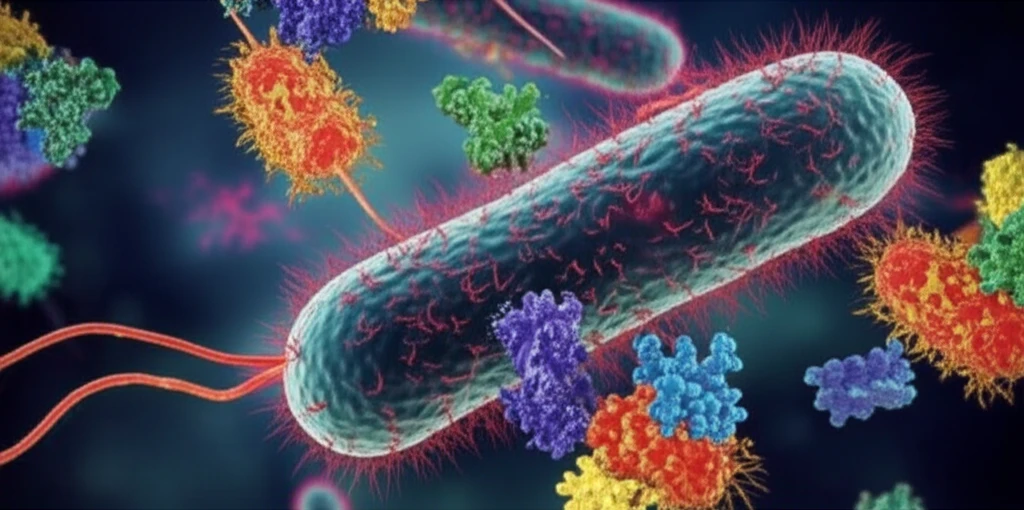
Campylobacter's Kryptonite? New Inhibitors Target Gut Infections

"Scientists discover potent compounds that disrupt a key bacterial process, offering hope for fighting antibiotic resistance and common foodborne illnesses."
Food poisoning is no joke, and Campylobacter jejuni is a leading cause of bacterial diarrhea worldwide. This sneaky bacterium not only triggers unpleasant bouts of gastroenteritis but has also been linked to more severe conditions like Guillain-Barré syndrome. As if that weren't enough, antibiotic resistance in Campylobacter is on the rise, making infections harder to treat.
The good news? Scientists are on the hunt for new ways to fight this bug. One promising approach focuses on disrupting essential processes within the bacteria, and a recent study published in ACS Chemical Biology has identified some exciting new compounds that could do just that.
Researchers have zeroed in on an enzyme called 5'-methylthioadenosine nucleosidase (CjMTAN) in Campylobacter. This enzyme plays a vital role in several metabolic pathways, including the synthesis of menaquinone, a molecule essential for bacterial survival. By blocking CjMTAN, scientists hope to cripple the bacteria and stop it in its tracks.
Unlocking the Potential of Transition-State Analogues: A New Class of Inhibitors
The research team designed and synthesized a series of compounds known as transition-state analogue inhibitors. These inhibitors are designed to mimic the intermediate stage of a chemical reaction, binding very tightly to the enzyme and preventing it from doing its job. Think of it like throwing a wrench into the gears of a machine.
- Picomolar Potency: They bind to CjMTAN with extremely high affinity.
- Broad Substrate Specificity: They can target multiple reactions involving CjMTAN.
- Effective in Culture: The most potent inhibitors successfully curbed Campylobacter growth in lab experiments.
- Targeted Action: Because the futalosine pathway is rare, these inhibitors are expected to have minimal impact on gut microbiome.
A Potential New Weapon in the Fight Against Campylobacter
This research represents a significant step forward in the search for new antibiotics to combat Campylobacter infections. By targeting CjMTAN with transition-state analogue inhibitors, scientists have identified a promising strategy for disrupting bacterial metabolism and overcoming antibiotic resistance. Transition-state analogues of MTAN reactions were effective in CjMTAN inhibition with binding dissociation constants in the picomolar or low nanomolar range.
While further research is needed to evaluate the safety and efficacy of these compounds in animal models and humans, the initial results are encouraging. These inhibitors also provided the lowest IC50 for inhibition of bacterial growth, supporting the hypothesis of CjMTAN inhibition as a potential antibiotic strategy against C. jejuni.
With antibiotic resistance posing a growing threat to public health, the development of new antibacterial agents is crucial. This study highlights the potential of CjMTAN inhibitors as a novel approach to tackle Campylobacter infections and contribute to the ongoing fight against drug-resistant bacteria. As only a few species use the futalosine pathway, the inhibitors described here are anticipated to have minimal effects on the gut microbiome.