
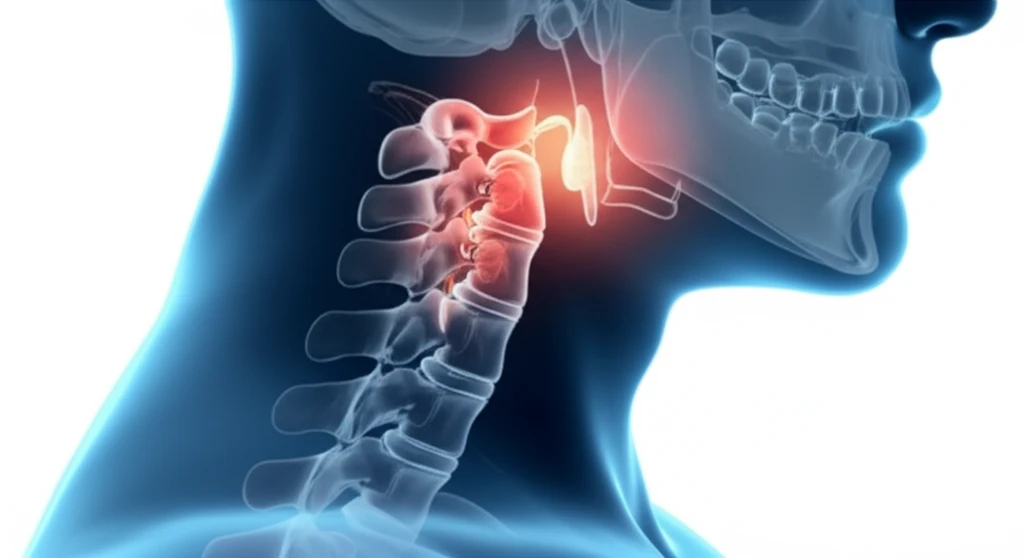
Illustration of a healthy spine with focus on the C1 area, representing spinal health awareness.

C1 Spine Check: Are You in the Clear? Understanding C1 Stenosis Risks

"Decoding the C1 spinolaminar line and its impact on spinal health: What you need to know about stenosis and prevention."


The cervical spine, particularly the C1 vertebra (also known as the atlas), plays a vital role in supporting the skull and facilitating head movement. Maintaining the health of the cervical spine is essential for overall well-being, and any compromise to its structure can lead to significant health issues. One such issue is spinal stenosis, a condition characterized by the narrowing of the spinal canal, which can compress the spinal cord and nerves.

Spinal stenosis in the C1 region is of particular concern due to its proximity to the brainstem and the concentration of critical neural pathways. While spinal stenosis can occur due to various factors, including trauma, degenerative changes, and congenital abnormalities, understanding the anatomical variations in this region is crucial for early detection and prevention. One key anatomical marker that healthcare professionals use to assess the risk of C1 stenosis is the C1 spinolaminar line.

Recent research has shed light on the variation of the C1 spinolaminar line and its prevalence in normal populations. By examining lateral cervical radiographs, researchers have sought to determine the relationship between the C1 spinolaminar line and the likelihood of C1 canal stenosis. This article will delve into the findings of these studies, explain the significance of the C1 spinolaminar line, and provide insights into the risks and preventive measures associated with C1 stenosis.

What is the C1 Spinolaminar Line and Why Does It Matter?

Illustration of a healthy spine with focus on the C1 area, representing spinal health awareness.

The C1 spinolaminar line is an imaginary line drawn on lateral cervical radiographs, connecting the spinolaminar junctions of the C2 and C3 vertebrae. It serves as a reference point for assessing the relative position of the C1 lamina (the bony arch of the C1 vertebra). The position of the C1 lamina in relation to this line can indicate the presence or risk of C1 canal stenosis. When the C1 lamina lies ventral (toward the front) to the C3-C2 line, it's considered a 'positive' finding, suggesting a higher likelihood of stenosis. Conversely, a C1 lamina lying dorsal (toward the back) to the line is a 'negative' finding.

The significance of the C1 spinolaminar line lies in its ability to act as an early screening tool for potential C1 canal stenosis. Early detection is crucial because it allows for timely intervention and management, preventing the progression of stenosis and minimizing the risk of spinal cord compression. By identifying individuals with a positive C1 spinolaminar line, healthcare professionals can implement preventive strategies and closely monitor their spinal health.

  • Early Detection: Acts as a screening tool.
  • Risk Assessment: Helps assess potential C1 canal stenosis.
  • Preventive Measures: Allows early intervention.
  • Monitoring: Enables close monitoring of spinal health.
Research indicates that individuals with a positive C1 spinolaminar line are more prone to developing C1 canal stenosis. This is primarily because the altered position of the C1 lamina reduces the space available for the spinal cord, making it vulnerable to compression. However, it's important to note that a positive C1 spinolaminar line does not automatically mean that an individual has stenosis; rather, it signifies an increased risk that warrants further evaluation and monitoring.

Take control of your spinal health

Understanding the C1 spinolaminar line and its implications for C1 spinal stenosis is essential for maintaining spinal health. While anatomical variations can predispose some individuals to a higher risk of stenosis, early detection and preventive measures can significantly reduce the likelihood of developing severe complications. If you have concerns about your spinal health or a family history of spinal stenosis, consult with a healthcare professional for a comprehensive evaluation and personalized management plan.

About this Article -

This article was crafted using a human-AI hybrid and collaborative approach. AI assisted our team with initial drafting, research insights, identifying key questions, and image generation. Our human editors guided topic selection, defined the angle, structured the content, ensured factual accuracy and relevance, refined the tone, and conducted thorough editing to deliver helpful, high-quality information.See our About page for more information.

Everything You Need To Know

1

What is the C1 spinolaminar line, and why is it used in assessing spinal health?

The C1 spinolaminar line is an imaginary line healthcare professionals use to evaluate the risk of C1 canal stenosis. It is drawn on lateral cervical radiographs by connecting the spinolaminar junctions of the C2 and C3 vertebrae. The position of the C1 lamina (the bony arch of the C1 vertebra) relative to this line indicates the presence or likelihood of C1 canal stenosis. A 'positive' finding (C1 lamina ventral to the line) suggests a higher risk, allowing for early detection and potential intervention.

2

How does the position of the C1 lamina affect the risk of C1 spinal stenosis?

The position of the C1 lamina relative to the C1 spinolaminar line is crucial. When the C1 lamina lies ventral (toward the front) to the line, it is considered a 'positive' finding, indicating an increased risk of C1 canal stenosis. This altered position reduces the space available for the spinal cord, increasing the likelihood of compression. Conversely, a dorsal (toward the back) position is a 'negative' finding, suggesting a lower risk.

3

What are the benefits of early detection related to the C1 spinolaminar line?

Early detection, facilitated by assessing the C1 spinolaminar line, is crucial for several reasons. It allows healthcare professionals to identify individuals at a higher risk of developing C1 canal stenosis. This early identification enables timely intervention and management strategies to prevent the progression of stenosis and reduce the risk of spinal cord compression. This proactive approach helps maintain overall spinal health.

4

Can a positive C1 spinolaminar line diagnosis confirm that I have spinal stenosis, and what are the next steps?

No, a 'positive' C1 spinolaminar line does not automatically confirm the presence of spinal stenosis. It signifies an increased risk, prompting further evaluation and monitoring. The next steps typically involve additional diagnostic tests and consultation with a healthcare professional. These steps may include further imaging studies and a personalized management plan to monitor and address the potential for stenosis. The goal is to proactively manage spinal health.

5

Besides understanding the C1 spinolaminar line, what else is important for maintaining spinal health in the cervical region?

Maintaining spinal health in the cervical region involves understanding the implications of the C1 spinolaminar line and the potential risks associated with C1 spinal stenosis. Early detection and preventive measures play a crucial role in maintaining spinal health. If there are concerns about spinal health or a family history of spinal stenosis, consulting with a healthcare professional for a comprehensive evaluation and personalized management plan is vital. This includes awareness of potential risk factors like trauma, degenerative changes, or congenital abnormalities.

Newsletter Subscribe

Subscribe to get the latest articles and insights directly in your inbox.