
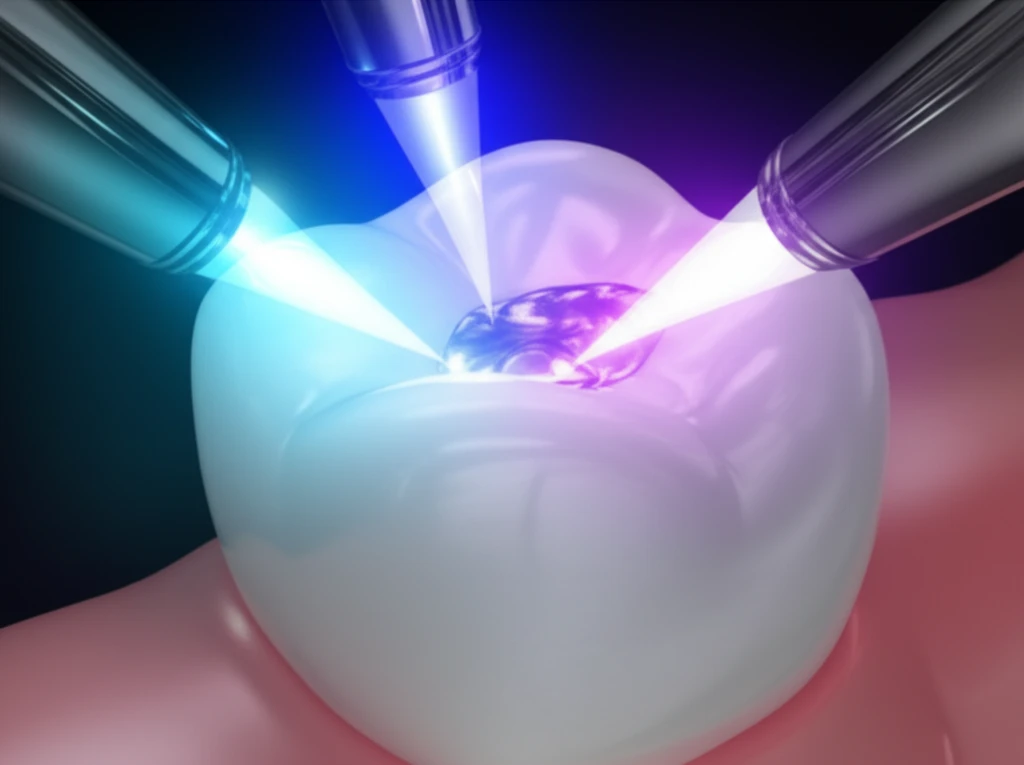
A composite filling is curing with different coloured light.

Brighter Smiles, Stronger Fillings? The Truth About Light Curing in Modern Dentistry

"Exploring how different light-curing methods impact the strength and longevity of your resin composite restorations."


A bright, healthy smile relies on durable dental work. When it comes to restoring teeth with composite fillings, factors like shade stability and a proper cure are critical for long-term success. As dental materials evolve, so do the techniques used to harden them, raising an important question: How do different light-curing methods affect the quality and lifespan of your fillings?

Traditional composite fillings often contained a yellow-tinted initiator called camphorquinone (CQ), which could lead to discoloration over time. Modern dental materials are increasingly incorporating alternative initiators like PPD (1-phenyl-1,2-propanedione) to improve aesthetics and address issues with water absorption in simplified adhesives. This shift has made the choice of light-curing devices even more important, as these alternative initiators respond best to different wavelengths of light.

This article explores a study that investigates how different light-curing units—QTH (quartz tungsten halogen), monowave LED, and polywave LED—affect the marginal integrity of composite restorations using materials containing both CQ and PPD initiators. We'll break down the findings to help you understand the implications for the durability and aesthetics of your dental work.

The Light Fantastic: Understanding Light-Curing Methods

A composite filling is curing with different coloured light.

The study focused on Class V restorations, a common type of filling along the gumline. Researchers prepared cavities in extracted human molars, carefully placing the margins (edges) of the fillings on both enamel and dentin. These fillings were then cured using one of three light sources:

Each curing unit was selected to represent a different approach to light activation:

  • Halogen (QTH): A traditional light source with a broad spectrum, known for effectively activating CQ.
  • Monowave LED: Emits a more focused wavelength of blue light, primarily targeting CQ.
  • Polywave LED: Offers a wider range of wavelengths, designed to activate both CQ and alternative initiators like PPD.
After curing, the restorations underwent thermomechanical loading, simulating the stresses of chewing and temperature changes in the mouth. Researchers then used scanning electron microscopy (SEM) to meticulously evaluate the marginal adaptation—how well the filling material sealed against the tooth structure—before and after this stress testing.

The Verdict: Choosing the Right Light for a Lasting Smile

The study revealed that while all light-curing methods initially provided good marginal adaptation, the polywave LED group showed a significant degradation in enamel margins after thermomechanical loading. This was characterized by an increase in enamel fractures, suggesting that the improved degree of cure with polywave LEDs might lead to increased brittleness in the composite material.

These findings highlight the importance of considering the specific initiators present in your dental materials and selecting a light-curing unit that optimally activates them without compromising the material's mechanical properties. While polywave LEDs offer the potential for a more complete cure, they may also increase the risk of enamel fractures in certain situations.

Ultimately, the best approach depends on a careful balance of factors, and your dentist is best equipped to make informed decisions about the materials and techniques that will ensure the longevity and aesthetics of your dental restorations. Further research will help refine these techniques and lead to even more durable and natural-looking fillings.

About this Article -

This article was crafted using a human-AI hybrid and collaborative approach. AI assisted our team with initial drafting, research insights, identifying key questions, and image generation. Our human editors guided topic selection, defined the angle, structured the content, ensured factual accuracy and relevance, refined the tone, and conducted thorough editing to deliver helpful, high-quality information.See our About page for more information.

This article is based on research published under:

DOI-LINK: 10.4012/dmj.2015-339, Alternate LINK

Title: Marginal Integrity Of Resin Composite Restorations Restored With Ppd Initiatorcontaining Resin Composite Cured By Qth, Monowave And Polywave Led Units

Subject: General Dentistry

Journal: Dental Materials Journal

Publisher: Japanese Society for Dental Materials and Devices

Authors: Tissiana Bortolotto, Francisco Betancourt, Ivo Krejci

Published: 2016-01-01

Everything You Need To Know

1

What is light-curing, and why is it used in dentistry?

In modern dentistry, light-curing is a crucial process used to harden composite fillings. This involves using specific light sources, such as QTH (quartz tungsten halogen), monowave LED, and polywave LED, to activate the initiators within the filling material. These initiators, which can be CQ (camphorquinone) or PPD (1-phenyl-1,2-propanedione), react to the light, causing the composite material to set and bond to the tooth structure. The type of light source used significantly impacts the effectiveness of this process, influencing the strength, durability, and aesthetics of the final restoration.

2

Why is the light-curing method important for dental fillings?

The choice of light-curing method is important because different methods impact the longevity and quality of dental fillings. The study showed the impact on Class V restorations, particularly focusing on the marginal integrity after thermomechanical loading. The study examined the difference between QTH, monowave LED, and polywave LED curing units. While all initially provided good marginal adaptation, the study found that polywave LED showed significant degradation in enamel margins after thermomechanical loading, indicating that while the polywave LED may have improved the degree of cure, it may lead to increased brittleness.

3

What is QTH, and how does it work?

QTH (quartz tungsten halogen) is a traditional light source used in dentistry. It emits a broad spectrum of light, which is effective in activating CQ (camphorquinone), a common initiator used in older composite materials. CQ is responsible for the yellow tint that can cause discoloration. This method offers a well-established approach to curing dental fillings, but may not be optimized for newer materials using alternative initiators like PPD.

4

How does monowave LED work in light-curing?

Monowave LED is a light-curing method that emits a more focused, single wavelength of blue light. This focused approach is primarily designed to activate CQ, similar to QTH. Its effectiveness is dependent on the use of CQ as an initiator. While monowave LED offers advantages in terms of energy efficiency and potentially reduced heat generation compared to QTH, it may not be as effective with newer composite materials that utilize initiators other than CQ, such as PPD.

5

What are the benefits and drawbacks of using polywave LED?

Polywave LED offers a wider range of wavelengths designed to activate both CQ and alternative initiators like PPD (1-phenyl-1,2-propanedione). The use of Polywave LED can lead to a more complete cure of the composite material, which can improve its strength and durability. However, the study indicated that the increased brittleness of the composite material may have negative effects. This is an example of why it is important to understand the implications of each method. The success and lifespan of the dental work rely on a balance between a good cure and marginal integrity.

Newsletter Subscribe

Subscribe to get the latest articles and insights directly in your inbox.