
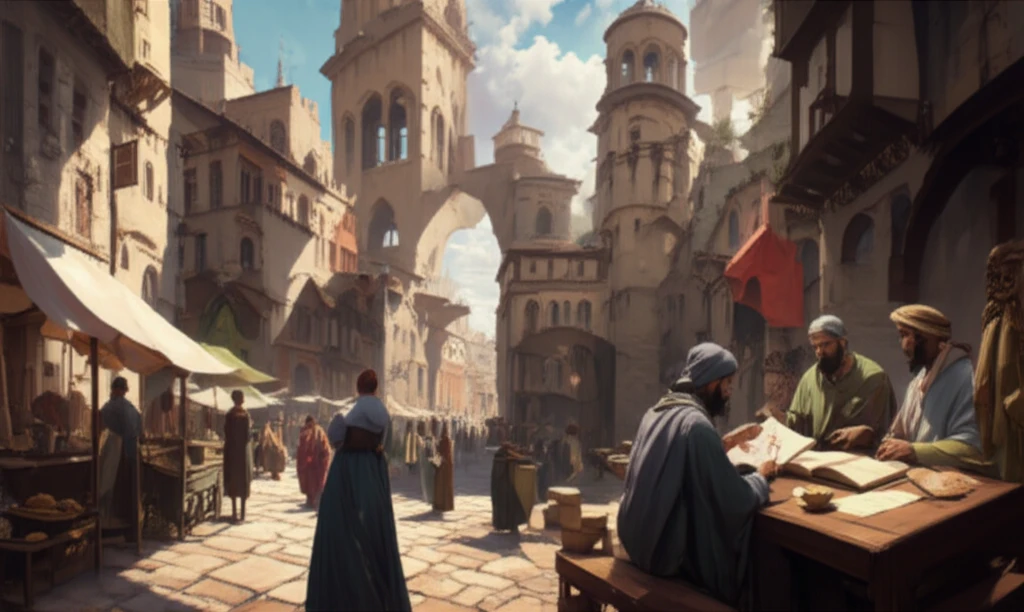
Bridging Worlds: How Medieval Christians Navigated Identity in Islamic Spain

"Discover the fascinating story of the Mozarabs, Christians living under Islamic rule in medieval Iberia, and how they negotiated their religious identity through language, translation, and cultural exchange."
Medieval Iberia, a land where Christian, Muslim, and Jewish cultures intertwined, presents a unique setting for exploring the complexities of religious identity. Among the most fascinating groups in this vibrant society were the Mozarabs—Christians living under Islamic rule. Their story, often overlooked, offers valuable insights into how individuals and communities negotiate their faith and cultural heritage in a diverse and sometimes challenging environment.
This article delves into the world of the Mozarabs, examining how they maintained their Christian identity while adopting aspects of Arabic language and culture. We will explore their use of language, their approach to translating religious texts, and the ways in which they engaged in cultural exchange with both the Islamic world around them and the Latin Christian traditions of their ancestors.
Our exploration will center around a remarkable artifact: Munich, Bayerische Staatsbibliothek, Cod.Ar. 238, a fourteenth-century manuscript containing an Arabic translation of the Gospels with Mozarabic origins. By examining this manuscript and other historical sources, we will uncover the strategies the Mozarabs employed to navigate their religious identity in a multi-confessional society.
The Mozarabs: Living in Between Worlds
The term "Mozarab" itself provides a starting point for understanding this community. Derived from the Arabic word must'arib, meaning "one who Arabizes," it highlights the Mozarabs' adoption of Arabic language and cultural practices. However, it's crucial to remember that this Arabization did not equate to a complete abandonment of their Christian faith or Latin cultural heritage.
- Language as a Bridge: The Mozarabs embraced the Arabic language, using it in their daily lives and even in religious contexts. This linguistic adaptation facilitated communication and integration within Islamic society.
- Translation as a Tool: The Mozarabs translated religious texts, including the Bible, into Arabic. This made religious knowledge accessible to Arabic speakers and allowed them to express their faith in their adopted language.
- Cultural Exchange: The Mozarabs participated in cultural exchange with both the Islamic world and the Latin Christian world. They adopted and adapted religious concepts and formulas from Muslim and Eastern Christian sources, while also maintaining connections to Western traditions.
Lessons from the Mozarabs: Identity, Dialogue, and Respect
The story of the Mozarabs provides valuable insights into the dynamics of religious identity and interfaith relations. Their experience demonstrates that adopting aspects of another culture does not necessarily equate to abandoning one's own beliefs or traditions.
While the Mozarabs engaged in cultural exchange and linguistic adaptation, they also maintained clear boundaries between their community and others. They used language, translation, and religious practice to define their identity and assert their distinctiveness.
Ultimately, the Mozarabs' story highlights the importance of dialogue and mutual respect in navigating religious difference. Despite their distinct identities and occasional tensions, Christians and Muslims in medieval Iberia were able to engage with each other, learn from each other, and, in some cases, even find common ground.