
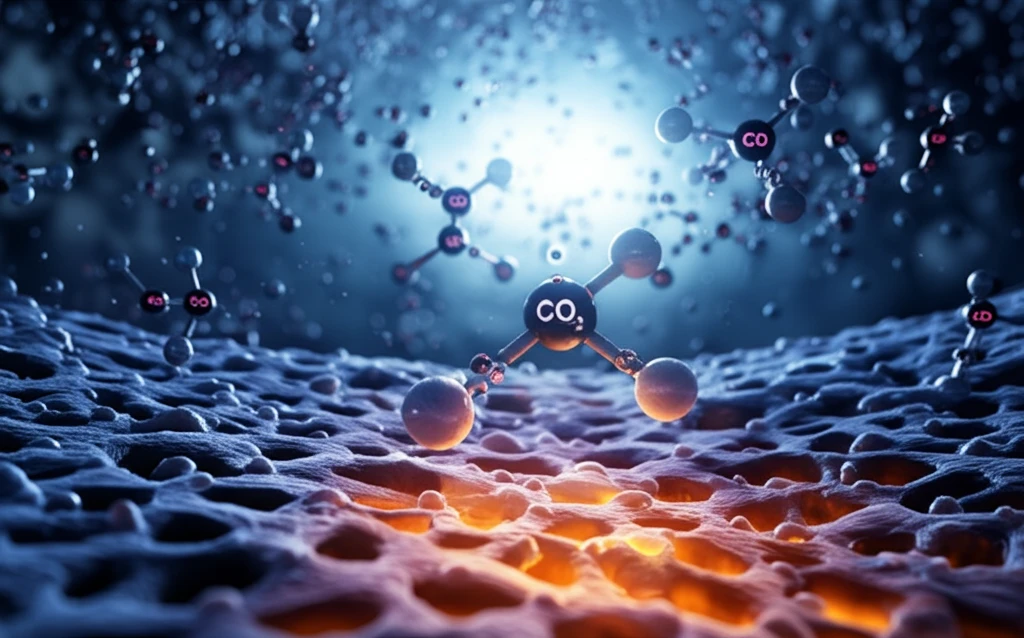
Breathe Easier: The Quest for the Ultimate CO2 Adsorbent

"Dive into the science of carbon capture and discover which materials are leading the charge in the fight against climate change, offering a breath of fresh air for our planet."
The concentration of carbon dioxide (CO2) in our atmosphere is a growing concern, driving the urgent need for innovative solutions to capture and store this greenhouse gas. Among the various strategies being explored, adsorption technology stands out as a promising approach. Adsorption involves using solid materials to trap CO2 molecules, offering a potentially cost-effective and efficient way to reduce emissions from industrial sources.
Selecting the right adsorbent material is crucial for the success of any carbon capture system. Researchers are actively investigating a range of materials, each with its unique properties and advantages. Zeolites, with their well-defined pore structures, and activated carbons, known for their high surface areas, are two prominent contenders in this quest for the ultimate CO2 adsorbent.
This article delves into the world of CO2 adsorption, examining the performance of various materials and exploring the factors that influence their effectiveness. By understanding the science behind these technologies, we can gain insights into the future of carbon capture and its potential to mitigate climate change.
The Scale of the CO₂ Challenge
Carbon dioxide emissions from human activities remain one of the most pressing drivers of climate change, with concentrations in the atmosphere continuing to rise as global energy demand grows. While exact figures fluctuate year to year, the scientific consensus is clear that reducing atmospheric CO₂ is essential to limiting global warming. Carbon capture technologies have emerged as a critical tool in the broader portfolio of climate mitigation strategies, aiming to intercept CO₂ before it reaches the atmosphere or even remove it directly from ambient air.
Absorption and Adsorption: The Two Pillars of CO₂ Capture
The two predominant methodologies for CO₂ capture are absorption, which employs liquid solvents to dissolve and concentrate carbon dioxide, and adsorption, which utilizes solid sorbent materials with high surface areas to bind CO₂ molecules either physically or chemically. Adsorption-based approaches are increasingly viewed as promising due to lower regeneration costs and reduced environmental impact compared to traditional chemisorption methods. However, a key limitation noted across the field is the lack of systematic consideration for designing and developing the entire adsorption process end to end. Meanwhile, the complete integration of carbon capture technologies across various industrial sectors remains a major hurdle for achieving a sustainable, low-carbon future. Both absorption and adsorption continue to be refined through ongoing research into materials, techniques, and processes.
A Decades-Long Road Toward Carbon Capture at Scale
Carbon capture and storage (CCS) has been recognized for decades as a pivotal technology for mitigating climate change, yet global deployment continues to lag significantly behind its expected contribution to greenhouse gas emission reduction. The number of patents covering CCS technologies surged during the 2000s but notably declined in the 2010s, reflecting uneven momentum in commercialization efforts. Global capture capacity has trended higher since 2017, but milestones over the years consistently highlight the difficulty of achieving commercial-scale development and implementation. Reviewing successful CCS practices in advanced countries offers valuable lessons for other nations seeking to accelerate their deployment timelines.
The Science of CO2 Adsorption: Finding the Right Fit
The heart of CO2 adsorption lies in the interaction between the adsorbent material and the CO2 molecules. Factors such as the material's pore size, surface area, and chemical properties play a significant role in determining its ability to capture and retain CO2. Researchers evaluate these materials based on their equilibrium and kinetic properties. Equilibrium refers to the amount of CO2 a material can hold at a given temperature and pressure, while kinetics describes how quickly the material can capture CO2.
- Zeolite 13X: Showed good adsorption capacity, fitting well with the Sips model for equilibrium data.
- Zeolite 5A and 4A: Also performed as expected for zeolites, but with varying degrees of CO2 capture. Zeolite 4A had the lowest overall capacity.
- Carbon Molecular Sieve (MSC-3R): Demonstrated a consistent performance, making it a reliable option.
- Activated Carbons (GCA-830 and GCA-1240): Stood out with the highest adsorption capacity, especially GCA-1240, and were best described by the Prausnitz model.
The Evolving Landscape of CO₂ Capture Research
Research into CO₂ capture continues to advance on multiple fronts, with scientists exploring novel materials, improved process designs, and innovative manufacturing techniques. The field is increasingly interdisciplinary, drawing on machine learning, additive manufacturing, and life cycle assessment to optimize capture systems. While progress is steady, the challenge of scaling laboratory findings to real-world industrial applications remains a persistent theme across recent reviews.
Persistent Challenges Limiting CCUS Progress
Despite its promise, carbon capture, use, and storage (CCUS) faces significant challenges and risks that continue to slow its progress, particularly within the petroleum industry where it has been a major focus. These limitations span technical hurdles in materials performance, economic barriers related to cost competitiveness, and broader systemic issues in deployment infrastructure. The gap between the potential of CCUS to remove atmospheric CO₂ and its actual implementation underscores that the technology is far from a silver bullet for climate change.
Absorption vs. Adsorption: Weighing the Mechanisms
The two primary mechanisms in carbon capture—adsorption and absorption—differ fundamentally in how they interact with CO₂. Absorption technologies employ liquid solvents that dissolve and concentrate carbon dioxide, while adsorption-based systems use solid sorbent materials with high surface areas to physically or chemically bind CO₂ molecules. Both approaches are considered promising for capturing CO₂ emissions from various industrial sources, but they offer different trade-offs in terms of energy requirements, regeneration costs, and scalability. Choosing between the two depends heavily on the specific application context, including the concentration of CO₂ in the source stream and available infrastructure.
The Future of Carbon Capture: A Breath of Fresh Air
The research on CO2 adsorbents is an ongoing effort, driven by the pressing need to mitigate climate change. While activated carbons like GCA-1240 show great promise, the ideal adsorbent will depend on the specific application and operating conditions. As technology advances, we can anticipate the development of even more efficient and cost-effective materials, paving the way for a cleaner and more sustainable future. From power plants to industrial facilities, these materials hold the key to capturing CO2 emissions and creating a healthier planet for generations to come.
Modeling Advances Sharpen CO₂ Capture Design
The design and optimization of CO₂ capture systems have been significantly improved through enhanced modeling techniques, which have deepened researchers' understanding of adsorption isotherms and kinetics. These modeling advances allow for more precise prediction of how materials will perform under real-world conditions, reducing the trial-and-error burden in system development. Beyond adsorption, a range of complementary processes—including gas-solid reactions, cryogenic methods, membrane processes, and capture via natural inclusion—are also being examined in detail to build a more comprehensive toolkit for CO₂ management.
Toward Sustainable Carbon-Based Adsorbents
Recent advances in activated carbons for CO₂ capture highlight both key progress and existing limitations in carbon-based adsorbent materials. Researchers are pursuing the rational design of sustainable and efficient carbon-based adsorbents aimed at practical CO₂ capture applications, with a focus on improving selectivity, capacity, and recyclability. Future research directions are expected to prioritize materials that balance high performance with environmental sustainability and economic viability. The field is moving toward adsorbents that can be produced from renewable or waste-derived feedstocks, aligning carbon capture technology with broader circular economy goals.
Scaling Solutions Beyond the Laboratory
Even the most promising CO₂ adsorbent materials face a gauntlet of systemic challenges before they can contribute meaningfully to climate mitigation at scale. Issues such as the energy intensity of regeneration cycles, the long-term stability of sorbent materials under real-world conditions, and the enormous capital investment required for capture infrastructure remain formidable barriers. Bridging the gap between laboratory-scale breakthroughs and industrial deployment requires coordinated effort across policy, finance, and engineering disciplines.
From Chemistry to Communities
The quest for the ultimate CO₂ adsorbent is not merely a scientific exercise—it carries profound implications for communities living near industrial facilities and in regions most vulnerable to climate change. Successful carbon capture deployment could improve local air quality and create new employment opportunities in green technology sectors. Conversely, failed or delayed implementation perpetuates the health and environmental burdens borne disproportionately by marginalized populations. Ultimately, the human dimension of carbon capture technology will determine whether its benefits are broadly shared or narrowly concentrated.