
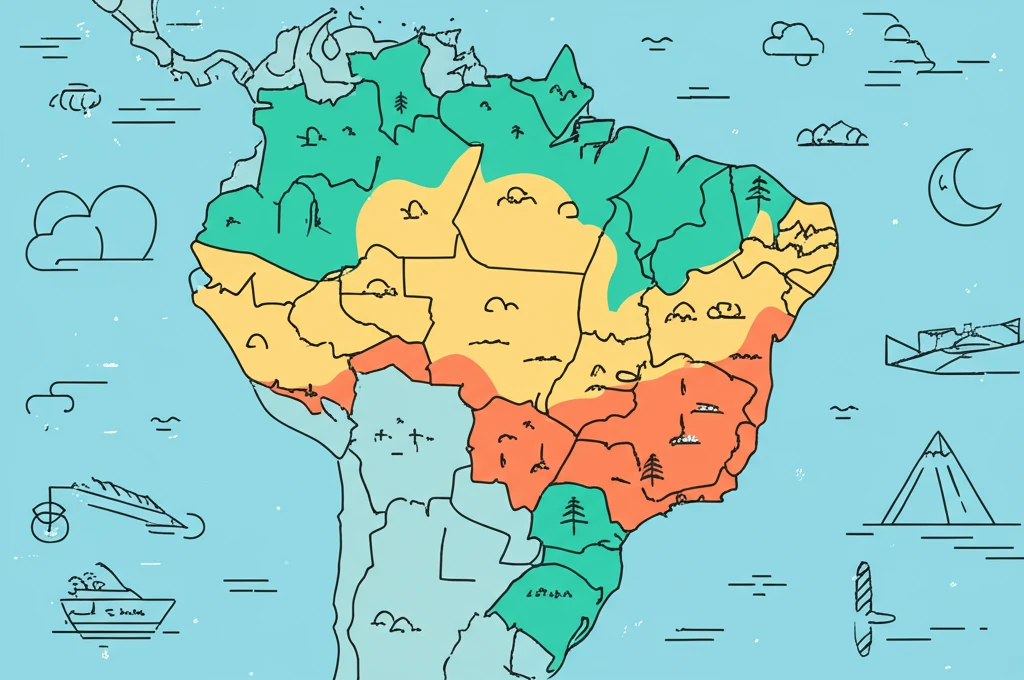
Brazil's Climate is Changing: What the Koppen Climate Classification Reveals

"Analyzing annual climate types in Brazil to understand climate change and its impact on regional weather patterns."
Climate change is a global phenomenon, but its effects are felt locally. Understanding how climate is changing in specific regions requires detailed analysis and effective communication. One method gaining traction is the use of the Köppen climate classification system, which helps categorize climate zones based on temperature and precipitation patterns. By examining changes in these classifications over time, scientists can gain insights into how regional climates are evolving.
A recent study focused on Brazil has utilized the Köppen classification to analyze climate change across the country. Brazil, with its vast size and diverse ecosystems, offers a unique opportunity to observe climate variations and shifts. The study looked at data from 208 weather stations over several decades to identify trends and changes in annual climate types.
This approach not only helps in visualizing climate change but also in understanding its potential impacts on agriculture, biodiversity, and human populations. The Köppen system provides a clear framework for assessing these changes, making it an invaluable tool for climate scientists and policymakers alike.
Global Temperature Data: The Statistical Backbone
The UNSD launched a Global Consultation on its draft Global Set of Climate Change Statistics and Indicators on 21 May 2021, reflecting the growing international push to standardize climate data. Official monitoring bodies like NOAA's Climate.gov track global temperature using records from the National Centers for Environmental Information, while NASA's climate portal provides current news and data streams about global warming. These statistics are central to understanding climate shifts, including the kind of regional reclassifications a climate classification system would reveal. However, as one critic argues in 'There's No Climate Apocalypse,' audiences also need statistical literacy to spot bad data among the numbers.
Accepted Methods and Their Limits
The standard toolkit for studying climate change relies on global climate models, but downscaling methods that refine those models are fundamentally limited by the quality and uncertainties present in the global climate models they rely on, as well as by their demanding data requirements. There is also no settled consensus on priorities: public debate continues over whether climate change is the most pressing issue of our time or one concern among many. Some commentators argue that relying on emissions cuts alone is a dangerous fantasy, and that approaches such as managing hard-to-abate emissions are the only way to reduce the long-term climate risks that remain even when net emissions reach zero. Together these limits explain why methods for mapping climate conditions carry inherent uncertainty.
A Five-Century View of Climate History
Environmental historian Sunil Amrith argues in The Burning Earth that while climate change's association with industrialization is well known, the connections between global warming and environmental shifts over the last 500 years are less understood. Ontario Nature similarly frames climate change through its own history and milestones, noting that the warming climate is imperiling water, food, biodiversity and the natural systems people rely on. Historical treatments also increasingly include Indigenous relations and cultural dimensions, with artists using their work to highlight climate change. This long view matters for reading climate records: today's patterns reflect centuries of cumulative human-environment interaction.
Tracking Climate Shifts with Annual Climate Types
The study, titled "Climate Change Evidence in Brazil from Köppen's Climate Annual Types Frequency," proposes using the Köppen classification to highlight climate changes in Brazil. Researchers compiled average monthly temperature and precipitation data from 208 stations, representative of Brazil's climatic diversity, spanning from 1964 to 2015. Instead of solely comparing averages between two reference periods, their approach involved classifying each year using Köppen's system. This led to the definition of "Annual Climate Types" (ACTs) and the determination of their frequency for each station and each 26-year period: 1964-1989 and 1990-2015.
- Expansion of aridity in Northeast Brazil.
- Increasing disappearance of tropical climates over temperate zones in the South.
- Changes in rainfall patterns in the South of the Amazon.
Attribution, Tipping Points and Rogue Fixes
Recent attribution research shows how quickly the picture is shifting: scientists concluded that Europe's heatwave was 'virtually impossible' 50 years ago—'yes this is climate change, yes it's us, no it's not El Niño.' Meanwhile, researchers mapping nine potential 'tipping points' define abrupt climate change as occurring when the climate system crosses a threshold, triggering a transition to a new state at a rate determined by the climate system itself and faster than the cause. Coverage of proposed fixes is also being scrutinized: reports suggesting scientists proposed 'dimming the sun' were overstated, with the underlying research serving as a fact-check of one extremely controversial and potentially catastrophic method. Open platforms like ResearchGate now make 160+ million publication pages accessible to researchers worldwide.
Market Failures and Ecological Limits
The Global Footprint Network argues that climate change, deforestation, overgrazing, fisheries collapse, food insecurity and rapid species extinction are all part of a single overarching problem: humanity is simply demanding more from the Earth than it can provide. Sir Nicholas Stern framed the same problem in economic terms, calling climate change 'the result of the greatest market failure the world has seen,' because those who damage others by emitting greenhouse gases generally do not pay. These failures help explain why emissions targets are missed and highlight the limits of purely market-based responses. Religious communities have also weighed in—Islamic scholars issued a declaration calling on the world's 1.6 billion Muslims to do their part.
Stronger Evidence, Stronger Messages
Comparison across IPCC assessment reports shows a clear trend: the evidence for human influence on recent climate change strengthened from the Second Assessment Report to the Fifth, and is now even stronger in this assessment. Behavioral research points in the same direction—a study found that reading that we only have 12 years left to reduce emissions before abrupt and catastrophic climate change occurs increases people's willingness to support government climate policies. Side-by-side comparisons of this kind help translate physical science into public action, much as comparing climate records reveals how boundaries between climate conditions shift over time. The comparative approach is increasingly used across platforms, from IPCC reports to everyday climate communications.
A Clearer Picture of Climate Change
This study underscores the value of the Köppen climate classification system as a tool for understanding and communicating climate change. By focusing on annual climate types, researchers can identify subtle but significant shifts in regional climates. This approach provides a practical framework for monitoring climate trends and informing strategies for adaptation and mitigation. As climate change continues to impact ecosystems and human societies, accessible and informative tools like the Köppen classification will be essential for fostering awareness and action.
The Paradox of Expertise
Expert commentary on climate change is marked by a central paradox: that climate change demands expertise, and faith in it, at precisely the moment when public confidence in expertise is collapsing. Researchers modeling the 'climate belief paradox' likewise find a complex relationship between recorded meteorological anomalies and shifting public sentiment, which they analyze through mathematical models of cognitive resistance. In specific domains, expert opinion remains essential—analyses of Arctic sea ice status draw on experts with various points of view, and one review concludes that expert opinion can be a useful tool to address knowledge gaps in the absence of adequate data. Synthesizing these expert voices is how credible climate narratives are built.
Plausible Futures, Missed Targets
The Hamburg Climate Futures Outlook released on 1 February 2023 found no plausible pathway towards limiting global warming to 1.5°C, based on assessing to what extent social changes are already in place while examining specific physical processes frequently discussed as responses. The Outlook series is the first systematic attempt to assess which climate futures are plausible, by combining multidisciplinary assessments of plausibility. Model-based forecasts are not infallible: critics point to NOAA's winter outlook, which failed to predict the temperatures that winter, as a caution against over-trusting long-range projections. Climate communicators increasingly try to translate these technical findings into accessible terms, such as the widely shared 'designer's primer' of nine things worth knowing about climate change.
A Systemic Challenge
The EEA's 2016 assessment describes climate change as a systemic challenge that does not happen in isolation but interacts with socio-economic factors, with regional and global trends adding an extra dynamic. This systemic view extends to food systems: researchers argue there is an inextricable link between food systems and accelerated climate change, and they call for innovating adaptation through agroecology. Health systems face their own systemic stresses—a scoping review maps pathways linking climate change to cardiovascular diseases and identifies health-system challenges across global, regional and national policy levels. Addressing climate change therefore requires systemic responses rather than single-sector fixes.
People at the Center
World Weather Attribution researchers examined climate change's role in the likelihood of the wildfire disaster in Los Angeles, finding that dynamical effects can be as large as the thermodynamic effects. The human stakes are unevenly distributed: a 'Stories from the Climate Crisis' mixer introduces students to 24 individuals around the world who are each affected differently—for some, climate change threatens to force them from their land, while for others it is a business opportunity. Yet people dramatically misjudge the climate impacts of their own actions, in part because it is effectively impossible to measure the real-world impact of, for instance, one person attending a climate march or discussing climate change at work. Interactive climate models used in education aim to make these human-environment connections concrete by investigating the effects of anthropogenic climate change on people and the environment.