
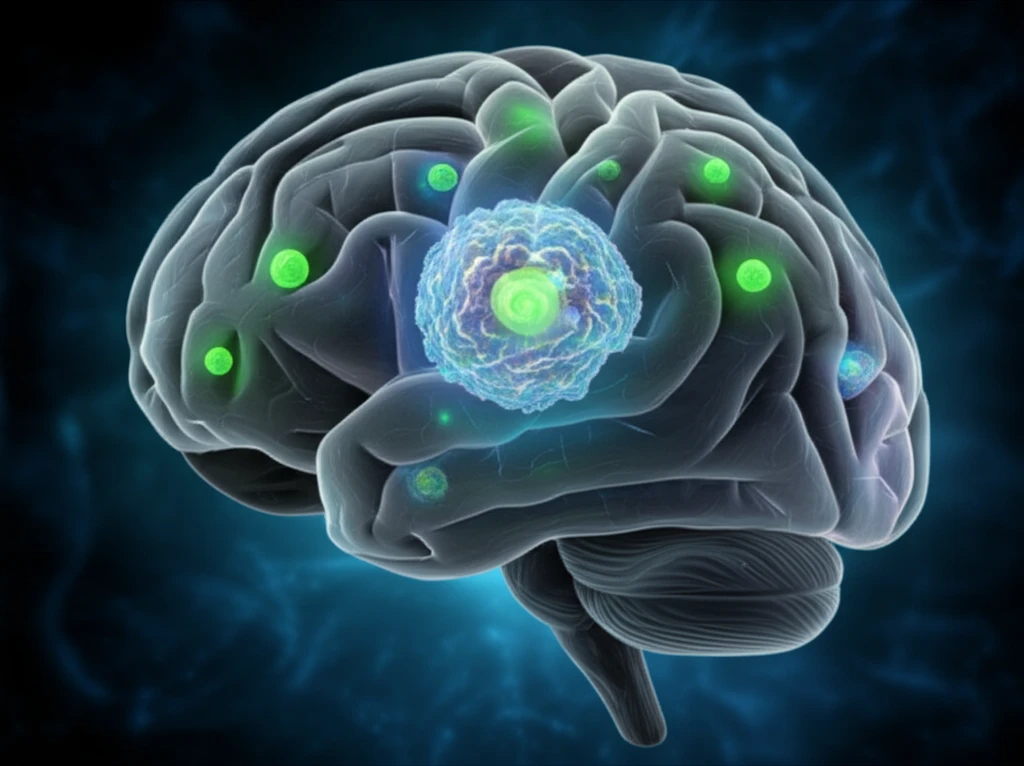
Glowing immune cells infiltrating a brain tumor.

Brain Cancer Breakthrough: Can This Mutation Improve Glioma Prognosis?

"New research identifies how the R132H mutation in the IDH1 gene promotes immune cell recruitment, offering hope for better glioma treatments."


Gliomas, aggressive tumors originating in the brain, pose a significant threat to human health. Classified from grade I to IV, these tumors exhibit varying degrees of malignancy, with glioblastoma (GBM), a grade IV astrocytoma, being the most aggressive. GBM is associated with a median survival time of fewer than 15 months, even with current medical interventions.

Recent advances in cancer research have highlighted the role of genetic mutations in tumor development and progression. One such mutation, occurring in the isocitrate dehydrogenase 1 (IDH1) gene, particularly the R132H mutation, has garnered attention for its association with improved prognosis in glioma patients. However, the underlying mechanisms responsible for this phenomenon remain largely elusive.

A groundbreaking study led by Professor Yi Zhang sheds light on the intricate relationship between the IDH1-R132H mutation and immune cell recruitment in gliomas. The findings reveal a novel mechanism by which the mutation promotes the infiltration of natural killer (NK) cells into the tumor microenvironment, leading to enhanced anti-tumor immunity and improved patient outcomes.

Decoding the IDH1-R132H Mutation: A Key to Unlocking Immune Response in Gliomas

Glowing immune cells infiltrating a brain tumor.

The research team embarked on a comprehensive investigation to elucidate the impact of the IDH1-R132H mutation on glioma progression and patient survival. By analyzing data from The Cancer Genome Atlas (TCGA) and the Chinese Glioma Genome Atlas (CGGA) databases, they observed a compelling correlation between the mutation and prolonged survival times. Further analysis revealed elevated levels of CD56, a marker for NK cells, in IDH1-R132H mutant glioma samples compared to wild-type samples. This discovery hinted at the potential role of NK cells in mediating the improved prognosis associated with the mutation.

To delve deeper into the mechanisms driving NK cell recruitment, the researchers established a cell line carrying the IDH1-R132H mutation and conducted a series of in vitro experiments. They discovered that IDH1-R132H mutant glioma cells exhibited an increased ability to attract NK cells compared to their wild-type counterparts. This observation led to the investigation of chemokines, signaling molecules that play a crucial role in immune cell trafficking.

  • CX3CL1 levels were significantly higher in IDH1-R132H gliomas.
  • TCGA and CGGA databases confirmed these results.
  • CX3CL1 was upregulated in mutant glioma cells.
  • CX3CR1, the receptor for CX3CL1, is expressed on NK cells.
The research team found that CX3CL1 mRNA levels were significantly higher in IDH1-R132H gliomas, while other chemokines did not show obvious differences. Additionally, The results revealed that more NK cells migrated to the lower chamber containing IDH1-R132H derived-conditioned medium than to the chamber containing the IDH1 WT conditioned medium . These results suggest that IDH1-R132H glioma cells could potentially recruit NK cells to the tumor bed, and thus promote an immune response.

Harnessing the Power of Immunity: A Promising Avenue for Glioma Treatment

Professor Zhang's study unveils a novel mechanism by which the IDH1-R132H mutation promotes NK cell recruitment in gliomas, offering a potential therapeutic avenue for this devastating disease. By understanding the intricate interplay between genetic mutations and immune responses, researchers can develop targeted immunotherapies to enhance anti-tumor immunity and improve patient outcomes. Further research is warranted to fully elucidate the clinical implications of these findings and translate them into effective treatment strategies for glioma patients.

About this Article -

This article was crafted using a human-AI hybrid and collaborative approach. AI assisted our team with initial drafting, research insights, identifying key questions, and image generation. Our human editors guided topic selection, defined the angle, structured the content, ensured factual accuracy and relevance, refined the tone, and conducted thorough editing to deliver helpful, high-quality information.See our About page for more information.

Everything You Need To Know

1

What is the significance of the IDH1-R132H mutation in the context of glioma treatment?

The IDH1-R132H mutation is significant because it has been associated with improved prognosis in glioma patients. Research indicates that this mutation promotes the recruitment of natural killer (NK) cells into the tumor microenvironment, enhancing anti-tumor immunity. This suggests a potential avenue for developing targeted immunotherapies to improve patient outcomes for those with gliomas.

2

How does the IDH1-R132H mutation affect the immune response within gliomas?

The IDH1-R132H mutation appears to boost the immune response by increasing the infiltration of natural killer (NK) cells into the tumor microenvironment. This is linked to the elevated levels of CX3CL1 in IDH1-R132H gliomas. CX3CL1, a chemokine, attracts NK cells, which then attack the tumor cells, thus enhancing anti-tumor immunity and potentially improving the prognosis of glioma patients.

3

What are gliomas, and why are they a significant health concern?

Gliomas are aggressive tumors that originate in the brain, posing a significant threat to human health. Classified from grade I to IV, they exhibit varying degrees of malignancy, with glioblastoma (GBM), a grade IV astrocytoma, being the most aggressive. GBM is associated with a poor prognosis, with a median survival time of fewer than 15 months even with current treatments. This highlights the critical need for effective treatment strategies.

4

How did researchers identify the role of CX3CL1 in the context of IDH1-R132H mutant gliomas?

Researchers found that CX3CL1 mRNA levels were significantly higher in IDH1-R132H gliomas compared to wild-type samples. Furthermore, experiments showed that more natural killer (NK) cells migrated to the environment containing IDH1-R132H derived conditioned medium, suggesting that the mutant glioma cells could recruit NK cells to the tumor bed, mediated by CX3CL1. The results were confirmed using data from The Cancer Genome Atlas (TCGA) and the Chinese Glioma Genome Atlas (CGGA) databases.

5

What are the potential implications of this research for future glioma treatments?

The research, led by Professor Yi Zhang, unveils a novel mechanism by which the IDH1-R132H mutation promotes NK cell recruitment in gliomas. This discovery offers a potential therapeutic avenue for developing targeted immunotherapies. By understanding the intricate interplay between genetic mutations and immune responses, researchers can potentially enhance anti-tumor immunity, improving patient outcomes. Further research is warranted to fully explore the clinical implications of these findings and translate them into effective treatment strategies for glioma patients.

Newsletter Subscribe

Subscribe to get the latest articles and insights directly in your inbox.