
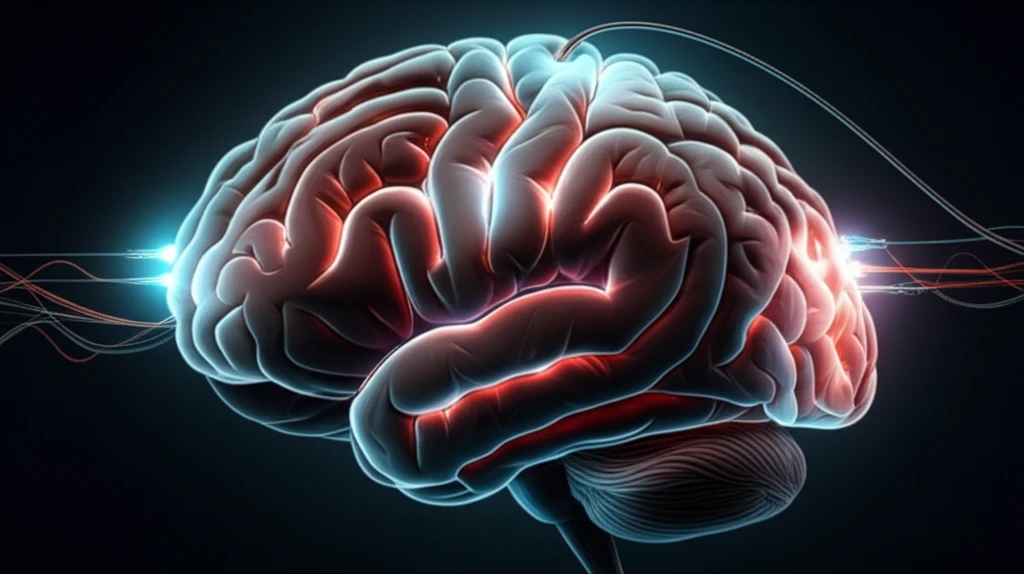
Illustration of a brain with an electrode implanted, showing the mechanism of deep brain stimulation for treating movement disorders.

Brain Breakthrough: Can Deep Brain Stimulation Treat Movement Disorders?

"A groundbreaking study explores how deep brain stimulation (DBS) could reshape treatments for Parkinson's disease and dystonia by targeting the brain's control centers."


Imagine a life where tremors and uncontrolled movements are a thing of the past. For millions living with Parkinson's disease and dystonia, this isn't just a dream, but a potential reality. Deep brain stimulation (DBS), a technique involving the implantation of electrodes deep within the brain, has already shown promise. New research is delving into the 'how' and 'why' of this groundbreaking procedure, offering hope for even more effective and targeted treatments.

DBS is not a simple 'on/off' switch. It's a complex interplay of electrical signals that interact with the brain's intricate networks. Understanding the mechanisms behind DBS is crucial for optimizing its effectiveness and expanding its use. This article delves into a recent study that investigates how high-frequency stimulation (HFS), a specific type of DBS, impacts the brain's globus pallidus, a key region in movement control.

The research, published in the Journal of Neuroscience, goes beyond just observing the effects of DBS. It seeks to unravel the cellular and molecular processes involved, providing a clearer picture of how DBS can potentially alleviate the debilitating symptoms of movement disorders. By exploring these details, scientists hope to develop more precise and personalized treatments for patients around the world.

Unlocking the Mystery: How DBS Works on a Cellular Level

Illustration of a brain with an electrode implanted, showing the mechanism of deep brain stimulation for treating movement disorders.

The study's primary focus was on the globus pallidus internus (GPi), a critical structure within the brain's basal ganglia, a region crucial for movement control. Researchers used HFS, applying electrical stimulation to the GPi in both human patients and rodent models. They meticulously observed how these electrical pulses affected individual brain cells, known as neurons.

The researchers found that HFS induced a variety of effects in GPi neurons. The most prominent was a phenomenon called 'after-facilitation' — an increase in neuronal firing that continued even after the stimulation stopped. This effect was observed in a significant portion of the neurons studied and was linked to improved firing patterns within the brain.

  • High-frequency stimulation (HFS) in the globus pallidus (GPi) can lead to prolonged changes in brain cell activity.
  • HFS can influence brain rhythm, reduce erratic burst firing, improving the ability to control motor movements.
  • These findings show a path to more targeted and customized DBS treatments for movement disorders.
In addition to the findings in humans, the researchers extended their investigation to animal models, focusing on brain slices from rats. This allowed them to delve into the underlying cellular mechanisms. They discovered that the after-facilitation involved the release of neurotransmitters, particularly glutamate and acetylcholine, at different levels of stimulation, suggesting that DBS has the potential to improve communication with the brain cells involved in movement.

A Brighter Future for Movement Disorder Treatment

This research gives a new lens to view and explore the effectiveness of DBS in treating movement disorders, it provides hope for more effective and tailored treatments. As scientists continue to unravel the intricacies of DBS, the potential for improving the lives of individuals with Parkinson's disease, dystonia, and other movement disorders remains a bright promise for future treatments.

About this Article -

This article was crafted using a human-AI hybrid and collaborative approach. AI assisted our team with initial drafting, research insights, identifying key questions, and image generation. Our human editors guided topic selection, defined the angle, structured the content, ensured factual accuracy and relevance, refined the tone, and conducted thorough editing to deliver helpful, high-quality information.See our About page for more information.

This article is based on research published under:

DOI-LINK: 10.1523/jneurosci.0785-18.2018, Alternate LINK

Title: Long-Lasting Electrophysiological After-Effects Of High-Frequency Stimulation In The Globus Pallidus: Human And Rodent Slice Studies

Subject: General Neuroscience

Journal: The Journal of Neuroscience

Publisher: Society for Neuroscience

Authors: Feng Luo, Linda H. Kim, Philippe Magown, M. Sohail Noor, Zelma H.T. Kiss

Published: 2018-10-29

Everything You Need To Know

1

What is Deep Brain Stimulation (DBS) and which movement disorders does it aim to treat?

Deep Brain Stimulation (DBS) is a technique that involves implanting electrodes deep within the brain. Current research explores how DBS can be used to treat movement disorders, specifically Parkinson's disease and dystonia, by targeting the brain's control centers to reduce tremors and uncontrolled movements. The procedure aims to modulate the brain's electrical signals to improve motor function.

2

How does High-Frequency Stimulation (HFS) within Deep Brain Stimulation impact the globus pallidus internus (GPi)?

High-Frequency Stimulation (HFS), a specific type of Deep Brain Stimulation, impacts the globus pallidus internus (GPi) by inducing a phenomenon called 'after-facilitation.' This involves an increase in neuronal firing that continues even after the stimulation has stopped. HFS can also influence brain rhythms and reduce erratic burst firing, potentially improving the ability to control motor movements affected by Parkinson's disease and dystonia. This suggests HFS can help improve communication between brain cells related to movement.

3

What cellular mechanisms are involved in the 'after-facilitation' effect observed in GPi neurons after High-Frequency Stimulation?

The 'after-facilitation' effect in GPi neurons involves the release of neurotransmitters, particularly glutamate and acetylcholine. The study indicates that High-Frequency Stimulation (HFS) can modulate the levels of these neurotransmitters, which have the potential to improve communication between brain cells involved in movement. Further research may explore how these changes in neurotransmitter release contribute to the therapeutic effects of DBS.

4

Can Deep Brain Stimulation be personalized, and how could research into its mechanisms contribute to more effective treatments for movement disorders?

The research suggests that a deeper understanding of the mechanisms behind Deep Brain Stimulation (DBS) can lead to more targeted and customized treatments. By exploring the cellular and molecular processes involved, scientists can tailor stimulation parameters to individual patients, potentially optimizing the effectiveness of DBS for Parkinson's disease, dystonia, and other movement disorders. Understanding the nuances of how High-Frequency Stimulation affects neuronal activity and neurotransmitter release allows for fine-tuning the therapy.

5

What future research could expand on these findings about Deep Brain Stimulation and High-Frequency Stimulation?

Future research could investigate the long-term effects of High-Frequency Stimulation (HFS) on the globus pallidus internus (GPi) and other brain regions involved in motor control. Studies could also focus on identifying specific biomarkers that predict a patient's response to Deep Brain Stimulation (DBS), further personalizing treatment strategies. Additionally, research is needed to explore how DBS can be combined with other therapies, such as medication or rehabilitation, to maximize its benefits for individuals with Parkinson's disease, dystonia and other movement disorders. This would include looking at other areas of the brain beyond the GPi and what role they play.

Newsletter Subscribe

Subscribe to get the latest articles and insights directly in your inbox.