
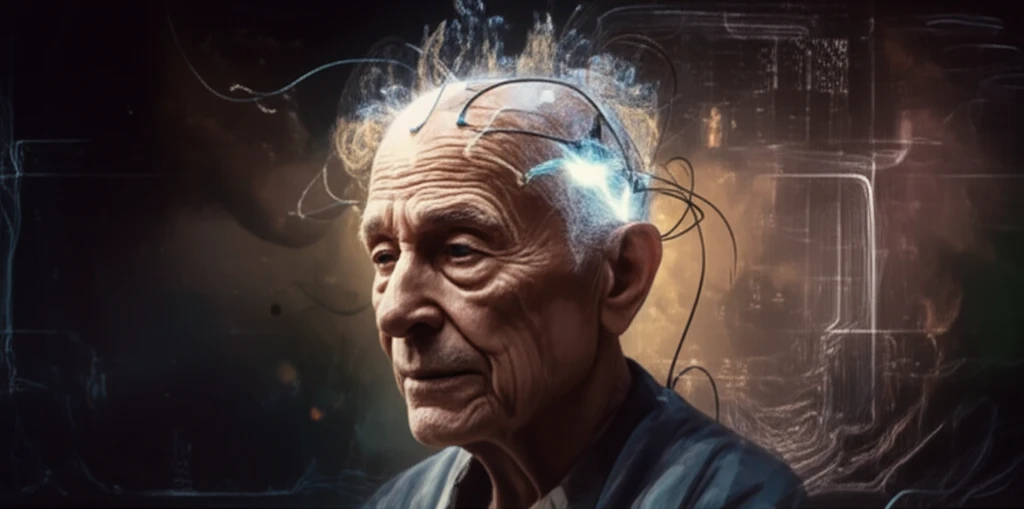
Brain Boost for Seniors: Can Stimulation Ease Pain and Sharpen Minds?

"Discover how non-invasive brain stimulation could offer new hope for aging adults struggling with chronic pain and cognitive decline."
As we age, maintaining both physical comfort and mental sharpness becomes increasingly vital. Chronic pain and cognitive decline are significant challenges for many older adults, impacting their overall quality of life. But what if there was a non-invasive way to address both issues simultaneously? Recent research explores the potential of transcranial direct current stimulation (tDCS) to do just that.
Transcranial direct current stimulation (tDCS) involves delivering a low-intensity electrical current to specific areas of the brain through electrodes placed on the scalp. This technique aims to modulate neuronal activity, potentially improving various brain functions. The dorsolateral prefrontal cortex (DLPFC), an area critical for executive functions and pain perception, has emerged as a key target for tDCS in aging populations.
A groundbreaking study published in the Archives of Gerontology and Geriatrics investigates the effects of tDCS on pain perception and executive function in aging individuals. The study provides compelling insights into how this innovative approach could offer a new avenue for managing age-related challenges.
Tackling Pain and Cognitive Decline: How Does tDCS Work?
The study's primary objective was to determine the feasibility of using tDCS to alleviate pain and enhance executive function in community-dwelling older adults. Researchers hypothesized that by stimulating the DLPFC, they could improve both pain perception and cognitive performance.
- Participants: Twenty-four elderly volunteers (6 men, 18 women, average age 71.25 years).
- Protocol: Double-blind, single-arm trial including a sham period.
- Intervention: Five consecutive sessions of anodal tDCS over the DLPFC.
- Stimulation Intensity: Sham, 1 mA, and 2 mA.
- Duration: 20 minutes per session.
- Measurements: Visual analogue scale (VAS), pain self-efficacy questionnaire (PSEQ), Tampa Scale for Kinesiophobia (TSK), Global perceived Effect scale (GPES), Trail Making Test (TMT), Timed Up and Go (TUG) dual, maximal grip strength, and 12-item Short Form survey.
The Future of Brain Stimulation in Elderly Care
This study offers a promising glimpse into the potential of tDCS as a non-invasive tool for managing pain and cognitive decline in the elderly. By targeting the DLPFC, researchers were able to demonstrate significant improvements in pain perception and quality of life. Further research is needed to explore the long-term effects and optimize the application of tDCS for age-related conditions. As our population ages, innovative approaches like tDCS may become increasingly important in maintaining the well-being of our senior citizens.