
Bow Hunter Syndrome: When Turning Your Head Hurts More Than You Know

"Uncover the rare condition where head rotation compresses arteries, leading to dizziness, stroke risk, and a need for innovative surgical solutions."
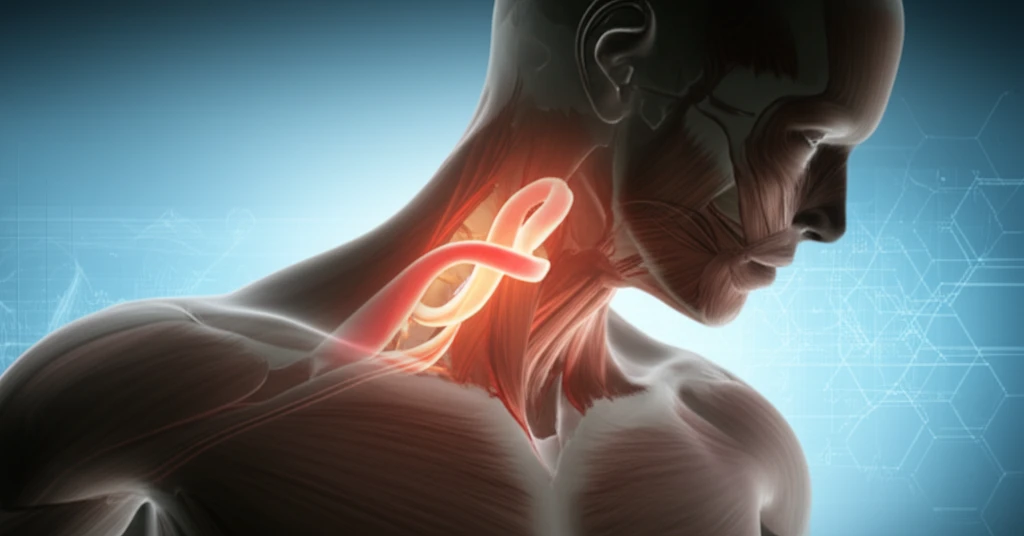
Imagine a scenario where simply turning your head could trigger vertigo, nausea, or even near-syncope. This is the reality for individuals with Bow Hunter Syndrome (BHS), a rare condition characterized by mechanical compression of the vertebral artery during head rotation. This compression restricts blood flow to the brain, leading to a range of debilitating symptoms.
While BHS is uncommon, its impact on quality of life can be significant. Symptoms often include dizziness, vertigo, visual disturbances, and fainting spells. The condition arises when the vertebral artery, a major vessel supplying blood to the brain, is compressed by surrounding structures during head movement. This compression can lead to vertebrobasilar insufficiency, a temporary reduction in blood flow to the back of the brain.
Treatment options for BHS range from conservative management, such as avoiding extreme head rotations, to surgical interventions aimed at decompressing the affected artery or stabilizing the cervical spine. In some cases, endovascular procedures like angioplasty or stenting may be considered. This article delves into a unique case of BHS complicated by a pseudoaneurysm, highlighting the diagnostic challenges and surgical strategies employed to address this complex condition.
A Unique Case: Bow Hunter Syndrome with Pseudoaneurysm
A recent case report details the experience of a 49-year-old woman who presented with neck pain, severe vertigo, nausea, and near syncope triggered by turning her head up and to the right. Initial magnetic resonance angiography (MRA) revealed a pseudoaneurysm – a bulge in the artery wall – in the V3 segment of the left vertebral artery. This segment is particularly vulnerable as it exits the C2 foramen, a bony opening in the cervical spine.
- MRA revealed a pseudoaneurysm in the V3 segment of the left vertebral artery.
- CTA confirmed compression of the V3 segment with head rotation.
- Diagnostic angiography showed near-total occlusion of the left vertebral artery during head rotation.
- The patient experienced severe symptoms, including vertigo, nausea, and near syncope, during the angiogram when her head was turned.
A Path to Stability and Symptom Relief
Following the surgery, the patient experienced a significant improvement in her condition. She remained without neurologic deficits and reported no further episodes of the debilitating symptoms she had experienced preoperatively. A 6-month follow-up MRA showed that the pseudoaneurysm was stable in size and shape.
This case highlights the importance of considering Bow Hunter Syndrome in patients presenting with positional vertigo and related symptoms. Early diagnosis and appropriate management, including surgical intervention when necessary, can significantly improve patient outcomes. The use of computer-assisted navigation and advanced surgical techniques allows for precise and effective stabilization of the cervical spine, relieving pressure on the vertebral artery and preventing further complications.
While this case offers a successful example of surgical management, it is crucial for patients to discuss all treatment options with their healthcare providers to determine the most appropriate approach for their individual situation. Continued research and advancements in surgical techniques hold promise for improving the lives of individuals affected by Bow Hunter Syndrome.