
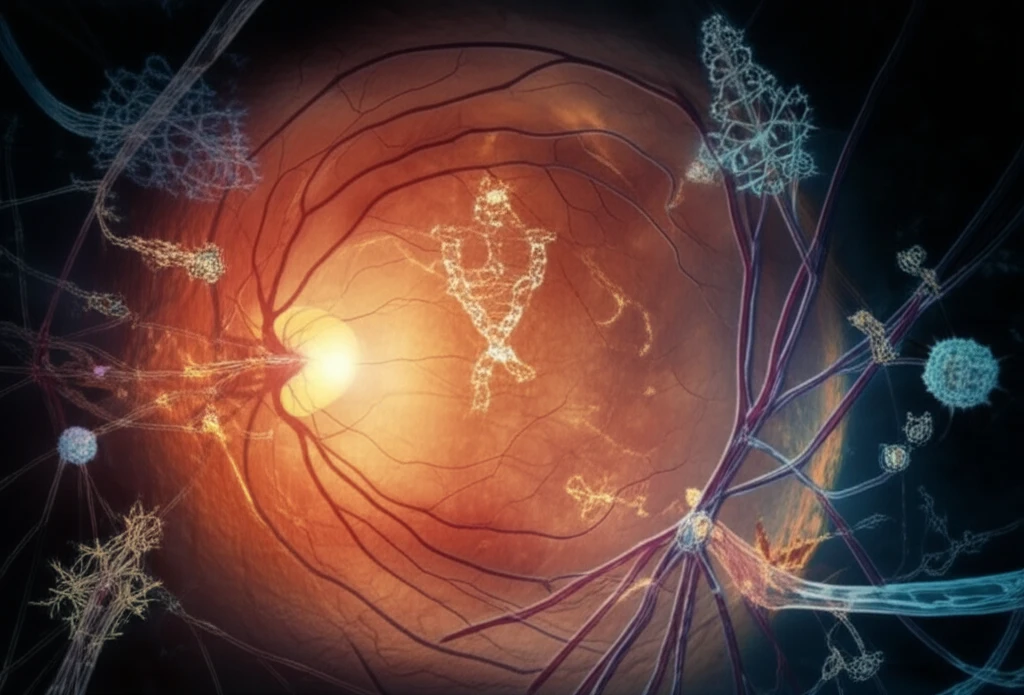
Illustration depicting the ATF6 gene within retinal cells, highlighting its role in vision and the impact of genetic mutations.

Blinding Breakthrough: New Hope for Preventing Vision Loss Through Genetic Discoveries

"Scientists Uncover Genetic Mutation Linked to Early-Onset Blindness, Paving the Way for Targeted Treatments"


Losing your sight is a fear shared by many. The world transforms, everyday tasks become challenging, and independence is threatened. For those who experience vision loss early in life, the impact is even more profound. Now, a team of scientists has made a significant breakthrough in understanding one cause of early-onset photoreceptor degeneration, offering a glimmer of hope for new treatments.

This research, published in Investigative Ophthalmology & Visual Science, centers around a genetic mutation in the ATF6 gene. This gene plays a crucial role in the unfolded protein response (UPR) pathway, which is a cellular mechanism that addresses stress within the endoplasmic reticulum (ER). When proteins misfold or accumulate in the ER, the UPR pathway activates to restore balance. The findings suggest that disruptions in this process can lead to vision loss.

The implications of this discovery are far-reaching. Understanding the genetic underpinnings of retinal diseases is the first crucial step toward developing targeted therapies. This research not only sheds light on a specific form of early-onset blindness but also opens doors to exploring the broader role of the UPR pathway in other retinal disorders.

Decoding the Genetic Puzzle: How ATF6 Mutations Cause Vision Loss

Illustration depicting the ATF6 gene within retinal cells, highlighting its role in vision and the impact of genetic mutations.

The study focused on a 2-year-old girl diagnosed with early-onset photoreceptor degeneration (PRD), a condition where the light-sensitive cells in the retina, called photoreceptors, gradually deteriorate. After ruling out other potential genetic causes, researchers turned to whole-exome sequencing (WES), a method used to analyze the protein-coding regions of the genome.

WES revealed that the patient carried mutations in the ATF6 gene. The first mutation created a premature stop codon, leading to a truncated, non-functional protein. The second mutation affected a splicing site, disrupting the way the gene's message is read and leading to the production of abnormal mRNA. These mutations were found to be inherited from both parents, confirming the loss-of-function nature and that the mutations were in trans, thus affecting the gene's ability to function properly.

  • Photoreceptor Degeneration: A condition characterized by the progressive deterioration of photoreceptor cells in the retina, leading to vision loss.
  • ATF6 Gene: A gene that provides instructions for making a protein involved in the unfolded protein response (UPR) pathway.
  • Unfolded Protein Response (UPR): A cellular pathway that responds to the accumulation of misfolded or unfolded proteins in the endoplasmic reticulum.
  • Whole-Exome Sequencing (WES): A genetic test that analyzes the protein-coding regions of the genome to identify mutations.
To further investigate, researchers examined the expression pattern of ATF6 in the retina using immunohistochemistry. They found that ATF6 was expressed in three neuronal cell layers. The study also screened a cohort of over 500 patients with retinal diseases and found that ATF6 mutations were rare, suggesting they are a cause of inherited retinal diseases. The findings support ATF6 as a novel disease-causing gene for PRD, indicating that disrupted protein quality control mechanisms may be a novel pathological mechanism underlying human retinal degeneration.

A Glimmer of Hope: The Future of Vision Research

This groundbreaking research offers a new perspective on the causes of early-onset blindness and, more broadly, on inherited retinal diseases. By identifying ATF6 as a critical factor, scientists have opened the door to potential treatments that target the UPR pathway. Future studies may focus on therapies that can prevent or slow down photoreceptor degeneration by supporting the cellular machinery that helps the eye handle stress. This study is a significant step forward, bringing us closer to a future where vision loss is preventable and treatable.

About this Article -

This article was crafted using a human-AI hybrid and collaborative approach. AI assisted our team with initial drafting, research insights, identifying key questions, and image generation. Our human editors guided topic selection, defined the angle, structured the content, ensured factual accuracy and relevance, refined the tone, and conducted thorough editing to deliver helpful, high-quality information.See our About page for more information.

Everything You Need To Know

1

What is the role of the ATF6 gene, and how does its mutation lead to vision loss?

The ATF6 gene provides instructions for making a protein involved in the Unfolded Protein Response (UPR) pathway. The UPR pathway is a critical cellular mechanism that addresses stress within the Endoplasmic Reticulum (ER). When the ATF6 gene is mutated, as demonstrated in the study, it disrupts this pathway. Specifically, the mutations in the ATF6 gene led to a truncated, non-functional protein or abnormal mRNA production. This malfunction impairs the ER's ability to handle misfolded proteins, which subsequently damages the photoreceptor cells and causes vision loss.

2

What is the Unfolded Protein Response (UPR), and why is it important in the context of retinal health?

The Unfolded Protein Response (UPR) is a cellular pathway activated in response to the accumulation of misfolded or unfolded proteins within the Endoplasmic Reticulum (ER). The ER is responsible for protein folding and modification, and the UPR acts as a quality control mechanism. In the context of retinal health, the UPR is critical because photoreceptor cells have a high protein turnover rate, making them particularly vulnerable to protein misfolding stress. When the UPR pathway malfunctions, it can lead to photoreceptor degeneration, as observed in cases with ATF6 mutations.

3

How was the genetic mutation linked to early-onset blindness identified in the study?

Researchers used Whole-Exome Sequencing (WES) to identify the genetic mutation. WES is a technique used to analyze the protein-coding regions of the genome. The study focused on a 2-year-old girl diagnosed with early-onset photoreceptor degeneration. After ruling out other potential genetic causes, WES revealed mutations in the ATF6 gene. These mutations were confirmed to be inherited from both parents, establishing their role in the patient's condition.

4

What are the potential implications of this research for developing treatments for retinal diseases?

The discovery of ATF6 as a critical factor in early-onset blindness opens the door to potential targeted therapies. This research highlights the role of the UPR pathway in retinal health. Future studies could focus on therapies that support the cellular machinery involved in handling stress within the eye. This includes interventions that help to regulate the UPR pathway, potentially preventing or slowing the degeneration of photoreceptors and thus preserving vision.

5

What is photoreceptor degeneration, and why is understanding its genetic basis important?

Photoreceptor degeneration (PRD) is a condition characterized by the progressive deterioration of photoreceptor cells in the retina. These photoreceptor cells are responsible for detecting light, and their degeneration leads to vision loss. Understanding the genetic basis of PRD is crucial because it allows for the development of targeted therapies. By identifying the specific genes and pathways involved, like ATF6 and the UPR pathway, researchers can design treatments to address the root cause of the disease, potentially slowing or even preventing vision loss.

Newsletter Subscribe

Subscribe to get the latest articles and insights directly in your inbox.