
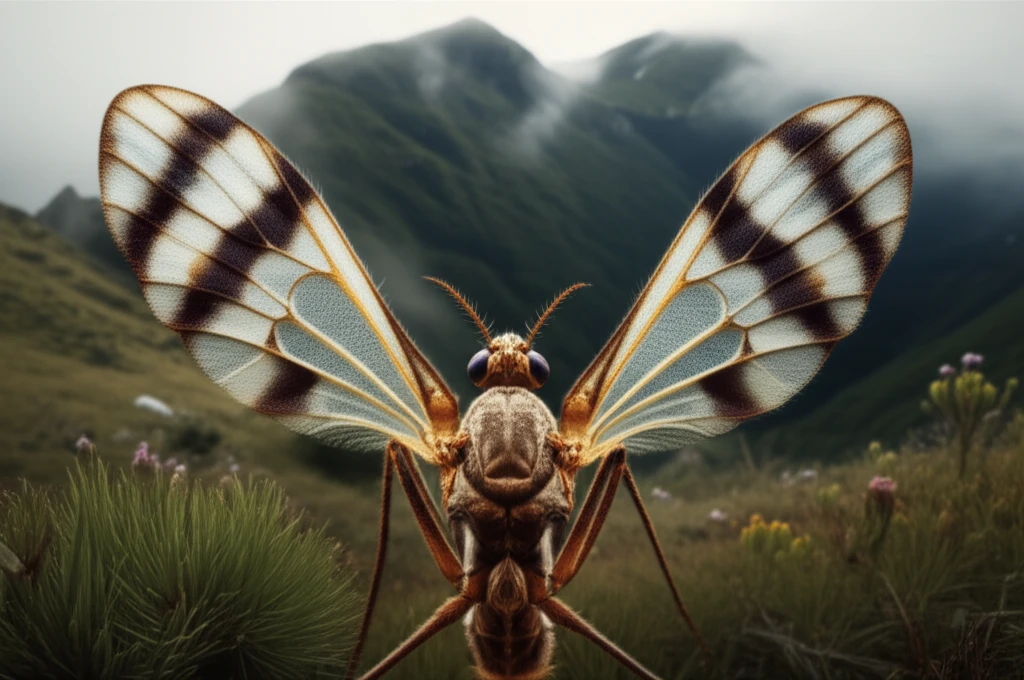
Detailed illustration of Culicoides lisicarruni in its natural Andean habitat.

Bite-Sized Discovery: A New Midge Species Buzzes into Colombia

"Unveiling Culicoides lisicarruni: A Tiny Insect with a Unique Identity in the Andes"


Biting midges, belonging to the genus Culicoides, are notorious worldwide as blood-sucking pests that target both humans and animals. The Neotropical Region alone is home to a vast diversity of these tiny insects, with over 266 species documented. These insects not only cause irritation but also act as vectors for various diseases, making their study crucial.

Recent research has focused on cataloging and understanding the Culicoides species in Colombia. While 114 species are confirmed to exist, another 66 are suspected to inhabit the country, highlighting the need for ongoing exploration. This article delves into the description of a newly discovered species within the Diphaomyia subgenus.

The discovery of Culicoides lisicarruni occurred in the high-altitude region of the Chingaza National Natural Park. This article explores the distinct features of this new midge species, comparing it with similar species and shedding light on its daily activity and habitat.

Distinctive Traits of Culicoides lisicarruni

Detailed illustration of Culicoides lisicarruni in its natural Andean habitat.

Culicoides lisicarruni stands out due to several unique characteristics. One of the most notable is the presence of sensilla coeloconica—specialized sensory structures—on specific segments (1, 9-13) of its flagellum. Additionally, the wing patterns exhibit two pale spots within a specific cell (cua), with one spot closely positioned near a wing vein (CuA₁) and the other narrowly separated from the wing's edge.

The female Culicoides lisicarruni has a dark brown head, with bare eyes separated by a distance roughly equal to the diameter of two ommatidia. The flagellum, also brown, has pale joints. The antennal ratio (AR), which compares the lengths of distal and proximal flagellomeres, ranges from 0.64 to 0.83. Detailed examination reveals the presence and number of sensilla on flagellomeres 1, 9, and 11.

  • Flagellomere 1: Two sensilla.
  • Flagellomeres 9 and 11: One sensillum each.
  • Flagellomeres 10 and 12: One to two sensilla each.
  • Flagellomere 13: Two to four sensilla.
Other identifying features include a dark brown palpus with a subcylindrical third segment, exhibiting a small sensory pit. The palpal ratio (PR) varies from 2.5 to 3.6, while the proboscis/head ratio (P/H ratio) ranges from 0.91 to 1.44. The mandible is equipped with 13 to 17 teeth. The thorax displays a dark brown scutum and scutellum. The legs are dark brown with pale rings on the fore and midfemora and tibiae. The hind tibial comb features four spines, with the first two being the longest and nearly equal in length. The wing has a length of 1.40-1.70 mm and a width of 0.65-0.96 mm. Its costal ratio (CR) is 0.56. Distinct pale spots are present, contributing to the wing's contrasting pattern.

Ecology and Significance

Culicoides lisicarruni has been identified solely within the Chingaza Natural National Park in Colombia. This region is characterized by high altitudes and temperatures ranging from 10°C to 12°C, with minimums between -2°C and 0°C. The area experiences a dry season from November to March and a rainy season from April to October. The midges exhibit peak activity during daybreak (06:00-08:00 am) and dusk (05:00-06:00 pm), with higher densities noted during the rainy season.

The discovery of Culicoides lisicarruni adds to the growing list of Diphaomyia species, now totaling 22. It is important to differentiate it from similar species like Culicoides marinkellei, which also inhabits the Colombian Páramo, as their wing patterns are nearly identical, apart from differences in the cell cua.

Understanding the biodiversity of biting midges is vital due to their role as both pests and disease vectors. Further research into the ecology and behavior of Culicoides lisicarruni could provide insights into disease transmission and potential control measures.

About this Article -

This article was crafted using a human-AI hybrid and collaborative approach. AI assisted our team with initial drafting, research insights, identifying key questions, and image generation. Our human editors guided topic selection, defined the angle, structured the content, ensured factual accuracy and relevance, refined the tone, and conducted thorough editing to deliver helpful, high-quality information.See our About page for more information.

This article is based on research published under:

DOI-LINK: 10.1590/s0074-02762010000800005, Alternate LINK

Title: Description Of Culicoides Lisicarruni (Diptera: Ceratopogonidae), A New Species From Cundinamarca, Colombia

Subject: Microbiology (medical)

Journal: Memórias do Instituto Oswaldo Cruz

Publisher: FapUNIFESP (SciELO)

Authors: Ligia Moncada, María Cristina Carrasquilla, Gustavo Spinelli, Ingrid Lotta, Nubia Matta

Published: 2010-12-01

Everything You Need To Know

1

What makes Culicoides lisicarruni different from other biting midges?

Culicoides lisicarruni is unique due to the presence of specialized sensory structures called sensilla coeloconica on specific segments of its flagellum. Its wing patterns also stand out, featuring two pale spots within cell cua, with one close to the CuA₁ wing vein and the other near the wing's edge. These, alongside detailed morphological measurements, differentiate it from other Culicoides species.

2

Where does Culicoides lisicarruni live, and what is its typical activity pattern?

Culicoides lisicarruni has only been found in the Chingaza Natural National Park in Colombia, which is characterized by high altitudes and cool temperatures. The midge is most active during daybreak and dusk, with higher populations during the rainy season. Understanding its habitat helps to predict where it might be found and how its activities are affected by climate and time of day.

3

What are the key physical characteristics of the female Culicoides lisicarruni?

Female Culicoides lisicarruni are identified by their dark brown heads, flagellum with pale joints, and bare eyes separated by a specific distance. Key features also include a subcylindrical third palpal segment with a small sensory pit, mandibles with 13 to 17 teeth, and dark brown legs with pale rings. These detailed characteristics are critical for accurate identification and differentiation from similar species.

4

Why is the discovery of a new midge species like Culicoides lisicarruni important?

The discovery of Culicoides lisicarruni contributes to the understanding of biodiversity in the Neotropical Region, which is home to a diverse range of Culicoides species. Identifying and cataloging these species is crucial because many Culicoides act as vectors for diseases, affecting both humans and animals. Continued exploration is needed to fully understand the Culicoides diversity in Colombia, where there are 66 suspected species still to be confirmed.

5

What is the significance of antennal and palpal ratios in identifying Culicoides lisicarruni?

The antennal ratio (AR) and palpal ratio (PR) are important measurements used in the taxonomic classification of Culicoides lisicarruni. The AR, ranging from 0.64 to 0.83, compares the lengths of distal and proximal flagellomeres. The PR, from 2.5 to 3.6, relates to the palpus's segments. These ratios, along with the proboscis/head ratio (P/H ratio), provide quantitative data that, in conjunction with other morphological traits, aid in distinguishing this species from its relatives. It is essential for robust species identification.

Newsletter Subscribe

Subscribe to get the latest articles and insights directly in your inbox.