
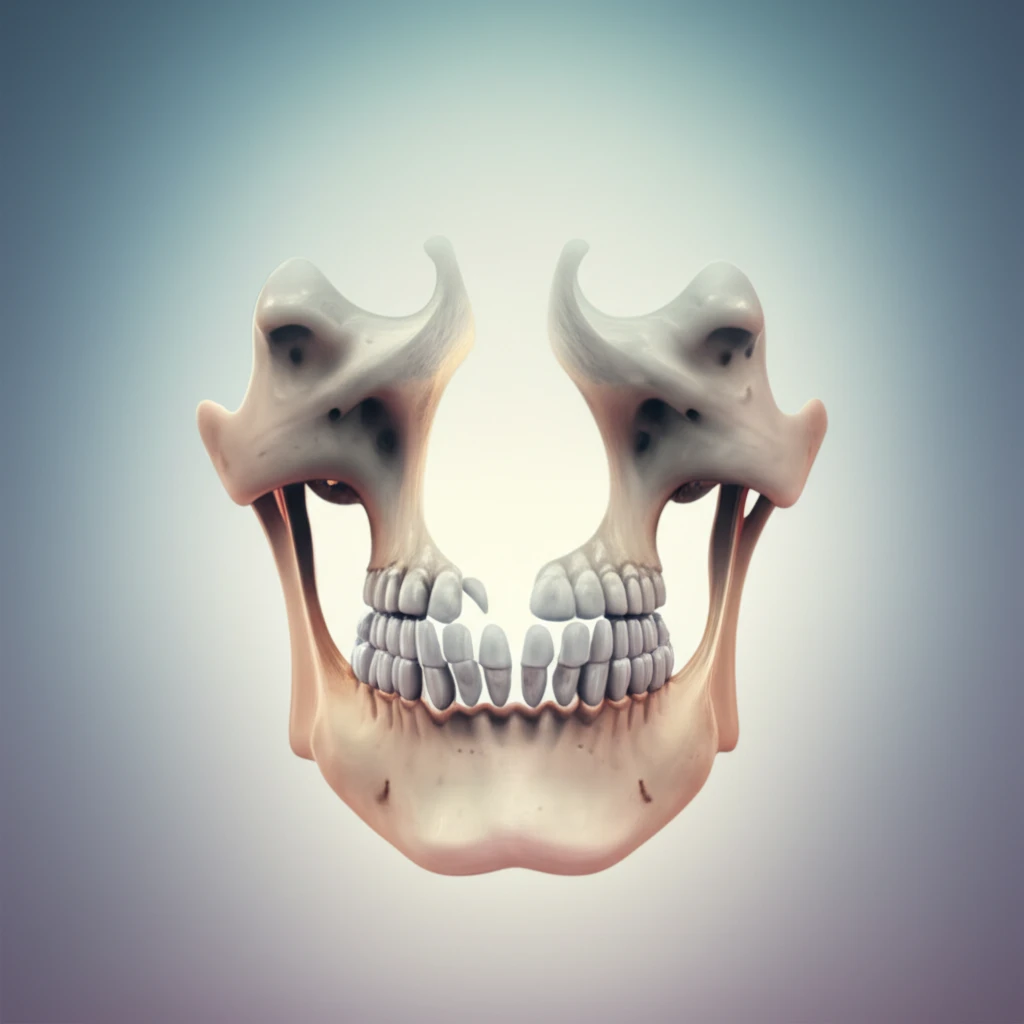
Illustration of a jaw bone with a bifid mandibular condyle

Bifid Mandibular Condyle: What Does a Split Jaw Bone Mean For Your Health?

"Uncover the prevalence and impact of bifid mandibular condyles (BMCs) on temporomandibular joint (TMJ) health. A deep dive into symptoms, diagnosis, and management of this rare anomaly."


A bifid mandibular condyle (BMC) is an uncommon anatomical variation where the mandibular condyle, the bony knob at the end of your jaw that fits into the temporomandibular joint (TMJ), is split into two parts. This condition, first identified in 1941, is usually discovered incidentally during routine radiographic examinations, often showing no immediate symptoms.

With the rise of advanced imaging technologies like cone-beam computed tomography (CBCT), the detection of BMCs has increased. CBCT scans provide a detailed three-dimensional view of the jaw, enabling healthcare professionals to identify and assess anomalies like BMCs with greater precision. But what does it mean if you have a bifid mandibular condyle, and should you be concerned?

This article aims to explore BMCs, drawing from a study assessing their prevalence and impact on TMJ health in both asymptomatic and symptomatic individuals. We'll delve into the potential causes, diagnostic methods, and whether this anatomical variation leads to TMJ-related issues.

Decoding Bifid Mandibular Condyles: Prevalence and Potential Impact

Illustration of a jaw bone with a bifid mandibular condyle

A recent study analyzed CBCT images from 7,424 patients, including both those with TMJ symptoms (like pain or clicking) and those without. The goal was to determine how common BMCs are and whether they correlate with TMJ problems. The study revealed that 0.50% of the patients had BMCs, with a similar prevalence in both symptomatic and asymptomatic groups.

Specifically, 15 out of 3,046 asymptomatic patients (0.49%) and 22 out of 4,378 symptomatic patients (0.50%) were found to have BMCs. This suggests that the presence of a BMC doesn't automatically lead to TMJ issues. Among those with BMCs, most had the condition on one side of the jaw (unilateral BMC).

  • Symptomatic Group: Consisted of individuals experiencing TMJ-related discomfort or functional issues.
  • Asymptomatic Group: Showed no clinical signs or symptoms of TMJ disorder.
  • CBCT Imaging: A high-resolution imaging technique used to visualize the condyles and assess their structure.
The study also investigated whether BMCs were associated with specific clinical features like pain, noise (clicking or crepitation), or changes in the bone structure of the condyle. Interestingly, the presence of BMC was not significantly linked to pain or noise. However, osteophytes (bony spurs) were more frequently observed on the normally shaped condyle side in symptomatic patients. This could suggest that typical biomechanical stress on the joint leads to osteophyte formation rather than BMC themselves directly causing these changes.

Key Takeaways: BMCs and Your TMJ Health

The research indicates that bifid mandibular condyles are often incidental findings, meaning they're discovered during imaging for other reasons and don't necessarily cause TMJ problems. While the presence of a BMC might sound alarming, it's not automatically a cause for concern.

If you're experiencing TMJ symptoms, the study suggests that the BMC itself might not be the primary culprit. Other factors, such as biomechanical stress or underlying joint conditions, could be more relevant. Further evaluation and personalized management strategies are essential to address the root cause of TMJ issues.

With advancements in imaging technology, anomalies like BMCs are more easily detected. This awareness helps healthcare professionals provide accurate diagnoses and guide appropriate management strategies. If you have concerns about your TMJ health or have been diagnosed with a BMC, consulting with an oral and maxillofacial radiologist or TMJ specialist is crucial for comprehensive evaluation and care.

About this Article -

This article was crafted using a human-AI hybrid and collaborative approach. AI assisted our team with initial drafting, research insights, identifying key questions, and image generation. Our human editors guided topic selection, defined the angle, structured the content, ensured factual accuracy and relevance, refined the tone, and conducted thorough editing to deliver helpful, high-quality information.See our About page for more information.

This article is based on research published under:

DOI-LINK: 10.5624/isd.2013.43.1.25, Alternate LINK

Title: Nontraumatic Bifid Mandibular Condyles In Asymptomatic And Symptomatic Temporomandibular Joint Subjects

Subject: Radiology, Nuclear Medicine and imaging

Journal: Imaging Science in Dentistry

Publisher: Korean Academy of Oral and Maxillofacial Radiology

Authors: Bong-Hae Cho, Yun-Hoa Jung

Published: 2013-01-01

Everything You Need To Know

1

What exactly is a bifid mandibular condyle, and why is it important?

A bifid mandibular condyle (BMC) is a rare anatomical variation where the mandibular condyle, the bony knob at the end of the jaw that fits into the temporomandibular joint (TMJ), is split into two parts. Its significance lies in its potential impact on TMJ health. While many people with BMCs experience no symptoms, the presence of this anomaly can be a factor in TMJ disorders for some individuals. The implications of having a BMC include the need for careful assessment and monitoring, especially if TMJ symptoms develop. Diagnosis often involves advanced imaging techniques like cone-beam computed tomography (CBCT), which provides a detailed view of the jaw's structure. The discovery of a BMC may prompt further investigation to rule out any underlying TMJ issues.

2

How common are bifid mandibular condyles?

The prevalence of bifid mandibular condyles (BMCs) was assessed in a study that analyzed cone-beam computed tomography (CBCT) images from 7,424 patients. The study revealed that 0.50% of the patients had BMCs. This means that in a large population, a small percentage of individuals may have this condition. The importance of this prevalence data lies in understanding how common BMCs are within the general population and whether they correlate with temporomandibular joint (TMJ) problems. The implications are that healthcare professionals can be more aware of the likelihood of encountering BMCs during radiographic examinations and can use this information to better interpret imaging results and guide patient care.

3

How are bifid mandibular condyles diagnosed, and why is this method important?

Advanced imaging techniques, particularly cone-beam computed tomography (CBCT), are crucial in diagnosing bifid mandibular condyles (BMCs). CBCT provides a detailed three-dimensional view of the jaw, allowing healthcare professionals to identify and assess anomalies like BMCs with greater precision than traditional radiographic methods. This is important because BMCs can be difficult to detect without such advanced imaging. The implications of using CBCT include more accurate diagnoses, better assessment of TMJ health, and the ability to rule out other potential causes of symptoms. These advanced imaging techniques allow for a clearer understanding of the condition of the temporomandibular joint (TMJ) and surrounding structures.

4

Do bifid mandibular condyles always cause problems like pain or clicking?

The study investigated the association between bifid mandibular condyles (BMCs) and temporomandibular joint (TMJ) symptoms, such as pain and clicking. Interestingly, the presence of BMCs was not significantly linked to pain or noise. The significance of this finding is that the mere presence of a BMC doesn't automatically mean a person will experience TMJ-related problems. The implications suggest that other factors, like biomechanical stress on the joint, may be more directly involved in causing symptoms, and that BMCs are often incidental findings. The asymptomatic group showed no clinical signs or symptoms of TMJ disorder, while the symptomatic group consisted of individuals experiencing TMJ-related discomfort or functional issues.

5

What are the main things to know about bifid mandibular condyles and their impact on TMJ health?

The key takeaways are that bifid mandibular condyles (BMCs) are often incidental findings, meaning they are discovered during imaging for other reasons and don't necessarily cause temporomandibular joint (TMJ) problems. This means that the presence of a BMC, while an anatomical variation, may not lead to any clinical symptoms or require specific treatment. The significance here is in setting patient expectations and avoiding unnecessary concern. The implications are that patients with BMCs should undergo a thorough evaluation, with potential monitoring of their TMJ health, and that the focus should be on managing any existing TMJ symptoms rather than treating the BMC itself. Moreover, osteophytes (bony spurs) were more frequently observed on the normally shaped condyle side in symptomatic patients, implying that biomechanical stress on the joint leads to osteophyte formation rather than BMCs directly causing these changes.

Newsletter Subscribe

Subscribe to get the latest articles and insights directly in your inbox.