
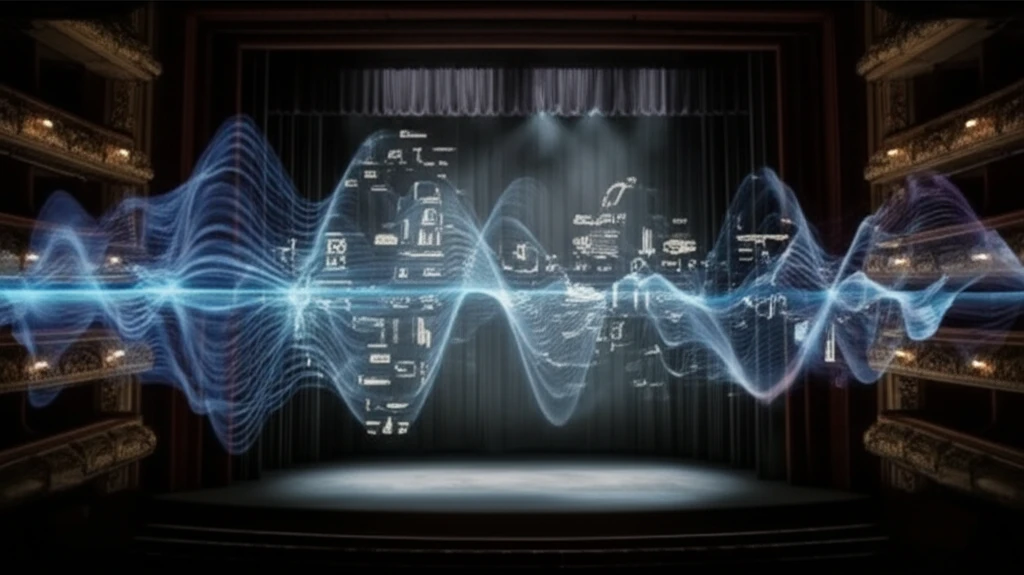
Surreal illustration of sound waves becoming hieroglyphs on a stage.

Beyond Words: How Avant-Garde Theatre Pioneers the Semiotics of Sound

"Explore the revolutionary legacy of Artaud and Böhme, where sound transcends traditional signs, creating immersive and affective theatrical experiences."


For centuries, theatre has predominantly relied on the spoken word, with sound playing a supporting role. However, a revolution has been brewing in the world of avant-garde theatre, challenging this established hierarchy. This movement recognizes sound not merely as an accompaniment, but as a primary element capable of conveying meaning, emotion, and atmosphere in ways that words simply cannot.

This shift places sound at the forefront of theatrical experiences, inviting audiences to engage with performances on a deeper, more visceral level. It encourages a semiotic understanding of sound, where its materiality and inherent qualities become the carriers of meaning, moving beyond traditional notions of signifiers and signifieds. The legacy of Antonin Artaud and the theories of Gernot Böhme serve as cornerstones for this exploration, providing frameworks for understanding how sound can create immersive and transformative theatrical moments.

This article delves into how avant-garde theatre pioneers the semiotics of sound, exploring the concepts of Artaud's 'hieroglyphic language' and Böhme's 'aesthetics of atmosphere.' We will examine how these revolutionary ideas transform the theatrical landscape, creating performances that resonate with audiences on a profoundly emotional and sensory level.

Artaud's Hieroglyphic Language: Sound as Raw Expression

Surreal illustration of sound waves becoming hieroglyphs on a stage.

Antonin Artaud, a towering figure in 20th-century theatre, vehemently rejected the dominance of text, seeking to liberate sound from its subservient role. He envisioned a 'theatre of cruelty' where sound, in its rawest form, becomes a primary means of expression. Artaud sought to create a visceral experience, bypassing intellectual understanding and directly impacting the audience's senses.

Artaud’s concept of 'hieroglyphic language' is central to his approach. He described it as 'language in space, language of sounds, of cries, of lights, of onomatopoeia,' arguing that theatre should 'organize veritable hieroglyphs with characters and objects.' This means using sound, gesture, and visual elements not to represent something else, but to be expressive in themselves. For Artaud, a cry, a gesture, or a sound could carry as much weight as a line of dialogue, resonating directly with the audience's subconscious.

  • Breaking the Chains of Text: Artaud challenged the idea that theatre must be dictated by a script, advocating for improvisation and spontaneity.
  • Sound as Sensation: He prioritized the physical impact of sound, aiming to create a sensory overload that would shatter conventional theatrical experiences.
  • The Body as Instrument: Artaud emphasized the performer's physical and vocal presence, transforming the body into an instrument of raw expression.
Artaud's influence can be seen in contemporary performances that prioritize sound and physicality over narrative. The Living Theatre's production of 'The Brig,' for instance, used repetitive sounds and movements to create a visceral and unsettling experience, reflecting Artaud's vision of a theatre that shocks and transforms.

Aural Semiosis and the Future of Theatre

The exploration of sound in avant-garde theatre opens exciting possibilities for the future of performance. By moving beyond traditional semiotics and embracing the materiality of sound, theatre can create deeply immersive and affective experiences. The legacies of Artaud and Böhme provide a rich foundation for exploring these new sonic landscapes, inviting audiences to engage with theatre on a more profound and sensory level. As theatre continues to evolve, the semiotics of sound will undoubtedly play an increasingly important role in shaping its future, transforming how stories are told and experienced.

About this Article -

This article was crafted using a human-AI hybrid and collaborative approach. AI assisted our team with initial drafting, research insights, identifying key questions, and image generation. Our human editors guided topic selection, defined the angle, structured the content, ensured factual accuracy and relevance, refined the tone, and conducted thorough editing to deliver helpful, high-quality information.See our About page for more information.

This article is based on research published under:

DOI-LINK: 10.7202/1051070ar, Alternate LINK

Title: Artaud’S Hyeroglyphic Sign And Böhme’S Aesthetics Of Atmosphere: The Semiotic Legacy Of The Avant-Garde’S Recognition Of The Materiality Of Sound

Subject: General Medicine

Journal: Recherches sémiotiques

Publisher: Consortium Erudit

Authors: Mladen Ovadija

Published: 2018-08-31

Everything You Need To Know

1

What exactly is Antonin Artaud's 'hieroglyphic language' and how does it function?

The 'hieroglyphic language' developed by Antonin Artaud is a method of using sound, gesture, and visuals as expressive elements in themselves, rather than representing something else. It moves beyond traditional semiotics, where the meaning of a sign is derived from its relationship to a signified concept. Artaud believed that sounds like cries, or gestures could carry as much weight as dialogue, directly impacting an audience's subconscious. This concept aims to create a visceral experience that bypasses intellectual understanding, impacting the audience's senses directly.

2

Why are the ideas of Antonin Artaud so important in the context of this theatrical movement?

Antonin Artaud’s ideas are important because he challenged the traditional dominance of the spoken word in theatre. His 'hieroglyphic language' prioritized the raw expression of sound and physicality, advocating for improvisation. This approach breaks the chains of text-driven theatre, prioritizing sound as a primary element. His work created a sensory overload that would shatter conventional theatrical experiences and transform the body into an instrument of raw expression, changing the way stories are told and experienced.

3

How does avant-garde theatre use sound to enhance the audience experience?

Avant-garde theatre uses sound to create immersive experiences. Sound is not just an accompaniment but a primary element that conveys meaning and emotion in ways that words cannot. This involves a semiotic understanding of sound, where its material qualities become carriers of meaning, moving beyond traditional signifiers and signifieds. By prioritizing sound, theatre can create deeply immersive and affective experiences, inviting audiences to engage on a more profound and sensory level.

4

Can you provide an example of how Artaud’s ideas have been put into practice in a specific performance?

Antonin Artaud’s work focused on prioritizing sound and physicality over narrative. He sought to create a visceral experience and challenged the dominance of text. An example of this is 'The Brig' by The Living Theatre which used repetitive sounds and movements to create a visceral and unsettling experience, reflecting Artaud's vision. The focus on sound and physicality allowed for a new form of storytelling, where sound and movement became the main tools for expression.

5

What does the future hold for theatre, given these new approaches to sound?

The exploration of sound in avant-garde theatre suggests exciting possibilities for the future of performance. By embracing the materiality of sound and moving beyond traditional semiotics, theatre can create deeply immersive and affective experiences. The legacies of Antonin Artaud and Gernot Böhme provide a foundation for exploring new sonic landscapes, inviting audiences to engage on a more sensory level. As theatre continues to evolve, the semiotics of sound will undoubtedly play an increasingly important role in shaping its future.

Newsletter Subscribe

Subscribe to get the latest articles and insights directly in your inbox.