
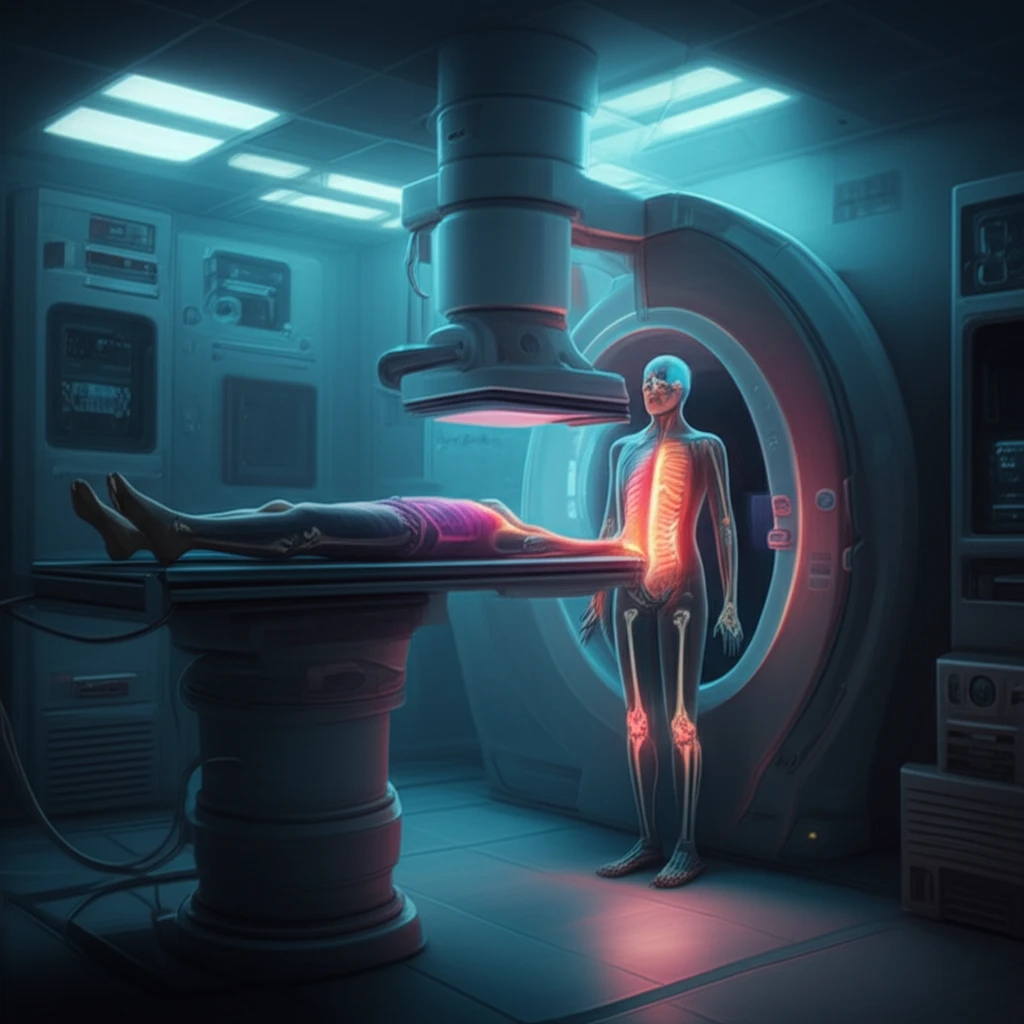
Beyond the Surface: How Low-Dose X-Ray Diffraction Tomography is Changing Medical Imaging

"Discover how interior X-ray diffraction tomography (XDT) combined with low-resolution exterior data enhances medical and industrial imaging, offering faster scans and reduced radiation."
Imagine peering inside an object to understand its composition without fully exposing it to harsh radiation. X-ray diffraction tomography (XDT) makes this possible, resolving the internal structures of materials in ways that conventional CT scans can’t. However, XDT faces challenges, particularly with long imaging times due to the weak signals it captures.
Researchers are constantly seeking ways to refine XDT, making it faster and more efficient. A significant hurdle involves the need to scan the entire object, even when the area of interest is just a small region within. Scanning the complete object can lead to unnecessary radiation exposure and prolonged scan times, especially critical in medical and industrial applications where speed and safety are paramount.
A recent study introduces an innovative approach that combines interior XDT with low-resolution exterior information. This method focuses on scanning only the region of interest while using limited external data to enhance the accuracy of the internal reconstruction. This technique not only reduces radiation exposure and scan times but also maintains high-quality imaging, opening new possibilities for medical diagnostics and material analysis.
What is Interior X-Ray Diffraction Tomography (XDT)?
X-ray diffraction tomography (XDT) is an advanced imaging technique used to determine the structural properties of materials at a microscopic level. Unlike standard X-ray CT scans that show the density of a material, XDT reveals its crystalline structure and composition by analyzing how X-rays diffract when they pass through the object. This makes XDT particularly useful for identifying different materials and their arrangement within a sample.
- Reduced Scanning Time: By focusing on a region of interest, the time required for scanning is significantly reduced.
- Lower Radiation Exposure: Scanning only the necessary area decreases the overall radiation exposure to the sample.
- Comparable Material Specificity: Provides material-specific information similar to a full XDT scan but more efficiently.
Future of Quasi-Interior XDT
The development of quasi-interior XDT represents a significant step forward in imaging technology, offering a pathway to faster, safer, and more efficient scans. The integration of photon-counting detectors promises to further reduce imaging times, making it a viable option for real-time applications. As the technology evolves, it holds great potential for various fields, including medical diagnostics, materials science, and industrial quality control, providing detailed insights into the structure and composition of objects with minimal intervention.