
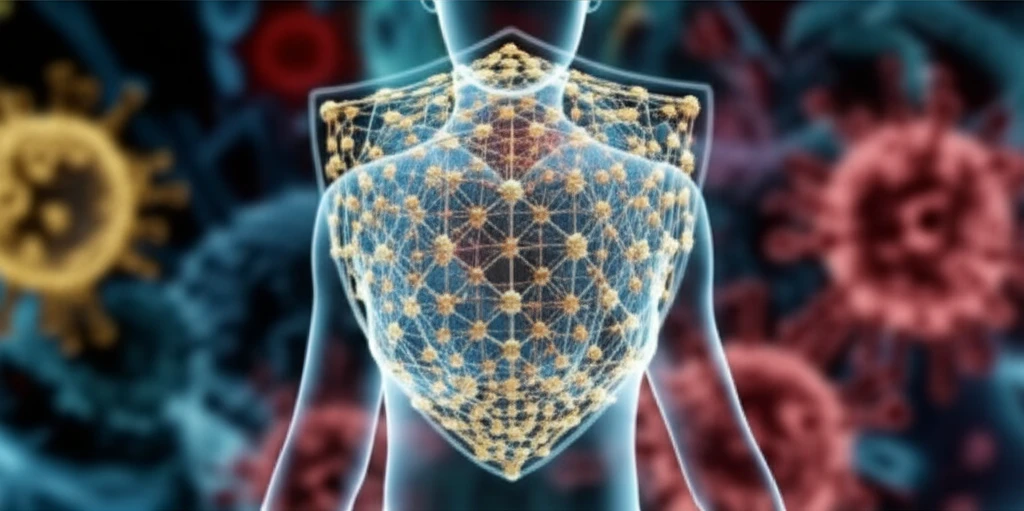
Nanoparticle vaccine shield against influenza.

Beyond the Shot: A New Universal Flu Vaccine on the Horizon?

"Could nanoparticle technology offer broader, longer-lasting protection against evolving influenza strains?"


Every year, the influenza virus poses a significant threat to global health and the economy, causing widespread illness and fatalities. Current inactivated influenza vaccines (IIVs) often fall short due to their narrow, strain-specific immune responses, leaving populations vulnerable to emerging viral mutations. That's why the search for vaccines with higher effectiveness, longer duration, and broader protection is crucial.

The key to defending against the flu lies in neutralizing antibodies, particularly those targeting the hemagglutinin (HA) protein on the virus's surface. While current vaccines primarily target the highly variable head region of HA, innovative research is exploring ways to induce responses against more conserved regions, like the HA stem, which could offer broader protection against diverse influenza strains.

Now, a groundbreaking study by Smith et al. introduces a novel seasonal recombinant HA nanoparticle influenza vaccine (NIV) formulated with Matrix-MTM, a saponin-based adjuvant. This vaccine is showing great potential in inducing strong antibody responses against a wide range of influenza A(H3N2) subtypes. Could this be the next generation of flu vaccines?

How Does This New Nanoparticle Vaccine Work?

Nanoparticle vaccine shield against influenza.

The novel vaccine uses hemagglutinin (HA) nanoparticles. These nanoparticles are created using the HA protein of seasonal influenza strains which are recommended by WHO for the year.

Here's a breakdown of the key components and how they contribute to the vaccine's potential:

  • Recombinant Hemagglutinin (HA) Nanoparticles: These nanoparticles are designed to present the influenza virus's HA protein in a way that maximizes immune recognition.
  • Matrix-MTM Adjuvant: This saponin-based adjuvant boosts the immune response by activating immune cells, facilitating antigen delivery to antigen-presenting cells, and enhancing antigen presentation through both MHC I and II molecules.
  • Broadened Immune Response: Unlike traditional vaccines that primarily target the HA head region, this vaccine aims to stimulate responses to conserved epitopes in both the HA head and stem regions.
The study compared the NIV to standard and high-dose inactivated influenza vaccines (IIV and IIV-HD) in ferrets. The results were encouraging. The NIV vaccine elicited significantly higher hemagglutination inhibition (HAI) and microneutralizing (MN) antibody responses compared to IIV-HD, offering a broader spectrum of protection against various influenza A(H3N2) subtypes.

The Future of Flu Vaccines

While these findings are promising, further research is needed to confirm the safety and efficacy of this novel vaccine in humans. However, the results suggest that NIV with Matrix-MTM adjuvant has the potential to provide broader and more durable protection against influenza, potentially reducing the impact of seasonal epidemics and offering a more effective defense against emerging viral threats. A universal flu vaccine might finally be within reach.

About this Article -

This article was crafted using a human-AI hybrid and collaborative approach. AI assisted our team with initial drafting, research insights, identifying key questions, and image generation. Our human editors guided topic selection, defined the angle, structured the content, ensured factual accuracy and relevance, refined the tone, and conducted thorough editing to deliver helpful, high-quality information.See our About page for more information.

This article is based on research published under:

DOI-LINK: 10.1016/j.vaccine.2017.08.021, Alternate LINK

Title: Novel Hemagglutinin Nanoparticle Influenza Vaccine With Matrix-M™ Adjuvant Induces Hemagglutination Inhibition, Neutralizing, And Protective Responses In Ferrets Against Homologous And Drifted A(H3N2) Subtypes

Subject: Infectious Diseases

Journal: Vaccine

Publisher: Elsevier BV

Authors: Gale Smith, Ye Liu, David Flyer, Michael J. Massare, Bin Zhou, Nita Patel, Larry Ellingsworth, Maggie Lewis, James F. Cummings, Greg Glenn

Published: 2017-09-01

Everything You Need To Know

1

How does the new vaccine work, and what are its key components?

The novel vaccine utilizes Recombinant Hemagglutinin (HA) Nanoparticles, which are designed to present the influenza virus's HA protein to the immune system in a way that maximizes immune recognition. This is combined with a Matrix-MTM Adjuvant, which is a saponin-based substance that boosts the immune response by activating immune cells, facilitating antigen delivery, and enhancing antigen presentation. Together, these components stimulate a broadened immune response, not only targeting the HA head region but also the conserved HA stem regions, leading to broader protection.

2

What is the main difference between this new vaccine and traditional flu vaccines?

The primary difference lies in the immune response. Traditional inactivated influenza vaccines (IIVs) primarily target the highly variable head region of the Hemagglutinin (HA) protein, which means they offer limited protection against new viral strains. The novel Nanoparticle Influenza Vaccine (NIV) aims to stimulate responses against more conserved regions of the HA protein, like the HA stem. Because the stem region is less prone to mutation, this approach could offer broader protection against diverse influenza strains. The inclusion of the Matrix-MTM adjuvant also enhances the immune response, leading to higher antibody production.

3

What are the benefits of the new vaccine, and why is this important?

The key advantage is broader protection. Current inactivated influenza vaccines often struggle to keep up with the rapidly evolving influenza virus. The new vaccine, by targeting conserved regions like the HA stem, has the potential to provide protection against a wider range of influenza strains. This is significant because it could reduce the need for frequent vaccine updates and offer better defense against both seasonal epidemics and emerging viral threats. If successful, the Nanoparticle Influenza Vaccine (NIV) could substantially reduce the global health and economic burden of influenza.

4

What is the role of the Hemagglutinin (HA) protein in this context?

The Hemagglutinin (HA) protein is a crucial surface protein of the influenza virus, essential for viral entry into host cells. Traditional vaccines often target the HA head region, which is highly variable and prone to mutations. The novel vaccine focuses on stimulating responses against more conserved regions, specifically the HA stem. The HA stem region is less susceptible to mutation, making it a better target for a broadly protective vaccine. The vaccine uses Recombinant Hemagglutinin (HA) Nanoparticles to present the HA protein in a way that maximizes immune recognition, and the Matrix-MTM adjuvant enhances the immune response.

5

What is the role of the Matrix-MTM adjuvant in the new vaccine?

The Matrix-MTM adjuvant is a saponin-based substance included in the novel vaccine to enhance the immune response. Adjuvants are substances that boost the effectiveness of vaccines. Matrix-MTM works by activating immune cells, helping deliver the antigen to antigen-presenting cells, and improving antigen presentation through both MHC I and II molecules. This leads to a stronger and more durable antibody response, contributing to the broader protection observed with the Nanoparticle Influenza Vaccine (NIV). It's important because a robust immune response is crucial for effectively combating influenza.

Newsletter Subscribe

Subscribe to get the latest articles and insights directly in your inbox.