
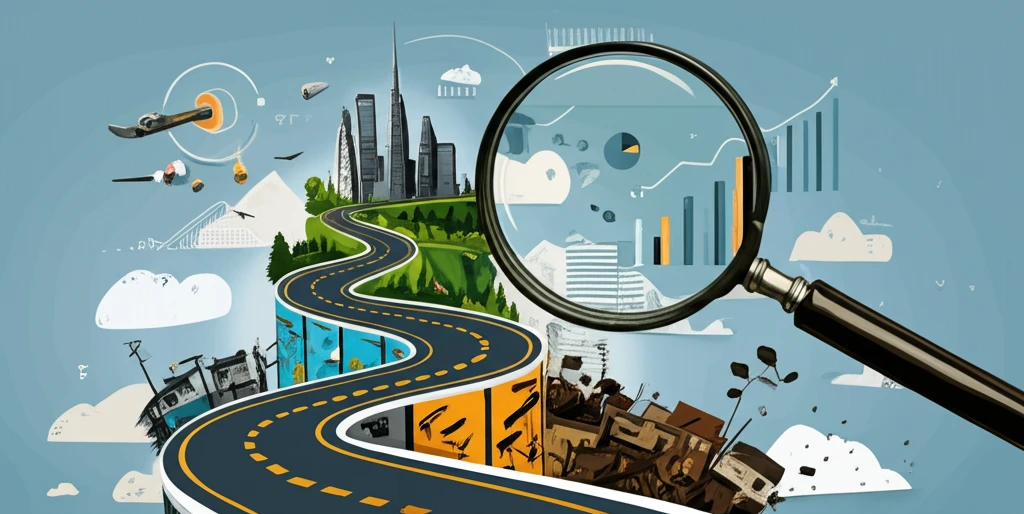
A surreal cityscape showing economic inequality, visualized through a winding road and contrasting wealth levels.

Beyond the Numbers: Visualizing Economic Inequality in the 21st Century

"New research unveils innovative ways to understand wealth disparities, offering fresh perspectives and tools for policymakers and everyday citizens alike."


Economic inequality is one of the defining challenges of our time. From debates about fair wages to discussions on wealth taxes, the issue of who gets what—and why—is constantly in the headlines. But beyond the statistics and policy jargon, understanding the true shape and scope of inequality can feel abstract and distant.

Traditional tools like the Lorenz curve and Gini coefficient have long been the standard for measuring income and wealth distribution. However, these methods often fall short in capturing the complexities of modern, multi-dimensional inequality. What happens when we consider not just income, but also wealth, access to healthcare, and other critical resources? How do we account for the ways these factors intersect and compound to create deeper disparities?

Enter a new wave of research that’s transforming how we visualize and analyze inequality. This article dives into a groundbreaking study that proposes a ‘vector Lorenz map’—a sophisticated tool designed to provide a more nuanced and comprehensive picture of economic disparities. We'll explore how this method works, what insights it reveals, and why it matters for creating a more equitable society.

Decoding the Vector Lorenz Map: A New Lens on Inequality

A surreal cityscape showing economic inequality, visualized through a winding road and contrasting wealth levels.

The traditional Lorenz curve, introduced over a century ago, plots the cumulative share of income held by a given percentage of the population. While useful, it primarily focuses on a single resource. The vector Lorenz map, however, extends this concept to multiple resources, offering a more complete view of economic well-being.

Imagine a society where some individuals have high incomes but little wealth, while others possess substantial assets but struggle with day-to-day expenses. A vector Lorenz map can capture these nuances, revealing how different resources are distributed across the population and highlighting potential vulnerabilities that might be missed by traditional measures.

  • Multi-dimensional Analysis: Examines the distribution of multiple resources (income, wealth, healthcare access, etc.) simultaneously.
  • Optimal Transport Theory: Leverages advanced mathematical techniques to rearrange and compare distributions.
  • Inequality Aversion: Reflects the preferences of social planners who prioritize reducing disparities across multiple dimensions.
By integrating these elements, the vector Lorenz map provides a powerful framework for assessing the fairness and equity of resource allocation. It allows us to move beyond simple averages and delve into the intricate patterns of wealth and well-being that shape individual lives.

From Theory to Action: Implications for a Fairer Future

The vector Lorenz map is more than just an academic exercise. It offers practical tools for policymakers and citizens alike to better understand and address economic inequality. By visualizing the distribution of multiple resources, it can help identify vulnerable populations, evaluate the impact of policy interventions, and promote a more equitable allocation of resources. As we move forward, embracing these innovative approaches will be essential for building a society where everyone has the opportunity to thrive.

About this Article -

This article was crafted using a human-AI hybrid and collaborative approach. AI assisted our team with initial drafting, research insights, identifying key questions, and image generation. Our human editors guided topic selection, defined the angle, structured the content, ensured factual accuracy and relevance, refined the tone, and conducted thorough editing to deliver helpful, high-quality information.See our About page for more information.

This article is based on research published under:

DOI-LINK: https://doi.org/10.48550/arXiv.2203.09,

Title: Lorenz Map, Inequality Ordering And Curves Based On Multidimensional Rearrangements

Subject: econ.em stat.me

Authors: Yanqin Fan, Marc Henry, Brendan Pass, Jorge A. Rivero

Published: 16-03-2022

Everything You Need To Know

1

What is the primary limitation of the traditional Lorenz curve and Gini coefficient in assessing economic disparities?

The traditional tools like the 'Lorenz curve' and 'Gini coefficient' are limited because they primarily focus on a single resource, such as income or wealth. They often fall short in capturing the complexities of modern, multi-dimensional inequality. These traditional methods do not account for other critical resources like access to healthcare or how various factors intersect to create deeper disparities. The 'vector Lorenz map' addresses these limitations by analyzing multiple resources simultaneously.

2

How does the 'vector Lorenz map' enhance our understanding of economic inequality compared to the traditional 'Lorenz curve'?

The 'vector Lorenz map' extends the concept of the 'Lorenz curve' to multiple resources, offering a more comprehensive view of economic well-being. Unlike the traditional 'Lorenz curve,' which focuses on a single dimension, the 'vector Lorenz map' examines the distribution of multiple resources simultaneously, such as income, wealth, and access to healthcare. It uses advanced techniques like 'optimal transport theory' and considers 'inequality aversion' to provide a nuanced picture of how different resources are distributed across the population, revealing potential vulnerabilities and complexities that might be missed by the traditional measures.

3

What is the significance of using 'optimal transport theory' within the 'vector Lorenz map' framework?

'Optimal transport theory' is a crucial element within the 'vector Lorenz map' because it allows for the sophisticated rearrangement and comparison of resource distributions. This theory provides the mathematical framework to analyze how resources are allocated across different segments of the population. By leveraging 'optimal transport theory', the 'vector Lorenz map' can offer a more precise and detailed understanding of the existing disparities. It helps to identify inefficiencies in resource allocation and evaluate the effects of potential policy interventions.

4

In practical terms, how can the 'vector Lorenz map' be utilized to create a fairer future?

The 'vector Lorenz map' provides practical tools for policymakers and citizens to better understand and address economic inequality. By visualizing the distribution of multiple resources, it can help identify vulnerable populations who may lack access to crucial resources like healthcare or have lower incomes. Policymakers can use this tool to evaluate the impact of policy interventions aimed at reducing disparities. This can lead to more equitable resource allocation by pinpointing areas where resources are lacking and ensuring a fairer distribution of wealth and opportunities, thereby promoting a society where everyone has a chance to thrive.

5

How does the 'inequality aversion' aspect influence the application and interpretation of the 'vector Lorenz map'?

The integration of 'inequality aversion' in the 'vector Lorenz map' reflects the preferences of social planners who prioritize reducing disparities across multiple dimensions. This aspect ensures that the analysis not only identifies inequalities but also considers the value of equity and fairness in resource allocation. By incorporating 'inequality aversion', the 'vector Lorenz map' goes beyond simple measurements of inequality. It provides a framework for assessing the fairness of resource distribution and evaluating policies based on their potential to reduce disparities, thereby promoting a more equitable and just society where all members have the opportunity to flourish.

Newsletter Subscribe

Subscribe to get the latest articles and insights directly in your inbox.