
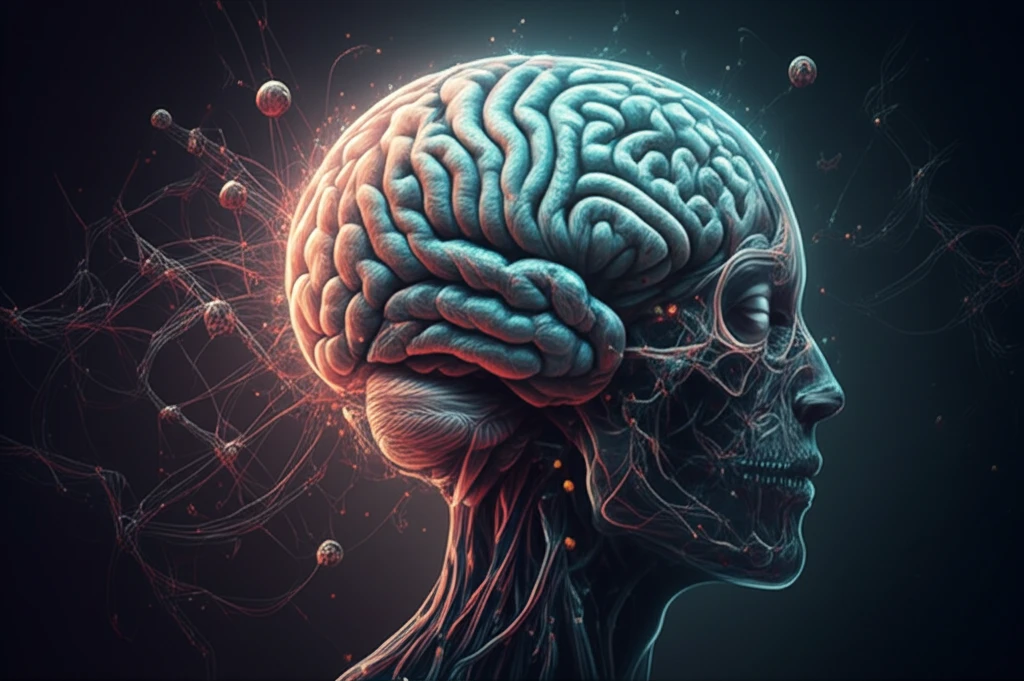
Beyond the Mirror: Unlocking the Neuroscience of Body Image

"Discover how brain imaging is revolutionizing our understanding of body image and its impact on eating disorders, offering new paths to treatment and self-acceptance."
For decades, body image has been understood through psychology and sociology, focusing on societal pressures and individual experiences. However, neuroscience is now offering a new lens through which to understand body image: the brain. Groundbreaking research using advanced brain imaging techniques is uncovering the intricate neural pathways that shape how we perceive our bodies. This opens doors to potentially revolutionary treatments for body image disorders.
Eating disorders like anorexia nervosa and bulimia nervosa are intimately linked to distorted body image. Individuals with these conditions often struggle with an inaccurate perception of their body size and shape, leading to immense distress and harmful behaviors. Brain imaging studies are now pinpointing the specific areas and networks in the brain that contribute to these distortions, paving the way for targeted interventions.
This article delves into the fascinating world of neuroscience and body image, exploring the key brain regions involved, the impact of eating disorders on brain structure and function, and the potential for innovative treatments. We'll break down complex research into accessible insights, offering a comprehensive overview for anyone interested in understanding the science behind body image.
The Statistics Behind Self-Perception
Body image is a complex construct, often used in the clinical context of describing a patient's cognitive perception of their own body. Understanding how this perception forms has become increasingly statistical in nature. The Simons Foundation reports that many of the big questions in neuroscience are statistical questions in disguise, from what information is encoded in neural populations to how cell types are defined. Statistical research programs, such as the Neuroscience Statistics Research Lab at MIT, train students at the intersection of statistics and brain science, while examples like Dunbar's Number show how neuroscience combined with statistics can produce theories that withstand repeated challenges.
Measuring the Body Image Approach
The Body Image Approach Task (BIAT) is a standard method in which participants view photos of their own body and a matched control body by zooming the images closer toward them on a screen. Touchscreen-based measures have also been developed to assess approach-avoidance tendencies in body image, though the current evidence is restricted to undergraduate women, a clear limitation for generalization. Body image itself is understood as the conscious mental representation of one's body. External pressures complicate this picture: girls and women are bombarded with images of so-called perfect bodies that are often unattainable without extreme weight control methods, and failure to achieve this ideal can lead to decreased self-esteem, feelings of unworthiness, or even an eating disorder.
From Nerve Studies to Brain Discoveries
Neuroscience's history contains milestones that remain relevant to today's questions. Foundational discoveries include Erlanger's pioneering work on nerve conduction velocity and its relationship to axon diameter. In the 1950s, Levi-Montalcini, Cohen, and Hamburger discovered the first neuronal trophic factor, nerve growth factor. Scholars argue that studying this history helps make the field relevant today, and recent developments, such as 2022 advances on the origins of multiple sclerosis and a potential new drug for Alzheimer's disease, build directly on that legacy.
The Body Image Brain: Key Regions and Networks
Our brains don't simply passively receive information about our bodies; they actively construct a representation of it. This construction involves a complex interplay of various brain regions, each contributing to different aspects of body image. Neuroimaging studies have identified several key players:
- Parietal Lobe: Is involved in integrating sensory information from various parts of the body and crucial for spatial awareness. The parietal lobe helps to create a cohesive sense of body ownership and position.
- Insula: Plays a key role in interoception, which is the awareness of internal bodily states like hunger, temperature, and heart rate. The insula connects these internal signals with emotions and self-awareness.
- Prefrontal Cortex: Is responsible for higher-level cognitive functions like self-evaluation and decision-making. It integrates information about the body with personal values and societal standards.
From Molecules to Lockdown Surveys
Recent work spans both molecular mechanisms and social context. Nature's computational neuroscience coverage reports that striatal endocannabinoids drive one-shot learning, with endocannabinoid-dependent corticostriatal plasticity underlying avoidance learning in mice after a single experience. At the social level, research reported by Neuroscience News suggests feminism may lead to better body image. During the lockdown period, a UK online survey (n = 264) found large individual differences in perceived changes in eating, exercise, and body image, with psychology outlets continuing to track body image and body dysmorphia research.
The Field's Open Questions
Critics of cognitive neuroscience point to unresolved fundamental problems, including the binding problem, questions of localization, the relationship between differentiation and integration in the brain, and troubles created by brain imaging. The field is also marked by an ongoing tension between optimism and skepticism. Neuroscientists argue that research must test both statistical and scientific hypotheses, noting that effect size is critical for calculating statistical power and that variability in effect sizes is sometimes overlooked by critics. These methodological debates matter for body image research, which spans psychological, historical, sociological, and neuroscientific perspectives that are not always easily reconciled.
Cross-Species and Cross-Disciplinary Lenses
Comparative neuroscience investigates patterns of brain organization across a large range of species, ideally focusing on aspects of brain organization with plausible behavioral correlates that allow an explanation of their causes, and magnetic resonance imaging has become a key tool for such cross-species work. Within the broader field, neuroscience studies how the brain and nervous system work at every level, from molecules to behavior, while neuropsychology is a branch focused specifically on how brain function and dysfunction affect cognition and behavior. Resources such as the OpenStax textbook Introduction to Behavioral Neuroscience illustrate how the discipline standardizes its educational foundations.
A Future Shaped by Neuroscience
Neuroimaging is not just about understanding the roots of body image issues. It's also revolutionizing treatment approaches. Cognitive-behavioral therapy (CBT) and other psychological interventions can be enhanced by understanding how they impact the brain. Furthermore, neurofeedback and transcranial magnetic stimulation (TMS) are being explored as potential tools to directly modulate brain activity in regions associated with body image distortion. While still in its early stages, this research holds immense promise for developing more effective and personalized treatments for eating disorders and body image concerns. The future of body image treatment lies in integrating neuroscience with traditional therapeutic approaches.
Plastic Brains and Expert Synthesis
Experts describe the human brain as plastic and malleable, a property that underlies the possibility of reshaping perception over time. According to Neuroscience News, a study published in BMC Pregnancy and Childbirth, led by academics from Anglia Ruskin University and the University of York, is thought to be the first meta-analysis comparing body image perception across two groups of women. Clinical research infrastructure is also advancing, with neuroscience trial management now incorporating precision motion monitoring and actigraphy solutions to ensure precise, reliable results. Together these developments reflect how expert commentary is translating neural principles into measurement and intervention.
Tech, AI, and the Next Decade
Looking ahead, predicted trends for neuroscience in 2025 center on technology, neuroplasticity, and neuroethics reshaping the way we understand the human mind. The growing collaboration between cognitive neuroscience and artificial intelligence is bridging the gap between understanding the human brain and replicating human-like intelligence, shaping the future of intelligent systems. These tools could generate new ways to study and intervene in perception, including the visual environments that shape body image. AI-driven image generation, for example, makes it easier than ever to produce the kinds of idealized imagery whose effects on body image researchers continue to investigate.
A Transdisciplinary Field With Public Health Stakes
Neuroscience is a fundamentally transdisciplinary field, encompassing molecular, cellular, developmental, systems, behavioral, cognitive, computational, integrative, translational, and clinical approaches, as reflected in the Journal of Neuroscience's author guidelines. The intersection of neuroscience and public health broadens the picture further: careers in this space study the social determinants of health and their impact on the brain, nervous system, and mental health. Fields such as neuropsychiatric epidemiology connect population-level factors to individual brain function. Body image research sits squarely at this intersection, linking social environments with neural and mental health outcomes.
Where Neuroscience Meets Lived Experience
Work at the meeting point of cognitive neuroscience and eating disorders examines constructs such as image schema, body shame, allocentric lock, and the role of autobiographical and episodic memory in distorted body experience. Eating disorders are described by clinicians as among the most resistant conditions in practice, underscoring the real-world stakes of body image research. Alongside neural mechanisms, cultural forces matter: mass media and reality television have been argued to exert dehumanizing effects in their depictions of body appearances and women. Together these perspectives show how perception, memory, and culture converge in lived experience.