
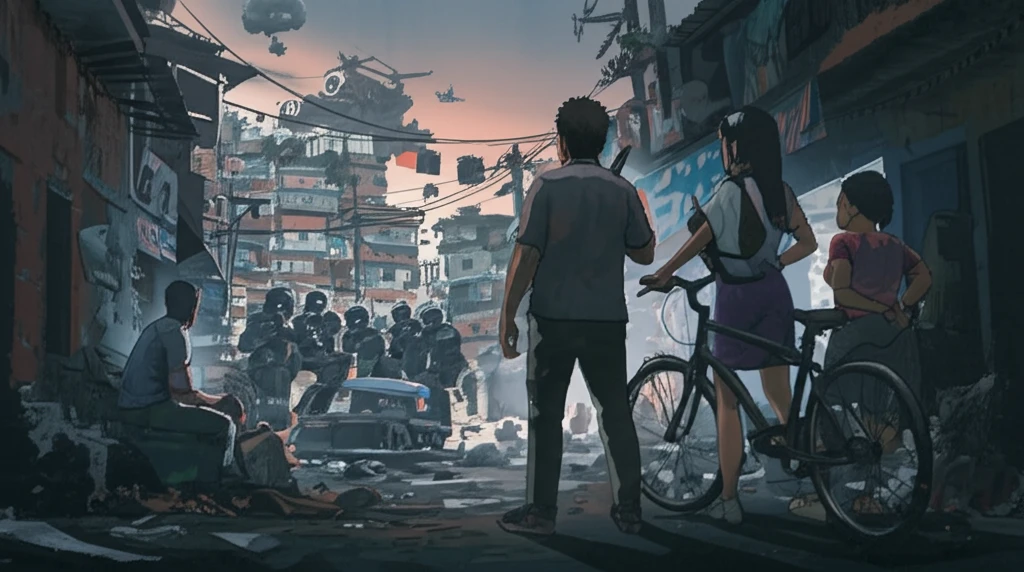
Beyond the Headlines: Unpacking the Impact of Pacification Policies on Precarious Communities

"A critical look at how security measures reshape social dynamics and territorial control in marginalized urban spaces."
In an increasingly interconnected world, the study of organizational spaces within their specific contexts is crucial for understanding the dynamics that shape our societies. Approaching these studies with a geographical perspective allows for a deeper analysis of organizational interactions, particularly in areas facing complex social and economic challenges.
One of the most pressing issues in urban management worldwide is the proliferation of informal settlements, often referred to as favelas. These areas, characterized by poverty and a lack of formal infrastructure, represent a significant challenge for urban planners and policymakers. While favelas often emerge as a solution to housing shortages for low-income populations, they also present a range of social and economic problems.
This article delves into the impact of pacification policies on favelas, focusing on the power dynamics and social transformations that occur when governmental interventions reshape these precarious organizational spaces. By examining the case of the Pacifying Police Units (UPPs) in Rio de Janeiro, we aim to uncover the hidden agendas and unintended consequences of these policies on the communities they are intended to serve.
A Sparse, Evolving Evidence Base
Independent, systematic data on the scale and effects of pacification policies on precarious communities remain limited, so current statistical claims should be read cautiously. Most available figures come from case-level reporting and administrative sources rather than from a robust peer-reviewed consensus, leaving measurement gaps across regions and time periods. Early evidence suggests outcomes vary widely depending on local implementation, community engagement, and policing context. Until more comparable data are collected and shared, broad numeric claims about these policies' impact should be treated as provisional rather than settled.
Curated Rankings and Their Built-In Biases
A widely used approach to understanding complex subjects is the curated list, which assembles expert opinions alongside community and market signals. The Goodreads 100, for example, blends highbrow literature with mainstream fiction to reflect the diversity of a large reading community, while Five Books gathers recommendations through interviews with authors, critics, journalists, and academics. Platforms such as Shortform go further by ranking titles based on world expert input, sales data, and millions of reader ratings, and Fictionary spans everything from 18th-century classics to modern works. These methods have clear limitations: selection reflects the tastes and reach of each curator or audience, rankings are inherently subjective, and the same underlying works can score very differently across platforms. As the Fictionary list itself notes, each entry is expected to have lasting impact, but what counts as impactful remains a matter of judgment rather than measurable fact.
An Incomplete Historical Record
The historical record on pacification policies and their treatment of precarious communities is incomplete, and the milestones most commonly cited are contested rather than universally agreed. Foundations for current practice appear to have emerged gradually across different jurisdictions, but systematic documentation is uneven. Scholars and practitioners continue to debate which moments mark genuine turning points versus incremental policy adjustments. Given these gaps, any timeline of foundational developments should be treated as a working reconstruction rather than definitive history.
The Hidden Agendas: Unveiling the Real Objectives of Pacification
The implementation of Pacifying Police Units (UPPs) in Rio de Janeiro represents a significant effort to reassert state control in areas previously dominated by criminal organizations. While the stated objective of these policies is to improve public safety and security, a deeper analysis reveals a more complex set of motivations.
- Control and Containment: Pacification policies often prioritize the physical occupation and containment of favelas, limiting the potential for social and economic integration.
- Economic Interests: The implementation of UPPs is often linked to broader economic interests, such as tourism and real estate development, which can lead to gentrification and displacement of local residents.
- Social Cleansing: In some cases, pacification policies can be used as a tool for social cleansing, targeting specific populations and activities deemed undesirable by the authorities.
User-Reported Failures in Digital Banking Interfaces
Recent user-reported experiences point to persistent friction in HDFC's digital banking channels rather than smooth, settled functionality. Community threads document failures to pay credit card bills through HDFC NetBanking, with one user reporting that Kotak also failed and that no obvious option existed to enable the required service. Multiple users describe being moved to a new NetBanking portal, and at least one asks whether it is possible to switch back to the old interface, suggesting the redesign was not universally welcomed. Another user reports difficulty locating a promotional cashback tab in the new portal, noting it could not be found in either the new or old interface. Together these accounts corroborate that navigation and payment reliability issues in the revised portal are a recurring theme, though each report reflects an individual experience rather than systematic testing.
Implementation Failures Undermine Policy Promise
Critics argue that well-intentioned policy approaches frequently fail at the point of implementation, and available evidence does not clearly support claims of uniform success. Programs that appear sound in design have been observed to produce uneven or unintended outcomes when applied in practice. Where reporting exists, it tends to highlight individual successes while downplaying cases of stalled or reversed progress. Accordingly, assessments that treat these policies as broadly effective should be weighed against documented instances of breakdown and mixed results.
A Single Property, Divergent Platform Reports
Comparative listings for 216 Wainoni Road, Avondale, Christchurch show substantial agreement on the home's core attributes while differing in how each platform frames its value. PropertyValue.co.nz describes a residential property built in 1950 with 2 bedrooms, 1 bathroom, and 1 parking space, estimating a value range of $450,000 to $500,000, while realestate.co.nz independently records the same 2-bedroom, 1-bathroom layout at 84 square meters and anchors its report with market insights for Avondale. homes.co.nz supplements this with free property records, a sales history, nearby sales, and school zone information, suggesting a more granular analytical window. homechch.co.nz takes a marketing-oriented view, calling it a well-placed 2-bedroom home in the tight-knit Avondale community, with all the hard work completed and ready to move into. The platforms thus broadly corroborate one another on size and configuration but frame valuation caveats and neighborhood appeal very differently.
Beyond Pacification: Towards Sustainable Solutions for Precarious Communities
The challenge of addressing the complex social and economic issues facing precarious communities requires a shift away from top-down, security-focused approaches towards more participatory and community-driven solutions. By empowering local residents, fostering social cohesion, and promoting economic opportunity, we can create more resilient and sustainable communities that are better equipped to address the challenges they face.
Expert Views Remain Divided and Preliminary
Expert commentary on pacification policies in precarious communities remains divided, with assessments ranging from cautious endorsement to explicit skepticism. Commentators tend to agree that context - including local governance, community trust, and existing deprivation levels - shapes outcomes far more than policy design alone. However, much of the commentary is preliminary, resting on limited case evidence rather than comprehensive evaluation. As such, synthesized conclusions should be read as early interpretive frameworks rather than settled expert consensus.
Open Questions at the Policy Frontier
Future directions for pacification policy are likely to hinge on better measurement, local adaptation, and stronger community participation, though none of these is assured. Emerging thinking points toward more granular, community-level evaluation rather than one-size-fits-all national metrics. There is also growing interest in how digital and administrative tools could improve transparency and responsiveness. Without sustained investment in evaluation and iteration, however, these promising directions may produce more rhetoric than durable change.
Systemic Constraints Shape Any Reform Effort
Any assessment of pacification policies must account for the structural pressures that shape them, including chronic resource constraints, institutional fragmentation, and deep-seated inequality in the communities most affected. These systemic factors can overwhelm even well-designed interventions, limiting what local actors can achieve. Reform discussions consistently bump up against the reality that precarious communities face compounding disadvantages that no single policy stream can address. Long-term progress therefore likely depends on aligning multiple systems rather than optimizing any one program in isolation.
Lived Experience Anchors the Debate
At its core, the impact of pacification policies on precarious communities is measured in everyday lives - in housing stability, safety, trust, and day-to-day dignity - rather than in abstract policy terms. Accounts from affected community members are essential but unevenly documented, and their lived experience does not always match official narratives. Those closest to the ground report outcomes that range from meaningful relief to new forms of hardship. Grounding future evaluations in these human realities will be essential for assessing whether policies truly improve life for the people they are said to serve.