
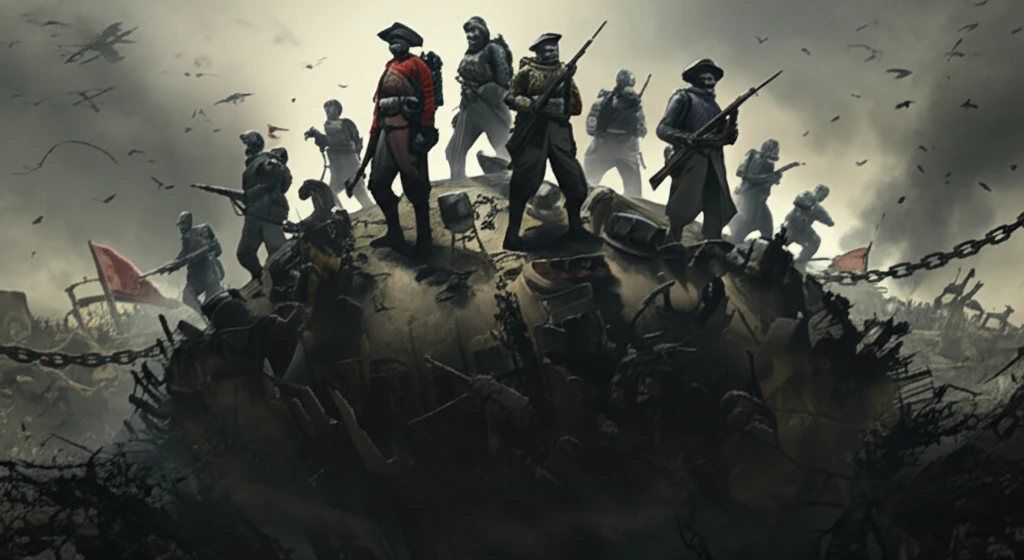
Beyond the Battlefield: Uncovering the Complex Legacy of Black Soldiers in Colonial Empires

"Exploring the multifaceted roles, challenges, and cultural impact of African-descended soldiers across centuries and continents."
The story of colonial empires is often told through the lens of European dominance, but the reality is far more complex. A crucial, yet frequently marginalized, aspect of this history is the role of soldiers of African descent. These men, often forced into service or lured by the promise of opportunity, served in the armies of European powers across vast stretches of time and geography. From the 18th century to the early 20th century, their presence shaped not only military campaigns but also the social, cultural, and political landscapes of both the colonizers and the colonized.
Consider the Easter 1816 rebellion in Barbados, also known as 'Bussa's Rebellion.' During a decisive battle at Bayley's plantation, around 400 enslaved rebels clashed with 150 men from the 1st West India Regiment, a unit comprised largely of West African personnel commanded by white officers. This regiment, like many others, was formed by the British in the late 1790s, sourcing manpower from purchased slaves or individuals 'liberated' from foreign slave ships after the abolition of the British slave trade. When some of the rebels called out for the black soldiers to join them, they were met with gunfire, a stark illustration of the complex allegiances and contradictions inherent in their position.
Despite their crucial role in suppressing the rebellion—James Stephen noted that they were 'the troops put in advance, and by whose fire the insurgents were dispersed'—the West India Regiment faced unfavorable reports questioning their conduct. These reports, likely originating from white slaveholders, highlight the precarious position of black soldiers, even when performing their 'duty' in the eyes of the empire. This special issue delves into the myriad historical themes surrounding the creation and deployment of these armed units, exploring their impact on both the Americas and Africa during a pivotal period of imperial expansion.
Quantifying Service and Sacrifice
Efforts to document Black military service span from grassroots transcription projects to historical registries. The Zooniverse platform hosts a citizen-science project dedicated to transcribing the military records of African American Civil War soldiers, enabling researchers to build a more complete picture of service and sacrifice. The American Battlefield Trust notes that Black soldiers participated in America's earliest conflicts, with a member of the Lexington militia wounded on the first day of the Revolution and the 1st Rhode Island Regiment featuring prominently at the Siege of Yorktown. Research into PTSD among soldiers broadly underscores the lasting psychological toll of combat, though specific data on Black soldiers' mental health outcomes remains underexplored in mainstream statistics.
Methodological Gaps in Studying Black Military History
The study of Black soldiers in colonial empires lacks a unified methodological framework, as researchers must draw from disparate disciplines and data types. Explainable AI approaches for medical and archival data are emerging as tools that could help historians parse large collections of military records, though their application to colonial-era service records remains in early stages. Current methods for analyzing historical military data face limitations around data quality, accessibility, and the fragmentary nature of records pertaining to non-white soldiers. A lack of standardized approaches means that findings often remain siloed within individual research projects rather than contributing to a cumulative body of knowledge.
From Colonial Militias to World War II
The term G.I., originally standing for 'Government Issue,' became the universal designation for U.S. soldiers by World War II, including the hundreds of thousands of Black Americans who served. The 761st Tank Battalion, an all-Black unit, fought in Europe and was photographed in front of the Prince Albert Memorial in Coburg, Germany, in 1945, exemplifying the combat roles Black soldiers filled despite systemic segregation. The Spanish-American War marked an important milestone in U.S. foreign relations history, during which Black regiments served with distinction in campaigns abroad. These milestones trace a long arc of Black military participation that predates the nation's founding and extends through its emergence as a global power.
Navigating Contradictions: The Complex World of Black Soldiers
The arming of African-descended men occurred amidst a complex web of imperial expansion, colonization, slavery, and anti-colonial resistance. This created a unique set of circumstances that profoundly shaped the experiences of these soldiers. They were often caught between conflicting loyalties, serving empires that simultaneously oppressed their people while offering them a path to potential advancement.
- Soldierly Identity: Examining how black soldiers perceived themselves and their role within the imperial structure, and the challenges they faced in forging their own identities in the face of racial prejudice and conflicting loyalties.
- Military Symbolism: Unpacking the cultural meanings associated with armed men of African descent, both as symbols of imperial power and as potential threats to white supremacy.
- Military Intermediaries: Investigating how black soldiers functioned as cultural and social bridges between colonizers and colonized populations.
Racial Tensions and Military Justice
The 1943 Riot of Bamber Bridge in England reveals how racial dynamics followed Black soldiers overseas, as the 1511th port company was welcomed in local establishments while white American soldiers brought their racist attitudes with them, creating friction. The earlier Houston Riot of 1917 saw a violent confrontation between Black soldiers and white authorities, resulting in the army holding three courts-martial in which 110 African Americans were found guilty, nineteen were executed, and sixty-three received life sentences. These incidents illustrate the paradox Black soldiers faced: serving a nation that denied them basic rights, both at home and in the theaters of war where they fought.
Institutional Failures Facing Black Service Members
Beyond the battlefield, Black soldiers have repeatedly confronted institutional failures from the institutions they serve. Reports of soldiers being charged extra baggage fees by airlines while returning from deployment highlight how service members can be treated as ordinary consumers rather than as individuals who have risked their lives in national service. These kinds of grievances, though not always specific to race, compound the broader pattern of Black soldiers receiving inadequate recognition and support from the systems they defend. The cumulative effect of such institutional shortcomings undermines the promise of equal treatment that military service is supposed to represent.
The Limits of Comparative Frameworks
Comparative analyses of soldiers across nations and eras often reduce complex human experiences to quantifiable metrics such as kill counts or equipment specifications. Popular comparison platforms and content tend to focus on hardware, tactics, or casualty figures, overlooking the social and political contexts that shaped soldiers' experiences. For Black soldiers in colonial empires, standard comparative frameworks fail to account for the dual burden of fighting for empires that simultaneously oppressed them. Meaningful comparison requires attention to how race, citizenship, and colonial status intersected with military service in ways that transcend simple rankings.
A Lasting Legacy
The story of black soldiers in colonial empires is a testament to their resilience, adaptability, and agency in the face of immense challenges. While imperial power largely remained in the hands of white colonizers, the contributions and experiences of these soldiers reveal a more nuanced and complex history—one where black hands sometimes wielded power, challenged authority, and shaped the course of empires in unexpected ways. By understanding their story, we gain a deeper appreciation for the multifaceted legacy of colonialism and the enduring impact of race and power on global history.
Expendable Yet Essential
Historian David Olusoga has argued that Black soldiers were treated as 'expendable' by the empires they served, noting that in 1915 the German government formally condemned the deployment of non-white combatants as an appeal to white racial unity aimed partly at American public opinion. Black WWII soldiers who helped defeat the Nazis and liberate parts of the Netherlands have in recent years received formal honors from the Dutch government, recognizing contributions long overlooked in mainstream narratives. Meanwhile, the deaths of three Black soldiers in a 2024 drone attack in Jordan sparked debate about whether the U.S. response was proportionate, reflecting ongoing questions about how much value the nation places on the lives of its Black service members. These episodes span more than a century but share a common thread: the tension between Black soldiers' essential contributions and the societies' unwillingness to fully acknowledge them.
Uncharted Territory in Research and Recognition
The study of Black soldiers in colonial empires stands at an inflection point where emerging research tools and growing public interest could unlock new understanding. Global economic and policy outlooks increasingly recognize the importance of historical equity in shaping present-day institutions, which may create new funding and institutional support for this field of study. The digitization of military archives and the development of AI-assisted research methods offer the possibility of recovering names and stories of soldiers who were previously lost to history. However, the field faces the challenge of moving beyond anecdotal recovery toward systematic analysis that can inform contemporary policy on military equity and veterans' affairs.
Data Gaps and Structural Barriers
Research into the impact of AI on institutional credibility and adoption highlights a challenge that mirrors the study of Black military history: data quality and availability determine what conclusions can be drawn. Colonial military records were often incomplete, biased, or entirely omitted when it came to non-white soldiers, creating structural gaps that persist in the historical record. Broader questions of institutional credibility depend on acknowledging these omissions and developing methods to address them. Without confronting these systemic data challenges, any analysis of Black soldiers' legacy will remain inherently incomplete, shaped as much by what was recorded as by what actually happened.
Oral Histories and the Long Freedom Struggle
The scholarly work 'Black Soldiers in America's Wars, 1754–1865' by Don Troiani and John U. Rees represents a major effort to document Black military service through original oral history and archival analysis, linking the military experience with the worldwide Black Freedom struggle. This 420-page project, directed by Professors Charles Henry, Ronald Takaki, and Waldo Martin, connects individual soldiers' stories to the broader arc of civil rights. The persistence of racial violence against Black people in America, as illustrated by cases like Ahmaud Arbery's killing while jogging, underscores that the freedoms Black soldiers fought for abroad remain contested at home. These human stories remind us that the legacy of Black military service is not merely historical but continues to shape the lived experience of Black Americans today.