
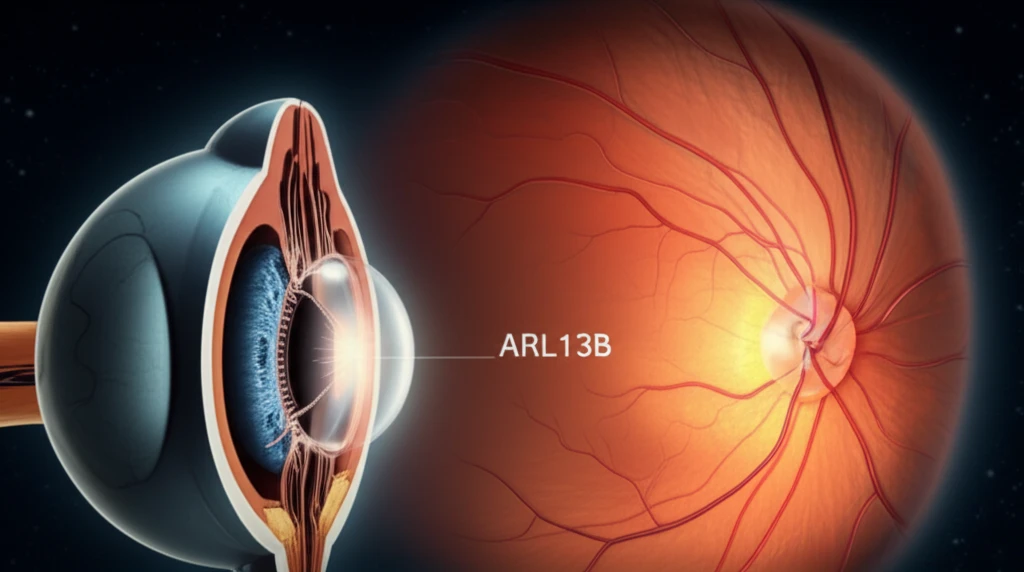
A stylized illustration of the human eye's retina, highlighting the ARL13B protein and its role in photoreceptor function, symbolizing hope for treatments for vision loss.

Beyond Sight: How a Tiny Protein Could Unlock the Secrets of Vision and Treat Blindness

"Groundbreaking research reveals the critical role of a protein called ARL13B in the development of our eyes, offering hope for new treatments for vision loss and the debilitating effects of Joubert Syndrome."


Imagine a world without the ability to see – a world shrouded in darkness, where the vibrant colors of life are replaced with an endless night. For millions around the globe, this is a daily reality. But what if there was a key, a hidden element, that could unlock the mysteries of vision and offer a path towards restoring sight? Recent groundbreaking research has identified a tiny protein, ARL13B, as a critical player in the development and maintenance of our eyes, offering a beacon of hope for those affected by vision loss.

This fascinating study delves into the intricate world of the retina, the light-sensitive tissue at the back of our eyes. It uncovers the crucial role of ARL13B, a small protein, in the formation and function of photoreceptors – the specialized cells responsible for detecting light. These photoreceptors are the gatekeepers of sight, converting light into signals that our brains can interpret as images. The findings have implications for understanding and treating a range of vision-related conditions, including the rare genetic disorder known as Joubert Syndrome.

Through meticulous investigation, scientists have illuminated the critical role ARL13B plays in every stage of photoreceptor development and maintenance, from the initial formation of the eye to the ongoing health of the cells that allow us to see. This discovery not only deepens our understanding of vision but also opens doors to potential new therapies that could change the lives of individuals facing the challenges of blindness and vision impairment.

Unveiling ARL13B: The Unsung Hero of Vision

A stylized illustration of the human eye's retina, highlighting the ARL13B protein and its role in photoreceptor function, symbolizing hope for treatments for vision loss.

The journey to understanding vision is akin to unraveling a complex puzzle, with each piece representing a different component of this extraordinary sense. ARL13B, a protein previously linked to the rare genetic condition Joubert Syndrome, has emerged as a key piece of this puzzle. Joubert Syndrome, characterized by vision impairment and other neurological symptoms, often results from mutations affecting the ARL13B gene. This new research goes beyond the known connection, revealing that ARL13B is essential not only for the overall structure of the retina, but also the cellular processes critical for sight.

At the heart of this discovery lies the photoreceptor, a specialized cell that is responsible for converting light into electrical signals that the brain can interpret as images. Within these photoreceptors, ARL13B plays a critical role in the development and function of the outer segments. These outer segments are the part of the photoreceptor that contains the light-sensitive molecules that absorb photons and trigger the cascade of events that leads to vision. When ARL13B is absent or dysfunctional, the outer segments are misshapen and the photoreceptors cells become damaged, leading to the loss of vision.

  • Outer Segment Formation: ARL13B is crucial for the proper formation of the outer segments, the light-detecting part of the photoreceptor cells.
  • Protein Trafficking: ARL13B helps to ensure that the proteins involved in vision are correctly transported to the outer segments.
  • Ciliary Function: ARL13B plays a role in the structure and function of the cilium, a cellular antenna that is essential for proper photoreceptor function.
  • Maintaining Vision: ARL13B is essential for the long-term survival and function of photoreceptor cells, ensuring that they can continue to detect light and transmit visual signals.
The research, which utilized both genetic and microscopic techniques, shows that ARL13B isn't just present in the retina; it's actively involved in multiple crucial processes. The team conducted in-depth research on mice, creating models where ARL13B could be selectively removed. This allowed them to observe what happens when this protein is missing and how it affects retinal function. The results were clear: without ARL13B, the structure of the photoreceptors was compromised, and their ability to respond to light was dramatically reduced. This work significantly advances our understanding of the biological processes needed to see and provides a foundation for future therapeutic development.

A Brighter Future for Vision: The Potential of ARL13B Research

The discovery of ARL13B's critical role in vision offers a glimpse into a future where vision loss may be more effectively addressed. By understanding the precise mechanisms by which ARL13B supports photoreceptor health, researchers can now focus on new treatments to target these mechanisms. This could include gene therapies to replace faulty ARL13B genes, or drug therapies that boost the function of the remaining protein. The findings offer renewed hope for individuals with Joubert Syndrome and others impacted by vision impairment, offering the promise of a future where the gift of sight is preserved, and the world can be experienced in all its visual splendor.

About this Article -

This article was crafted using a human-AI hybrid and collaborative approach. AI assisted our team with initial drafting, research insights, identifying key questions, and image generation. Our human editors guided topic selection, defined the angle, structured the content, ensured factual accuracy and relevance, refined the tone, and conducted thorough editing to deliver helpful, high-quality information.See our About page for more information.

This article is based on research published under:

DOI-LINK: 10.1523/jneurosci.1761-18.2018, Alternate LINK

Title: Arl13B, A Joubert Syndrome-Associated Protein, Is Critical For Retinogenesis And Elaboration Of Mouse Photoreceptor Outer Segments

Subject: General Neuroscience

Journal: The Journal of Neuroscience

Publisher: Society for Neuroscience

Authors: Tanya L. Dilan, Abigail R. Moye, Ezequiel M. Salido, Thamaraiselvi Saravanan, Saravanan Kolandaivelu, Andrew F.X. Goldberg, Visvanathan Ramamurthy

Published: 2018-12-20

Everything You Need To Know

1

What is the primary role of the protein ARL13B in the context of vision?

ARL13B plays a critical role in the development and maintenance of photoreceptors, the specialized cells within the retina responsible for detecting light. It ensures the proper formation of the outer segments of these cells, facilitates the transport of vision-related proteins, supports ciliary function, and contributes to the long-term survival of photoreceptors. Without ARL13B, the structure and function of photoreceptors are compromised, leading to vision loss or impairment.

2

How is ARL13B connected to Joubert Syndrome, and what are the implications of this connection?

ARL13B is linked to Joubert Syndrome, a genetic disorder characterized by vision impairment and other neurological symptoms. Mutations in the ARL13B gene can lead to this syndrome. The connection highlights that ARL13B is essential for not only the general structure of the retina but also cellular processes critical for sight. This understanding opens doors to potential therapies that could improve the lives of those with Joubert Syndrome, potentially targeting the ARL13B pathways to correct the underlying genetic defects.

3

What are the specific functions of ARL13B within photoreceptor cells, and why are these functions so important for vision?

Within photoreceptor cells, ARL13B is involved in several critical processes. It ensures the correct formation of the outer segments, which are responsible for detecting light. It aids in protein trafficking, ensuring that the necessary proteins for vision are correctly transported to these outer segments. It also plays a role in the function of the cilium, a cellular antenna crucial for photoreceptor function. These functions are essential because they enable photoreceptors to convert light into electrical signals that the brain interprets as images. Without these processes, the photoreceptors cannot effectively capture and transmit visual information, resulting in vision loss.

4

What experimental methods were used to study ARL13B, and what were the key findings from these studies?

The research employed both genetic and microscopic techniques, including creating mouse models where ARL13B could be selectively removed. By observing what happens when ARL13B is absent, researchers discovered that the structure of photoreceptors was compromised, and their ability to respond to light was severely reduced. These findings confirm that ARL13B is essential for photoreceptor health, providing a basis for future therapeutic development. Further studies highlighted the active involvement of ARL13B in multiple crucial processes within the retina.

5

What are the potential future therapeutic avenues based on the discovery of ARL13B's role in vision, and how might they impact individuals with vision impairment?

The discovery of ARL13B's critical role in vision provides opportunities for new treatments to address vision loss. Researchers can focus on gene therapies to replace faulty ARL13B genes or develop drug therapies that enhance the function of the remaining protein. These therapies could target the specific mechanisms by which ARL13B supports photoreceptor health, offering hope for individuals with Joubert Syndrome and others affected by vision impairment. The ultimate goal is to preserve or restore the gift of sight, allowing individuals to experience the world visually.

Newsletter Subscribe

Subscribe to get the latest articles and insights directly in your inbox.