
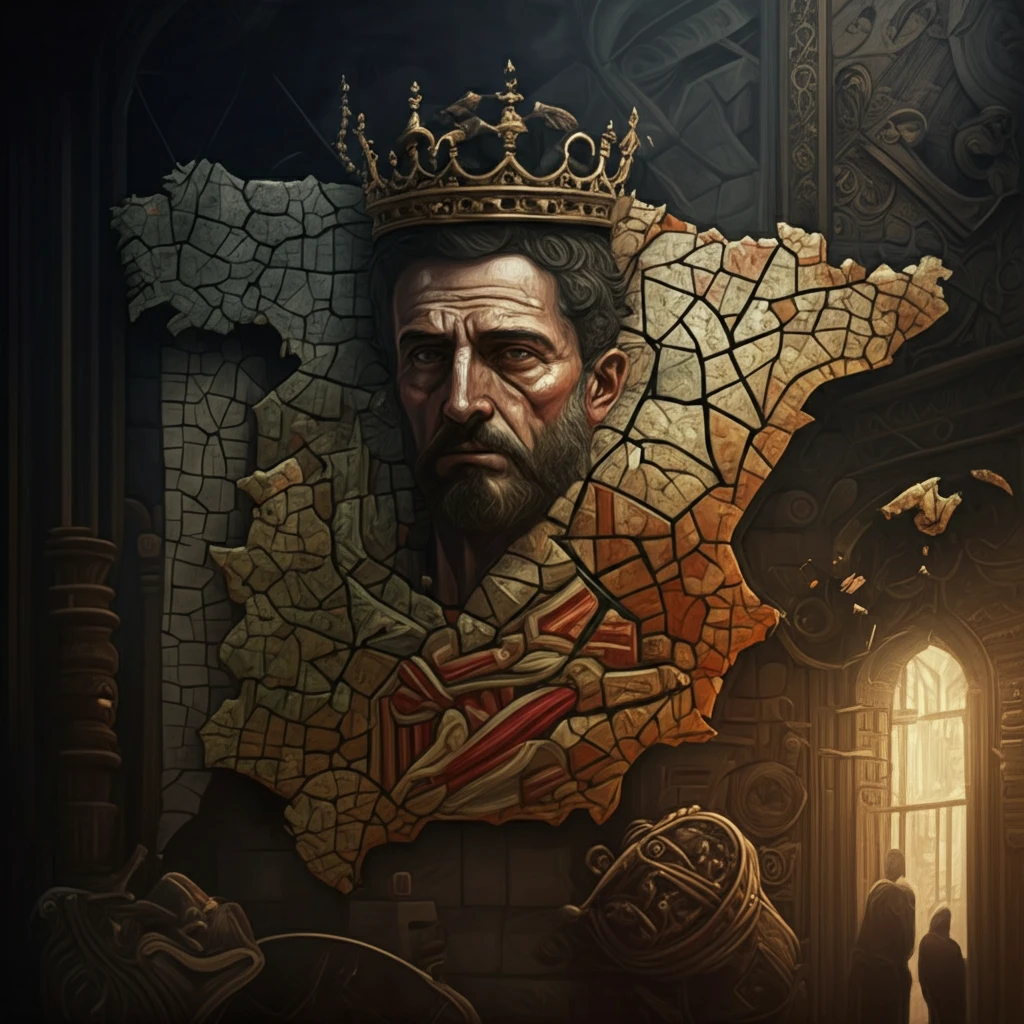
Beyond Rome: How Identity Shaped Europe After the Empire Fell

"Uncover the surprising ways fragmented statehood and aristocratic identity defined the post-Roman world."
The year is 407. Roman legions in Britannia, far removed from the heart of the Empire, declare their own emperor, Constantine III. This act of defiance, though ultimately short-lived, sets in motion a cascade of events that will forever alter the course of Western Europe. As central Roman authority crumbles, the Iberian Peninsula, like many other regions, finds itself adrift, grappling with new rulers and the urgent need to redefine itself.
The narrative of the post-Roman world is often painted as a simple decline, a descent into chaos and barbarism. However, a closer examination reveals a far more complex and fascinating story: one of adaptation, innovation, and the forging of new identities in the crucible of political upheaval. The Iberian Peninsula, in particular, offers a compelling case study of how local aristocracies navigated the collapse of Roman power and crafted new forms of statehood.
This isn't just about kings and battles. It's about the lives of ordinary people, the shifting power dynamics, and the enduring human need for order and belonging. Understanding this period is crucial to understanding the very foundations of modern Europe. It's a story of resilience, reinvention, and the enduring power of identity.
Genetic Evidence of Post-Roman Migration
Ancient DNA studies of post-Roman Europeans reveal a measurable rise in northern European genetic ancestry at post-Roman sites, reflecting large-scale population movements into the region after the empire fell. This genetic turnover offers a concrete, data-driven picture of how identities and populations were reshaped once imperial rule receded.
Conventional Explanations for Rome's Fall
Standard accounts of Rome's decline typically focus on a set of interlocking pressures, with historians commonly citing reasons such as economic instability, military overstretch, and internal political decay. One widely debated argument holds that the spread of Christianity dovetailed with the decline, with some scholars suggesting the rise of the new faith undermined traditional Roman structures. These approaches tend to foreground institutional collapse while giving less attention to how local identities re-formed in the aftermath.
From Republic to Empire to Fragmentation
At its height around 117 CE, the Roman Empire was the most extensive political and social structure in western civilization, built upon foundations laid by the Roman Republic. The collapse of that structure produced not a single successor state but a Europe of fragmented statehood, where new aristocratic identities emerged in place of a universal imperial identity. These foundational milestones set the stage for the regional kingdoms that would define the medieval period.
Crafting a New Order: Navigating Barbarian Rule
With Constantine III's demise in 411, the Iberian Peninsula became a chessboard for migrating tribes – the Suevi, Vandals, and Alans. The established order was upended, and local elites faced a daunting challenge: how to survive and maintain their influence in this new world. The strategies they employed were far from uniform, varying significantly across different regions of the peninsula.
- Adaptation to local conditions
- Negotiations with incoming barbarian rules
- Preservation of city governance
- Integration of power structures
Ancient DNA Rewrites the Post-Roman Story
New research using ancient DNA from post-Roman European sites reveals the emergence of genetically distinct populations, with a clear rise in northern European ancestry linked to large-scale migrations into the region. This evidence provides a fresh window into how communities formed and reformed after the empire fell, moving beyond purely textual accounts of kings and battles.
The Christianization Debate and Its Critics
A prominent counter-argument to purely political or economic explanations of Rome's fall links imperial decline to the rise of Christianity, suggesting that the spread of the new faith sapped the civic religion that had helped bind the empire together. Critics note that correlation is not causation, and that the empire weathered other major changes before its collapse. As a result, the Christianization thesis remains contested rather than settled among historians.
From Fragmented Kingdoms to Great Powers
The Iberian Peninsula illustrates how the post-Roman order fragmented: most of the peninsula became part of the expanding Umayyad Empire under the name of al-Andalus, organized as a province subordinate to Ifriqiya, with governors appointed during its first decades. By the end of the 15th century, that fragmented landscape had consolidated into great powers, with England, France, the Netherlands, Portugal, and Spain playing predominant roles in global affairs. The comparison shows how regional identities built on the ruins of Rome eventually coalesced into the states that shaped the modern world.
A Legacy of Reinvention
The fall of the Roman Empire in Iberia was not simply an end, but a beginning. It was a period of intense adaptation, innovation, and the forging of new identities. From the civic notables of Lusitania to the militarized communities of the northern plateau, local elites across the peninsula navigated the challenges of barbarian rule and shaped the destiny of their regions. The legacy of this era continues to resonate today, reminding us that even in times of profound upheaval, the human spirit is capable of resilience, reinvention, and the creation of new orders.
Identity as Rome's Enduring Legacy
Beyond kings and battles, the enduring legacy of Rome's fall on regions such as the Iberian Peninsula lies in fragmented statehood and the emergence of new aristocratic identities. Analysts frame the post-imperial period less as a simple collapse and more as a reordering in which identity, rather than a single imperial center, came to define political life.
A DNA-Driven Frontier for Medieval History
Ancient DNA studies represent one of the next frontiers for understanding post-Roman Europe, promising finer-grained reconstructions of the population movements that accompanied the empire's fall. As sampling expands across the continent, researchers expect to clarify how northern European ancestry spread into specific regions and how those movements aligned with historical records of migration.
Systemic Pressures and Long-Term Consolidation
The decline of Rome unfolded alongside systemic pressures that no single cause fully explains, including the rise of Christianity and the broader transformations of late antiquity. Yet the long-term outcome was the consolidation of power into a handful of European states, which by the end of the 15th century emerged as predominant players in global affairs. This trajectory shows how systemic breakdown can, over centuries, give way to new and durable political orders.
A Living Story of Warriors and Explorers
The post-Roman reshaping of the Iberian Peninsula remains a story still experienced today, told from the Portuguese side as a land shaped by warriors, empires, and explorers. This lived connection to the past demonstrates that the identity forged after Rome's fall is not merely a historical curiosity but a legacy that continues to inform regional culture and self-understanding.