
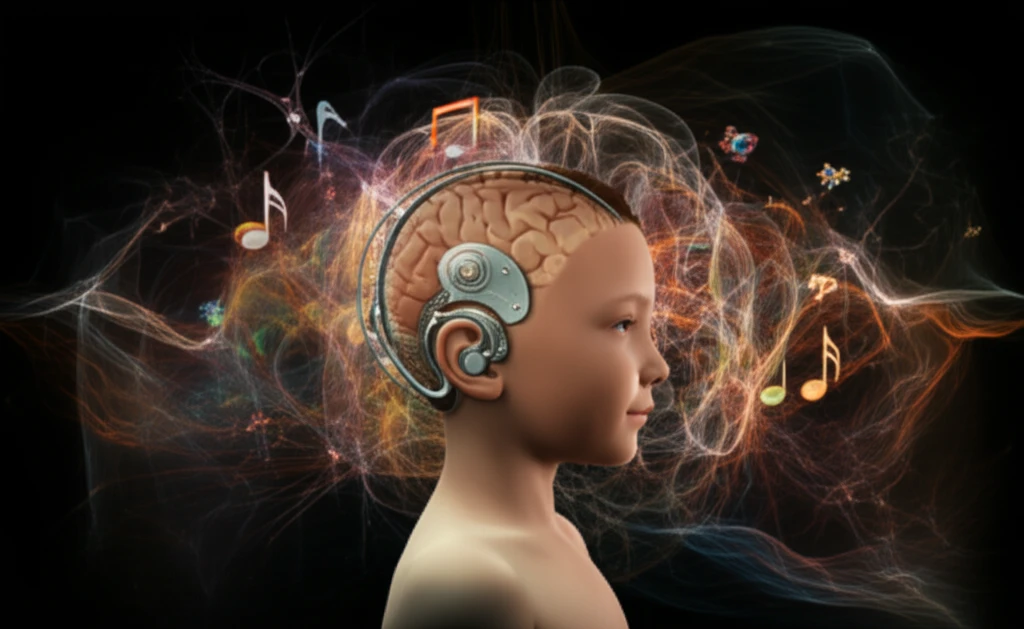
Stylized illustration of a child with auditory implants, surrounded by sound waves and neural pathways.

Beyond Cochlear Implants: Can Auditory Brainstem Implants Restore Hearing?

"Innovative Approach Combines ABI and CI for Enhanced Hearing in Children with Nerve Deficiencies."


For children born with or who acquire profound hearing loss due to cochlear nerve deficiencies, traditional cochlear implants (CIs) may not be enough. The auditory brainstem implant (ABI) is designed to directly stimulate the brainstem, bypassing the damaged auditory nerve. While ABIs have been used for decades, a new approach combines the ABI with a contralateral CI to maximize auditory input and improve outcomes.

A recent study has explored this combined approach in pediatric patients, focusing on those who initially received CIs without significant benefit. This research offers insights into how the brain adapts to and utilizes signals from both devices, potentially unlocking synergistic effects that enhance overall hearing and speech development.

This article delves into the findings of this study, examining the impact of combined ABI and CI on auditory perception and speech production in children. It addresses the critical questions surrounding patient selection, timing of intervention, and the potential for improved quality of life.

Unlocking Potential: How ABI and CI Work Together

Stylized illustration of a child with auditory implants, surrounded by sound waves and neural pathways.

The study, conducted as a retrospective case review at a tertiary referral center, focused on four children with cochlear nerve deficiency. These children had initially undergone cochlear implantation but showed limited progress. As a result, they received an ABI in the ear contralateral to their existing CI.

The primary goal was to assess their bimodal auditory performance—how they functioned with both devices. Researchers used age-appropriate speech perception and production assessments to measure the outcomes.

  • Improved Auditory Perception: Three out of four subjects demonstrated better auditory perception when using both their CI and ABI compared to using either device alone.
  • Subjective Improvement: The fourth subject, while having only preliminary data, subjectively performed better with both devices.
  • CI Performance Over Time: The study noted continued improvement in CI performance over time, even when initial benefits were not apparent before ABI implantation. This suggests a potential synergistic effect between ABI and CI or the brain's adaptive capacity.
These results suggest that the combined use of ABI and CI can lead to significant improvements in auditory perception and speech development for children with cochlear nerve deficiencies. The brain's ability to adapt and utilize signals from both devices highlights the potential for synergistic effects.

New Horizons in Pediatric Hearing Restoration

This case series highlights the potential benefits of combining ABI and CI in children with cochlear nerve deficiencies. While more research is needed, these findings suggest that this approach can significantly improve auditory perception and speech development.

The study also underscores the importance of considering individual patient factors and the timing of intervention. Further research should explore the optimal criteria for patient selection and the long-term outcomes of combined ABI and CI use.

As technology advances, the integration of ABI and CI offers a promising avenue for restoring hearing in children who are not candidates for traditional cochlear implantation. By understanding how these devices interact and how the brain adapts, we can unlock new possibilities for improving the quality of life for these children.

About this Article -

This article was crafted using a human-AI hybrid and collaborative approach. AI assisted our team with initial drafting, research insights, identifying key questions, and image generation. Our human editors guided topic selection, defined the angle, structured the content, ensured factual accuracy and relevance, refined the tone, and conducted thorough editing to deliver helpful, high-quality information.See our About page for more information.

This article is based on research published under:

DOI-LINK: 10.1159/000493085, Alternate LINK

Title: Performance With An Auditory Brainstem Implant And Contralateral Cochlear Implant In Pediatric Patients

Subject: Speech and Hearing

Journal: Audiology and Neurotology

Publisher: S. Karger AG

Authors: David R. Friedmann, Leena Asfour, William H. Shapiro, J. Thomas Roland Jr., Susan B. Waltzman

Published: 2018-01-01

Everything You Need To Know

1

What is an auditory brainstem implant (ABI), and how does it differ from a cochlear implant (CI)?

An auditory brainstem implant, or ABI, is a device designed to directly stimulate the brainstem, bypassing a damaged auditory nerve. It's used in cases where traditional cochlear implants, or CIs, aren't effective due to cochlear nerve deficiencies. The ABI sends auditory signals directly to the brainstem, offering an alternative pathway for hearing.

2

How are auditory brainstem implants (ABIs) and cochlear implants (CIs) used together to improve hearing?

In some cases, children with cochlear nerve deficiencies receive both an auditory brainstem implant, or ABI, and a cochlear implant, or CI. The CI is placed in one ear, and the ABI in the opposite ear. This combined approach aims to maximize auditory input, leveraging the potential for synergistic effects where the brain adapts to and utilizes signals from both devices to enhance overall hearing and speech development.

3

Who were the participants in the study, and what specific outcomes were measured after receiving both a cochlear implant (CI) and an auditory brainstem implant (ABI)?

The study focused on children with cochlear nerve deficiency who initially received cochlear implants, or CIs, but didn't experience significant benefit. They later received an auditory brainstem implant, or ABI, in the ear opposite their CI. Researchers then assessed their bimodal auditory performance, that is, how they functioned with both devices. The study specifically measured improvements in auditory perception and speech production.

4

What were the main findings regarding the combined use of auditory brainstem implants (ABIs) and cochlear implants (CIs) in children with hearing loss?

The findings suggest that using an auditory brainstem implant, or ABI, in combination with a cochlear implant, or CI, can lead to marked improvements in auditory perception and speech development for children with cochlear nerve deficiencies. The brain’s ability to adapt to and use signals from both devices indicates the potential for synergistic effects. Continued improvement in CI performance over time, even when initial benefits were not apparent before ABI implantation, supports this idea.

5

What are some of the outstanding questions and areas for future research regarding the combined use of auditory brainstem implants (ABIs) and cochlear implants (CIs)?

While the combined auditory brainstem implant, or ABI, and cochlear implant, or CI, approach shows promise, several questions remain. Future research needs to determine the optimal criteria for patient selection, the best timing for ABI intervention after CI implantation, and the long-term impact on auditory and speech development. Additionally, understanding the specific neural mechanisms underlying the synergistic effects of combined ABI and CI use could further refine treatment strategies.

Newsletter Subscribe

Subscribe to get the latest articles and insights directly in your inbox.