
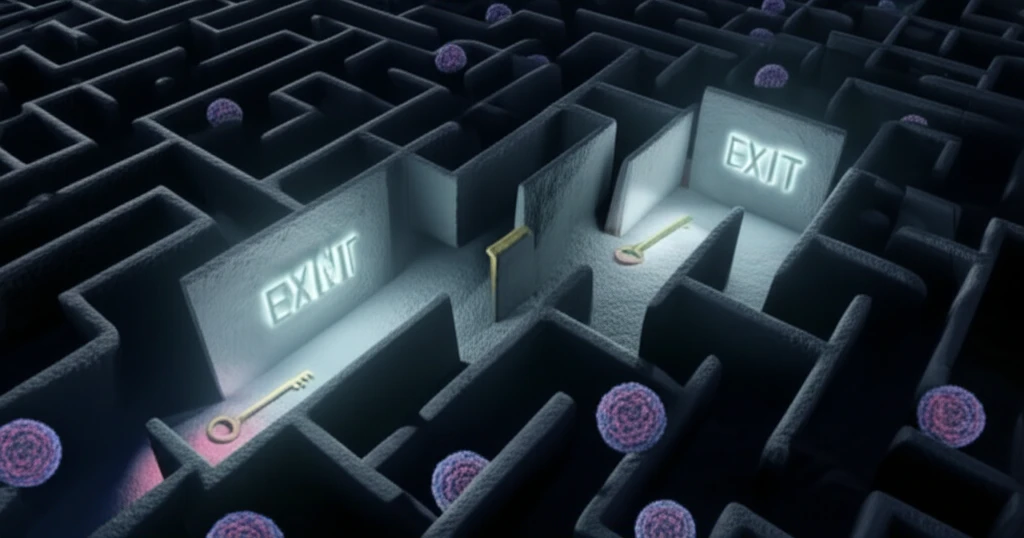
Cancer cells in a maze, illustrating drug resistance and a potential solution.

Beating Resistance: How to Outsmart Cancer's Escape Routes

"Uncover the mechanisms behind cancer cell resistance to targeted therapies and explore innovative strategies to maintain treatment effectiveness."


Targeted therapies have revolutionized cancer treatment, offering hope for more effective and less toxic approaches. However, cancer cells are masters of adaptation, frequently developing resistance that limits the long-term success of these treatments. Understanding these resistance mechanisms is crucial for developing strategies to stay one step ahead of the disease.

One area of intense research focuses on how cancer cells bypass the effects of targeted drugs. This involves intricate molecular pathways that allow cancer cells to survive and thrive even when key targets are blocked. By identifying these escape routes, scientists aim to design more effective combination therapies and personalized treatment approaches.

This article will focus on a recent study investigating resistance mechanisms in KRAS-mutated colorectal cancer, a particularly challenging subtype. The study sheds light on how activation of the PI3K-AKT pathway can lead to resistance to EGFR and MEK inhibitors, two commonly used targeted therapies. We'll explore the study's findings and discuss potential strategies to overcome this resistance.

Decoding the PI3K-AKT Pathway: Cancer's Ingenious Escape Mechanism

Cancer cells in a maze, illustrating drug resistance and a potential solution.

The PI3K-AKT pathway is a critical signaling network within cells, regulating processes like growth, survival, and metabolism. In many cancers, this pathway is hyperactivated, contributing to uncontrolled cell proliferation and resistance to therapy. Researchers have found that resistance to anti-EGFR and MEK inhibitors in KRAS-mutated colorectal cancer is often linked to increased activity in the PI3K-AKT pathway.

The study highlighted that resistant cancer cells frequently exhibit hyperactivation of the PI3K-AKT pathway alongside increased activation of multiple receptor tyrosine kinases (RTKs) such as HER2, HER3, and IGF1R. This suggests a coordinated effort by cancer cells to bypass the intended effects of the targeted therapies.

To clarify the roles of specific kinases in resistance, the scientists used:
  • Selective knockdown of RTKs like HER2 and HER3.
  • Treatment with Afatinib (BIBW2992), a pan-HER inhibitor.
  • Pictilisib (GDC-0941), a selective PI3Ka inhibitor.
The most effective treatment was Pictilisib. These experiments showed that inhibiting PI3K directly could restore the sensitivity of resistant cells to the original drug combination. This points to PI3K activation as a central mechanism of resistance in this context.

Future Directions: Overcoming Resistance for Long-Term Cancer Control

The study's findings underscore the importance of understanding resistance mechanisms to improve cancer treatment outcomes. By identifying PI3K activation as a key driver of resistance in KRAS-mutated colorectal cancer, researchers have opened new avenues for therapeutic intervention. Future research will likely focus on developing more effective PI3K inhibitors, as well as combination therapies that target multiple resistance pathways simultaneously. This comprehensive approach holds the promise of overcoming resistance and achieving more durable responses in patients with colorectal cancer and other malignancies.

About this Article -

This article was crafted using a human-AI hybrid and collaborative approach. AI assisted our team with initial drafting, research insights, identifying key questions, and image generation. Our human editors guided topic selection, defined the angle, structured the content, ensured factual accuracy and relevance, refined the tone, and conducted thorough editing to deliver helpful, high-quality information.See our About page for more information.

This article is based on research published under:

DOI-LINK: 10.1093/annonc/mdy268.001, Alternate LINK

Title: Receptor Tyrosine Kinase Dependent Pi3K Activation Is An Escape Mechanism To Vertical Suppression Of The Egfr/Ras/Mapk Pathway In Kras-Mutated Colorectal Cancer Cell Lines

Subject: Oncology

Journal: Annals of Oncology

Publisher: Elsevier BV

Authors: P.P. Vitiello, C. Cardone, D. Ciardiello, G. Barra, N. Matrone, V. Belli, G. Martini, L. Poliero, C. Borrelli, M. Terminiello, T. Troiani, F. Morgillo, F. Ciardiello, E. Martinelli

Published: 2018-10-01

Everything You Need To Know

1

What are targeted therapies, and why is resistance to them a problem?

Targeted therapies are treatments designed to specifically attack cancer cells, often by targeting particular molecules or pathways crucial for their growth and survival. They represent a significant advancement over traditional chemotherapy because they aim to be more precise and less toxic to healthy cells. However, cancer cells can develop resistance, limiting the therapy's long-term effectiveness. This resistance often involves the activation of alternative signaling pathways that bypass the intended target of the therapy, allowing cancer cells to continue growing and thriving. Overcoming this resistance is a major challenge in oncology.

2

What is the PI3K-AKT pathway, and why is it important in cancer?

The PI3K-AKT pathway is a critical signaling network inside cells that regulates vital functions such as cell growth, survival, and metabolism. When this pathway becomes hyperactivated in cancer cells, it can lead to uncontrolled cell proliferation and resistance to treatments. This hyperactivation allows cancer cells to bypass the effects of targeted drugs and continue to grow, making it a key target for therapeutic intervention. Inhibiting the PI3K-AKT pathway can help restore sensitivity to other treatments and prevent the further spread of cancer.

3

How does the PI3K-AKT pathway contribute to drug resistance in KRAS-mutated colorectal cancer?

In KRAS-mutated colorectal cancer, resistance to EGFR and MEK inhibitors is often linked to the hyperactivation of the PI3K-AKT pathway. This means that even when EGFR and MEK are inhibited, the cancer cells can still grow and survive by using the PI3K-AKT pathway as an alternative route. Additionally, receptor tyrosine kinases (RTKs) like HER2, HER3, and IGF1R are also activated, contributing to this resistance. This complex interplay makes treating KRAS-mutated colorectal cancer particularly challenging, requiring strategies to target multiple resistance mechanisms simultaneously.

4

What methods are scientists using to study and overcome drug resistance in cancer cells?

Scientists are using various methods to understand and overcome resistance in cancer cells. These include selectively knocking down RTKs like HER2 and HER3, treating cells with inhibitors like Afatinib (a pan-HER inhibitor), and using selective PI3K inhibitors like Pictilisib (GDC-0941). By inhibiting PI3K directly, researchers have shown that resistant cells can regain sensitivity to the original drug combination. These experiments help identify key drivers of resistance and inform the development of more effective combination therapies.

5

What are the future directions in research for overcoming cancer resistance?

Future research is focused on developing more effective PI3K inhibitors and combination therapies that target multiple resistance pathways simultaneously. This comprehensive approach aims to overcome resistance and achieve more durable responses in patients with colorectal cancer and other malignancies. By identifying and targeting the specific mechanisms that cancer cells use to evade treatment, researchers hope to improve long-term outcomes and reduce the burden of cancer.

Newsletter Subscribe

Subscribe to get the latest articles and insights directly in your inbox.