
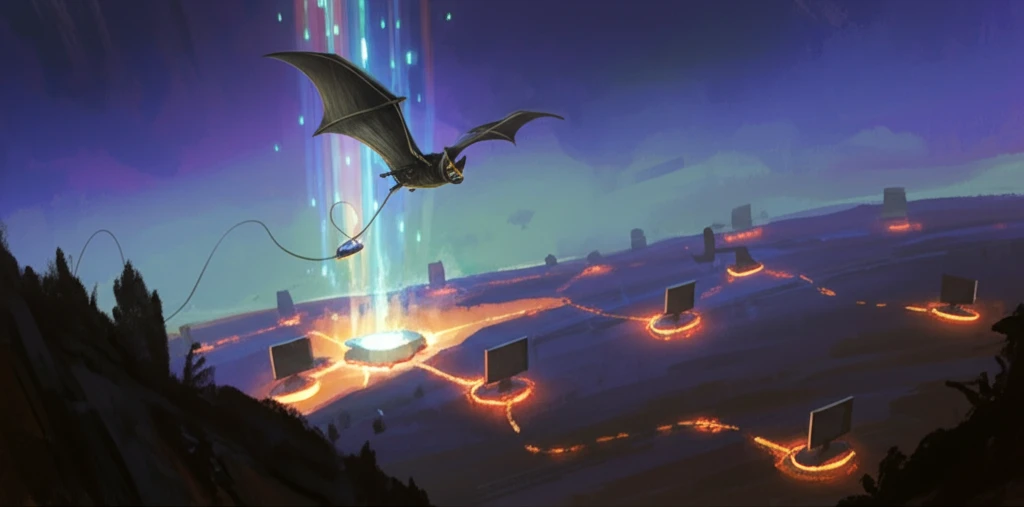
Bat-Tech: How Tiny Sensors Are Revolutionizing Wildlife Tracking

"Discover the groundbreaking sensor tech that's unlocking the secrets of bat behavior and reshaping our understanding of ecosystems"
For over half a century, the field of biologging – tracking animals remotely – has been driven by technological innovation. What started as simple observation has evolved into a sophisticated, interdisciplinary science thanks to advances in digital transceivers and miniature sensors. This technology is now capable of revealing intricate details about animal behavior, transforming fields like movement ecology, sociobiology, and conservation.
The challenge? Balancing performance with practicality. Advanced tracking devices, such as GPS tags, offer incredible data collection capabilities but come with a significant trade-off: increased weight. Larger batteries, necessary for more complex functions, can burden animals, altering their behavior and even affecting their survival. This is especially critical for smaller species, where tag weight must remain a tiny fraction of their body mass.
Enter the world of Wireless Sensor Networks (WSNs). Scientists are now deploying these compact, energy-efficient systems to monitor even the smallest creatures. This article dives into a groundbreaking project called BATS, an Adaptive Ultra Low Power Sensor Network designed to track the elusive lives of bats. We'll explore how this innovative technology is pushing the boundaries of animal tracking and opening new doors for ecological research.
Digital Tools Mobilize Public Wildlife Observation
Government agencies are increasingly leveraging digital platforms to crowdsource wildlife data. The New Jersey Department of Environmental Protection launched the NJ Wildlife Tracker, a web application accessible from cell phones and computers, enabling the public to report rare species observations and wildlife encountered on roadways. On the private-sector side, startups like WildTrack AI have built apps combining artificial intelligence and augmented reality to enhance wildlife monitoring. These tools reflect a broader shift toward democratizing wildlife data collection through accessible technology.
From Physical Traps to AI-Powered Detection
Traditional wildlife tracking methods range from hands-on field techniques such as setting physical traps and following animal trails to laboratory-based scientific approaches like compound-specific isotope analysis used to trace fish origins. More recent computer-vision methods employ object detection algorithms like YOLOv12 combined with DeepSort trackers for real-time wildlife identification and tracing, specifically targeting scenarios like preventing crop damage from roaming animals. These modern algorithmic approaches aim to automate detection in ways that manual field methods cannot scale to achieve.
Ancient Skills Meet Cloud-Based Analytics
The foundational skill of wildlife tracking lies in reading and aging tracks and signs—determining how fresh a trail is remains critical to successfully following and locating animals. This ancient practice, refined over lifetimes by expert trackers, forms the bedrock knowledge upon which modern technology is built. Today, cloud-based platforms like Utah's Wildlife Tracker visualize and analyze real-time movements of collared animals, representing the digital evolution of those early observational techniques. The transition from reading footprints in soil to interpreting GPS pings in the cloud illustrates the field's long arc of development.
BATS: A New Era of Bat Tracking
The BATS project (Dynamic Adaptable Applications for Bat Tracking by Embedded Communicating Systems) tackled the challenge of creating a lightweight, long-lasting sensor network capable of revealing bat behavior in unprecedented detail. The system combines several key components:
- Communication between these nodes allows for tracking bat encounters and social interactions.
- A network of ground nodes records flight trajectories with high precision.
- A long-range telemetry system transmits data from bats even outside the main network's range.
YOLO Advances and the Motus Network Push Frontiers
Recent deep-learning research is advancing wildlife detection through successive improvements to the YOLO architecture, with studies comparing YOLOv8 and YOLOv9 models specifically tailored for real-time wildlife tracking and anomaly detection. The Motus Wildlife Tracking System, highlighted by the Renewable Energy Wildlife Institute, provides a collaborative network that enables scientists to track individual animal movements across vast landscapes, with storm-tracking radars now contributing mapping data across mountain states. Near-infrared spectroscopy is also emerging as a tool for marine mammal research and care, broadening the sensor toolkit beyond traditional radio telemetry.
Black-Box Systems Threaten Scientific Transparency
A growing concern in wildlife tracking is the opacity of proprietary technologies. Many remote sensing products rely on processing pipelines that researchers cannot fully access or verify, while some wildlife tracking devices provide only processed animal locations while withholding the underlying raw data. This lack of transparency mirrors broader problems with black-box AI systems, which critics argue can undermine confidence in scientific findings. Without open access to raw data and methodologies, the reproducibility and trustworthiness of tracking-derived results remain in question.
Cost, Accuracy, and the Need for Aspirational Conservation
Comparative analysis in wildlife tracking extends beyond technology to the economics and experience of fieldwork. Gorilla tracking, for example, carries significantly higher permit costs than chimpanzee tracking, making accessibility an important variable in conservation program design. Conservation advocates stress the importance of focusing on accurate tracking means while also making wildlife conservation aspirational and trendy to drive broader public engagement. Accurate identification methods—whether through comparative track charts or algorithmic classification—remain central to both scientific rigor and public-facing conservation efforts.
The Future of Animal Tracking
The BATS project demonstrates the incredible potential of combining cutting-edge technology with ecological research. By creating a system that is both powerful and adaptable, scientists are unlocking new insights into the lives of bats and paving the way for a deeper understanding of our natural world. This approach could revolutionize how we study and protect vulnerable species in a rapidly changing environment.
Expert Trackers Bridge Field Wisdom and Conservation
Expert wildlife trackers like Renias Mhlongo, whose skills were refined over a lifetime, demonstrate that deep field knowledge remains irreplaceable even as sensors proliferate. Indirect assessment methods—analyzing scat, tracks, and other signs—are still considered among the most reliable techniques for identifying and monitoring forest mammals. Certified guides such as Dan Gardoqui continue to lead hands-on tracking adventures, reinforcing the experiential dimension of wildlife knowledge. These human experts provide the interpretive context that raw sensor data alone cannot supply.
Pipeline Optimization and Open Challenges
Researchers are actively optimizing multi-stage wildlife tracking pipelines to improve both speed and accuracy. One documented project calibrated the MegaDetector model to achieve a twofold speedup and a 15% gain in recall by systematically testing 27 parameter configurations across a three-stage pipeline. Broader discussions in the scientific literature continue to address key challenges and future outlook for tracking technologies, while platforms like the OCEARCH shark tracker demonstrate how real-time animal movement data can be made publicly accessible. The trend points toward faster, more efficient pipelines with greater public transparency.
Data Integrity and Institutional Infrastructure
Effective wildlife tracking systems depend on robust institutional infrastructure for data management, skills training, and equitable access. Research on rural early-childhood providers in Tennessee illustrates how skills training and incentive programs can improve social mobility—an organizational model relevant to building local capacity for conservation tech workforce development. As tracking technologies scale, the systemic challenges of data governance, standardization, and human resource development become as critical as the hardware and software themselves. Without addressing these structural issues, technological gains risk remaining isolated rather than transformative.
From Koala Collars to Citizen Conservation
The K-Tracker, an award-winning smart collar and tag system, exemplifies how purpose-built remote telemetry monitors are directly contributing to koala population conservation in the wild. On the public-engagement side, Fahlo's animal tracking bracelets connect consumers to real individual animals through an interactive 3D map app, with each purchase supporting conservation efforts. Field guides focused on winter wildlife tracking highlight how climate change impacts on animals can be revealed through careful track analysis, while also encouraging collaboration with conservation organizations. Together, these tools show that real-world impact requires both sophisticated hardware and meaningful public participation.