
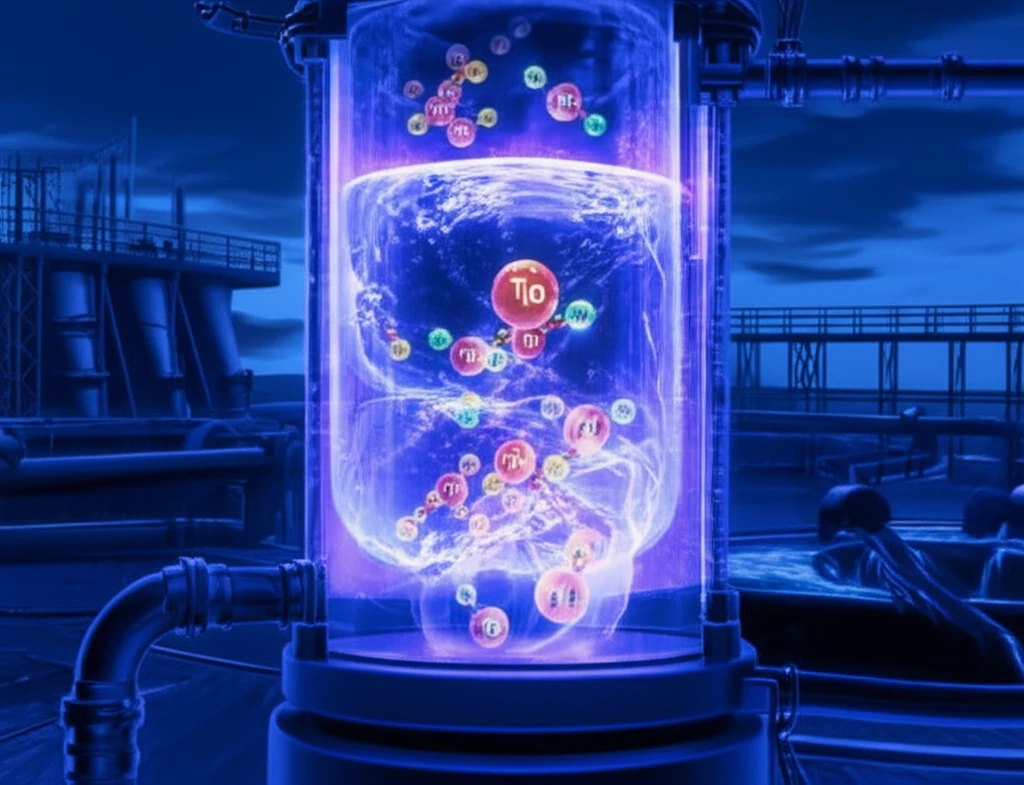
Baffled photocatalytic reactor degrading Acid Orange 52 dye.

Baffled by Wastewater? How This Reactor Design Could Clear Things Up

"A kinetic study reveals how a novel photocatalytic reactor efficiently degrades harmful dyes, offering a promising solution for textile industry wastewater treatment."


In recent years, the quest for cleaner water has led to the development of advanced oxidation processes (AOPs). These methods harness the power of highly reactive hydroxyl radicals to obliterate a wide range of organic pollutants, including the persistent dyes used in the textile industry. Among these techniques, the use of titanium dioxide (TiO2) nanoparticles as photocatalysts has emerged as a particularly promising avenue.

Azo dyes, characterized by their vibrant colors and complex molecular structures, pose a significant challenge to conventional wastewater treatment plants. These dyes not only impart undesirable color to water bodies but can also break down into carcinogenic aromatic amines, threatening aquatic ecosystems and human health. Traditional methods often struggle to completely remove these dyes, highlighting the need for innovative solutions.

Now, researchers are exploring innovative reactor designs to enhance the efficiency of TiO2 photocatalysis. A new study investigates a baffled photocatalytic reactor for treating wastewater contaminated with Acid Orange 52 (AO52), a common azo dye. This design aims to improve pollutant contact with the photocatalyst and enhance light distribution, leading to more effective dye degradation. Let's dive into how this technology could revolutionize wastewater treatment.

How Does the Baffled Reactor Boost Dye Degradation?

Baffled photocatalytic reactor degrading Acid Orange 52 dye.

The core of this technology lies in its unique reactor design. Unlike traditional systems, this reactor incorporates a series of baffles strategically placed to create a swirling flow pattern. These baffles, coated with TiO2 nanoparticles, maximize the contact between the dye molecules and the photocatalyst. When exposed to UV light, the TiO2 nanoparticles become activated, generating highly reactive hydroxyl radicals that attack and break down the AO52 dye.

The study meticulously examined the impact of various factors on the reactor's performance, including pH levels, dye concentration, TiO2 nanoparticle loading, flow rate, and temperature. What they found?

  • Hydroxyl Radicals are Key: Active species scavenging experiments revealed that hydroxyl radicals play a dominant role in the degradation process, followed by superoxide radicals.
  • Biodegradability Boost: The reactor significantly improved the wastewater's biodegradability. The BOD5/COD ratio, a measure of how easily wastewater can be treated biologically, increased substantially after treatment, making it suitable for further processing in conventional wastewater treatment plants.
  • Toxicity Reduction: LC-MS analysis showed that the initial breakdown of AO52 resulted in the formation of less toxic benzene annular compounds, indicating a significant reduction in overall wastewater toxicity.
The degradation kinetics closely followed a pseudo-first-order model, well-described by the Langmuir-Hinshelwood mechanism. This model helps predict the rate of dye breakdown under different operating conditions, allowing for optimization of the reactor's performance.

A Promising Step Towards Cleaner Water

This study showcases the potential of baffled photocatalytic reactors as an effective and sustainable solution for treating textile wastewater. By immobilizing TiO2 nanoparticles on baffles and optimizing reactor parameters, the technology achieves efficient dye degradation, reduces wastewater toxicity, and enhances biodegradability.

The kinetic modeling provides valuable insights into the reaction mechanisms and allows for the prediction of reactor performance under various conditions. This knowledge can be used to design and optimize full-scale wastewater treatment plants using this technology.

While further research is needed to address potential challenges such as catalyst fouling and long-term stability, this innovative approach offers a promising pathway toward cleaner water and a more sustainable textile industry. It's a reminder that creative engineering and a dash of photocatalysis can go a long way in tackling complex environmental problems.

About this Article -

This article was crafted using a human-AI hybrid and collaborative approach. AI assisted our team with initial drafting, research insights, identifying key questions, and image generation. Our human editors guided topic selection, defined the angle, structured the content, ensured factual accuracy and relevance, refined the tone, and conducted thorough editing to deliver helpful, high-quality information.See our About page for more information.

This article is based on research published under:

DOI-LINK: 10.1016/j.jes.2018.06.012, Alternate LINK

Title: Kinetic Study On Photocatalytic Degradation Of Acid Orange 52 In A Baffled Reactor Using Tio2 Nanoparticles

Subject: General Environmental Science

Journal: Journal of Environmental Sciences

Publisher: Elsevier BV

Authors: Payam Zanganeh Ranjbar, Bita Ayati, Hossein Ganjidoust

Published: 2019-05-01

Everything You Need To Know

1

How does the baffled photocatalytic reactor work to degrade dyes in wastewater?

The baffled photocatalytic reactor enhances dye degradation through a unique design incorporating strategically placed baffles coated with titanium dioxide (TiO2) nanoparticles. These baffles create a swirling flow pattern, maximizing contact between dye molecules, such as Acid Orange 52, and the TiO2 photocatalyst. When exposed to UV light, the TiO2 nanoparticles generate highly reactive hydroxyl radicals that break down the dye. This design also enhances light distribution, contributing to more effective dye degradation.

2

What role do hydroxyl radicals play in the baffled reactor's dye degradation process, and what other changes occur in the wastewater?

The degradation of Acid Orange 52 by the baffled reactor primarily relies on hydroxyl radicals. Active species scavenging experiments confirm that hydroxyl radicals play a dominant role in breaking down the dye, followed by superoxide radicals. The reactor's efficiency is also reflected in the enhanced biodegradability of the wastewater, shown by an improved BOD5/COD ratio, and a reduction in toxicity, indicated by the formation of less toxic benzene annular compounds.

3

What kinetic model describes the degradation of Acid Orange 52 in the baffled reactor, and how is it useful?

The study found that the degradation kinetics of Acid Orange 52 in the baffled reactor closely followed a pseudo-first-order model, which is well-described by the Langmuir-Hinshelwood mechanism. This model allows researchers to predict the rate of dye breakdown under various operating conditions by relating the dye degradation rate to the concentration of the dye and the adsorption characteristics on the TiO2 nanoparticle surface. This predictive capability enables the optimization of the reactor's performance by adjusting parameters such as flow rate, pH, and TiO2 loading.

4

Why are Advanced Oxidation Processes (AOPs) important in wastewater treatment?

Advanced Oxidation Processes (AOPs) are crucial because they offer a powerful means to degrade a wide range of organic pollutants in wastewater, including persistent dyes like those from the textile industry. These processes, which often utilize titanium dioxide (TiO2) nanoparticles as photocatalysts, generate highly reactive hydroxyl radicals. These radicals can effectively obliterate pollutants that traditional wastewater treatment methods struggle to remove, addressing the challenges posed by complex and harmful compounds like azo dyes and contributing to cleaner water and a healthier environment.

5

How does the baffled photocatalytic reactor utilize titanium dioxide (TiO2) nanoparticles, and what factors influence its effectiveness?

The baffled photocatalytic reactor uses titanium dioxide (TiO2) nanoparticles, which, when exposed to UV light, become activated and generate hydroxyl radicals. These radicals initiate the degradation of pollutants like Acid Orange 52. The effectiveness of this process depends on factors like pH levels, dye concentration, TiO2 nanoparticle loading, flow rate, and temperature. Optimizing these parameters is crucial for maximizing the reactor's performance and ensuring efficient dye degradation, reduced wastewater toxicity, and enhanced biodegradability. The reactor's ability to enhance the wastewater's biodegradability, measured by the BOD5/COD ratio, indicates that the treated water is more amenable to subsequent biological treatment processes, offering a comprehensive approach to wastewater management.

Newsletter Subscribe

Subscribe to get the latest articles and insights directly in your inbox.