
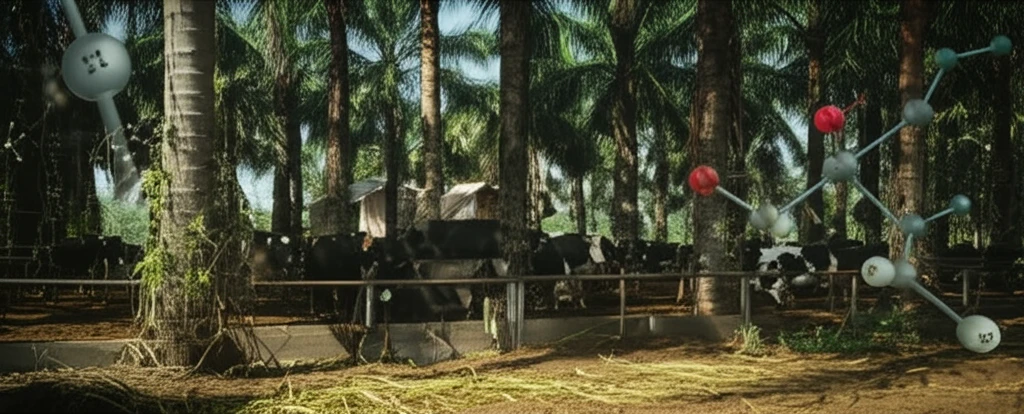
Babassu Meal: Unlocking a Sustainable Food Source for Ruminants

"Exploring the potential of babassu residue as a cost-effective and environmentally conscious feed alternative for livestock."
In an era where environmental consciousness and sustainable practices are paramount, the agricultural sector faces increasing pressure to adopt cleaner and more efficient technologies. The quest for alternative food sources that reduce production costs while maintaining nutritional value has led to a surge of interest in regional resources. Brazil, with its vast territorial expanse and diverse climate, is uniquely positioned to explore and leverage its natural bounty for energy and food production.
Traditionally, livestock diets rely heavily on corn and soy, which can constitute up to 90% of feed ingredients and significantly drive up costs. This dependence on a limited number of sources makes the industry vulnerable to price fluctuations and supply chain disruptions. Therefore, identifying and integrating alternative feedstuffs is crucial for ensuring economic stability and environmental responsibility.
This article delves into the potential of babassu meal, a residue from babassu oil production, as a viable alternative for ruminant feed. By evaluating its nutritional properties and digestibility, we aim to uncover whether this locally abundant resource can contribute to a more sustainable and cost-effective approach to livestock farming.
A Low-Cost Protein and Energy Feed
Babassu oil meal contains 22-25% crude protein and 15-32% crude fiber, positioning it as a viable protein or energy feed for ruminants. Because of its low cost, it can be an economically attractive substitute for more expensive sources of protein and energy at a time when conventional feedstuffs such as corn, soybean meal and fish meal continue to rise in price.
Feeding Trials and Ration Substitution
Babassu meal is palatable and is used in ruminant diets in much the same way as coconut meal, typically as a substitute for other feedstuffs within a complete mixed ration. Standard practice has been validated through digestion and growth trials, including feedlot studies in which babassu meal replaced 0, 10, 20 and 30% of Panicum maximum hay in isonitrogenous diets for lambs. A limitation of this approach is that its fiber content must be managed carefully within the ration.
Early Feeding-Value Digestion Trials
Foundational digestion trials were conducted to establish the feeding values of perilla meal, hempseed meal, babassu meal, and kapok meal for ruminants. These early experiments laid the groundwork for treating babassu meal as a legitimate ruminant feed ingredient and informed decades of subsequent substitution studies.
Evaluating Babassu Meal as Ruminant Feed
A study was conducted to assess the nutritional value of babassu meal when included in ruminant diets. The experiment, designed as a randomized block with four treatments and six repetitions, aimed to determine the optimal inclusion level of babassu meal while monitoring its impact on digestibility and overall nutritional balance. Twelve Santa Inês male lambs were selected for the study, ensuring uniformity in breed and developmental stage.
- Napier grass hay: Provided the roughage necessary for ruminant digestion.
- Soybean meal: Served as a protein source to balance the diet.
- Citrus pulp: Added to improve palatability and provide additional energy.
- Babassu meal: Included at increasing levels to assess its impact.
Recent Feedlot and Digestibility Studies
Recent research evaluated the performance and nutrient digestibility of lambs kept in feedlot and fed complete mixed rations containing babassu meal at inclusion levels of 0, 10, 20 and 30% in substitution for Panicum maximum hay. Additional studies have assessed the nutritional value and inclusion levels of babassu meal in grower layer pullet diets through digestibility, metabolism and growth trials, while reviews continue to examine babassu and its by-products in both poultry and ruminant nutrition.
Fiber, Fiber Limits and Regulatory Scrutiny
The relatively high crude fiber content of babassu meal, ranging from 15 to 32%, can constrain its inclusion in finely balanced rations and may affect digestibility at higher substitution levels. Research is needed to confirm optimal inclusion rates for different ruminant classes, and ruminant feed use remains subject to regulatory oversight, including FDA inspections for compliance with BSE and ruminant feed regulations.
A Cheaper Alternative to Conventional Feeds
Rising costs of conventional feedstuffs such as corn, soybean meal and fish meal have increased the demand for cheaper alternatives in animal diets, and babassu meal fills that role as a lower-cost source of both protein and energy. It is palatable and can be used in the same manner as coconut meal, giving producers a flexible substitute whose composition (22-25% crude protein, 15-32% crude fiber) compares favorably for ruminant applications.
Conclusion: Balancing Sustainability and Nutrition
The findings of this study suggest that babassu meal has a relatively low nutritional value for ruminants, particularly in terms of energy. Its inclusion in diets should be limited to a maximum of 20% of dry matter intake to avoid reducing digestibility and animal productivity. While babassu meal may not serve as a primary feed source, it can be a valuable component of a sustainable feeding strategy when used judiciously. Future research should focus on optimizing babassu meal processing methods to improve its nutritional profile and enhance its economic viability for livestock farmers.
Palatable, Cheap and Ruminant-Ready
Across the available evidence, babassu meal emerges as a palatable, low-cost feed ingredient that can substitute for more expensive protein and energy sources in ruminant diets. Its dual role as either a protein or an energy feed, supported by decades of digestion trials, makes it a practical choice for cost-conscious ration formulation.
Refining Inclusion Levels and Feed Processing
Future work should refine optimal babassu meal inclusion levels across beef cattle, dairy cattle, sheep and goats, building on the feedlot and digestibility trials reported for lambs. Professionally configured ruminant feed production lines capable of producing pellets for these species suggest that processing infrastructure is ready to scale up babassu-based rations.
Feed Economics and Regulation
The broader challenge is systemic: volatile prices for corn, soybean meal and fish meal pressure producers to find cheaper alternatives, and babassu meal is one response to that economic squeeze. At the same time, the use of ruminant feeds is governed by regulatory frameworks such as FDA BSE and ruminant feed regulations, meaning cost savings must be pursued within compliance.
Practical Gains for Small Ruminant Producers
For farmers starting or expanding sheep and goat operations, affordable raw materials and straightforward ration formulation are decisive, and babassu meal's low cost directly addresses that need. By lowering feed expenses without sacrificing palatability, it helps small-scale ruminant producers sustain their herds in regions where imported protein sources are prohibitively expensive.