
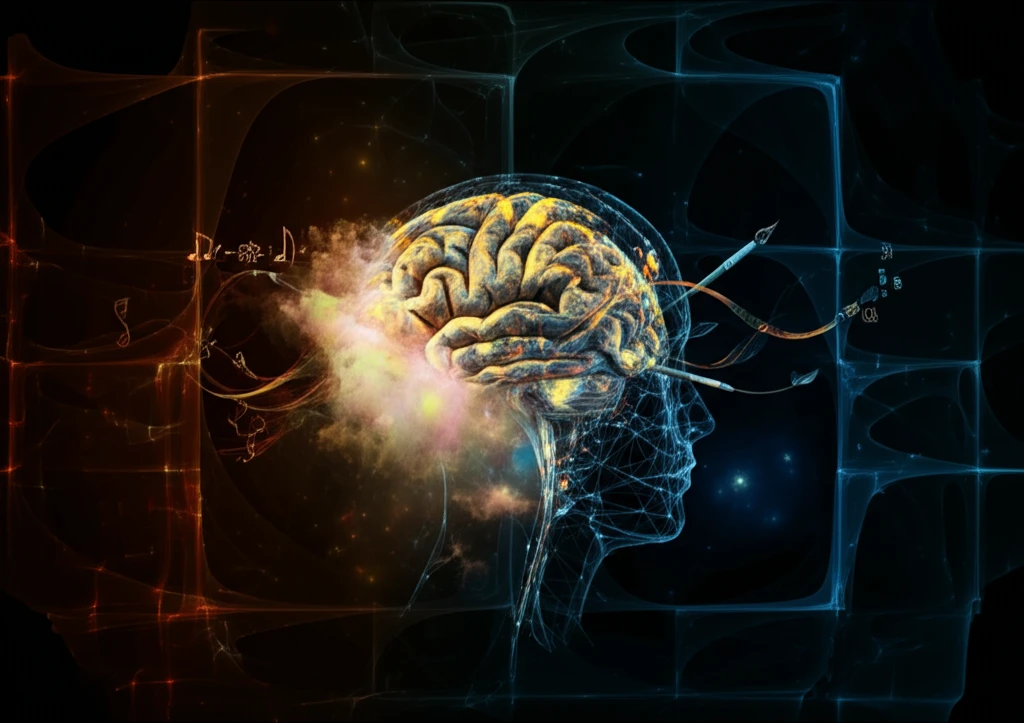
Art Meets Science: How Interdisciplinary Creativity Sparks Innovation

"Discover how the fusion of art and science is reshaping our understanding of the world, driving innovation, and fostering a new wave of interdisciplinary collaboration."
For millennia, art and science have been perceived as distinct disciplines, often relegated to opposite ends of the intellectual spectrum. Art, with its emphasis on creativity, emotion, and subjective interpretation, has long been associated with the humanities. Science, on the other hand, is rooted in empirical observation, rigorous experimentation, and objective analysis. Yet, beneath these perceived differences lies a common thread: a shared quest to understand the world around us. From the ancient cave paintings of Chauvet Cave to modern molecular biology, the interplay between artistic expression and scientific inquiry has been a constant throughout human history.
The integration of art and science is not merely a historical curiosity; it's a burgeoning movement that is reshaping education, driving innovation, and fostering a more holistic understanding of complex problems. As our world becomes increasingly interconnected and complex, the ability to bridge disciplines, think creatively, and communicate effectively is more critical than ever. The STEAM movement, which advocates for integrating the arts into STEM education (science, technology, engineering, and mathematics), is a testament to the growing recognition of the importance of interdisciplinary thinking.
This article delves into the profound ways in which art and science are converging, highlighting examples of collaborative projects, educational initiatives, and groundbreaking discoveries that have emerged from this unlikely partnership. By exploring the historical context, examining contemporary applications, and considering the future potential of this interdisciplinary approach, we aim to demonstrate how the fusion of art and science can unlock new levels of creativity, innovation, and understanding.
Statistics as Science and Storytelling
Official statistics and data science increasingly combine analytical rigor with visual and narrative craft. The Office for National Statistics is the UK's largest independent producer of official statistics and its recognised national statistical institute, gathering data from across the country. Shopify's engineering team describes data science as a balancing act between math, science, art, and communication, with storytelling central to effective data analysis. Dedicated venues and tools such as the Journal of Computational and Graphical Statistics and Google's Dataset Search underline how much of modern statistical work revolves around finding, representing, and interpreting data.
Method Limits and Creative Remedies
Standard methods carry well-documented limitations alongside their strengths, a point captured in methodological discussions of correlational research, whose strengths and weaknesses are routinely assessed. The problem of method heterogeneity is starkly visible in liquid biopsy technologies, where analytical differences across platforms and thresholds can confound direct comparisons and generalization, and a lack of standardized protocols persists. Interdisciplinary approaches offer one corrective: books on drawing as a way of knowing in art and science show how decision-making made visible in the drawing process can be fruitful for artists and scientists alike. In both cases, transparency about method is what separates rigorous inquiry from noise.
Milestones in Art's Long Evolution
The evolution of art is conventionally charted through origins, milestones, and masterpieces, with art itself typically defined as skilled, imaginative creation that pleases the senses and carries symbolic or useful meaning. The very notion of a milestone traces back to 1746, when the word described stone pillars set along roadways to mark distances in miles. The history of AI-generated art extends this arc into the present, reflecting the intersection of technology and human imagination through its own origins and milestones. Together these accounts show how art history keeps adopting new tools while preserving its defining elements of skill, imagination, and symbolic meaning.
Historical Symbiosis: When Artists Were Biologists
The Paleolithic cave paintings found in Chauvet Cave, France, offer a compelling glimpse into the early connections between art and science. These ancient artworks, dating back over 30,000 years, depict a variety of animals with remarkable accuracy and detail. Archaeologist Jean Clottes, who led the team that dated the paintings, emphasizes that these early artists possessed an intimate knowledge of the animals they portrayed, gained through careful observation and interaction with their environment.
- Enhanced Observation: Art trains individuals to observe details and patterns, which can enhance scientific data collection and analysis.
- Creative Problem-Solving: The creative thinking fostered by art can lead to innovative approaches to scientific challenges.
- Effective Communication: Art can help scientists communicate complex ideas to a broader audience, promoting understanding and engagement.
Where Crossover Research Surfaces
Interdisciplinary findings are documented across a wide range of research channels. PNAS publishes the latest articles spanning the biological, physical, and social sciences, while ScienceDaily aggregates breaking news about discoveries in science, health, environment, and technology from leading universities, journals, and research organizations. ResearchGate reports access to more than 160 million publication pages, helping researchers share findings, connect with their scientific community, and collaborate with peers. These venues together illustrate how art-science crossover is surfacing across disciplines and being catalogued at scale.
Criticism as a Path to Improvement
Criticism is part of how science improves rather than a sign of its failure. As the overview on Wikipedia explains, criticism of science addresses problems within science in order to improve science as a whole and its role in society, coming from philosophy, from social movements like feminism, and from within science itself. A helpful distinction, drawn from Coleridge's principle, is that literary criticism concerns the work being criticized, whereas scientific criticism concerns the aspects of the real world that the science addresses. Figures such as evolutionary biologist Stephen Jay Gould, whose public career is examined in Myrna Perez's Criticizing Science, show how scientists themselves navigate such critique.
Comparison as the Common Thread
Comparison sits at the heart of rigorous method in both research and everyday decisions. Clinical studies, for instance, compare dosing regimens directly—such as alternate-day versus daily administration and single morning doses versus twice-daily schedules—to determine what works best. The same logic powers consumer-facing platforms like Versus, which offers side-by-side comparisons across more than 100 categories with detailed specifications, filters, and data visualizations. From clinical trials to habit-tracker guides that weigh desktop apps against upload-based services, comparative thinking is the common thread linking evidence and choice.
The Future of Interdisciplinary Collaboration
The convergence of art and science is not merely a passing trend but a fundamental shift in the way we approach knowledge and problem-solving. By embracing interdisciplinary collaboration, fostering creative thinking, and promoting effective communication, we can unlock new levels of innovation and understanding. As Jonathan Kingdon so eloquently stated, "The humblest field record is always an act of translation," reminding us that all forms of inquiry, whether artistic or scientific, are ultimately about making sense of the world around us and sharing that understanding with others.
The Convergence of Art and Science
Expert commentary increasingly treats art and science as convergent rather than opposed fields. The London Evening Standard reports that recent Government preference for science has accelerated the merging of art and science, with universities offering MA options in combined programmes and scientists—driven by funding outcomes—exploring dialogues with artists. Academic publishing reflects the same impulse, with journals such as Expert Opinion on Drug Delivery foregrounding cross-disciplinary perspectives. Broader knowledge platforms, including JSTOR's browsable collections of journals, books, and research reports and Q&A communities like Quora, circulate this expert exchange to wider audiences.
AI as the Next Engine of Discovery
Future outlooks increasingly centre on artificial intelligence as an engine for discovery. One notable essay, 'Artificial Intelligence to Win the Nobel Prize and Beyond: Creating the Engine for Scientific Discovery,' envisions AI taking a leading role in scientific breakthroughs; the essay circulates through repositories like Sci-Hub, whose database is said to cover more than 90% of scientific articles published in world journals before 2022. On the creative side, AI ecosystems such as ONPASSIVE describe using art to stretch the value of video across social platforms, pointing toward novel applications. Future-oriented research literature across fields, from global poultry production to the arts, routinely pairs current-state assessments with explicit outlooks, a template increasingly applied to interdisciplinary work.
Systemic Pressures on Both Sides
Interdisciplinary art-science work proceeds against formidable systemic pressures. The arts establishment has long cited aging audiences, skyrocketing costs, demographic shifts, failing education, and decreasing social relevance as threats to its future. On the technology side, discussions of artificial intelligence flag the broader impact these systems have on AI credibility and adoption, shaping how new tools are received. Historian Lynn Gamwell has shown how art engages with scientific versions of nature out of a spirit of curiosity, absorbing new advances—evidence that the exchange between fields is valuable but dependent on the health of both institutions.
Deep Engagement Behind Real Impact
Real-world impact ultimately depends on people who bridge research and practice. A SAGE article on planetary challenges argues that deep engagement means continuously straddling the chasm between research and practice while facing the tensions and paradoxes that arise in striving for both practical and scientific impact. The same sensibility has deep roots in conservation science, where Lande's foundational work in Science linked genetics and demography to biological conservation. Institutions such as Taylor's University now frame graduate research explicitly around creating real-world impact, and even everyday pursuits are cast in these terms—an interactive workshop marketed as 'the art and science' of pour-over coffee brewing.