
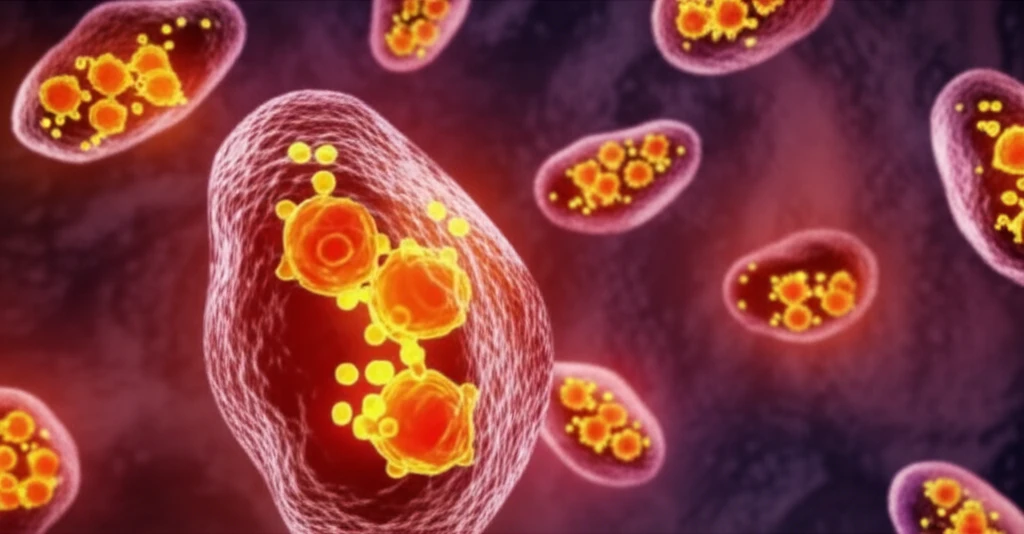
Arsenic Disulfide Attacking Breast Cancer Cells

Arsenic Disulfide: A Promising New Weapon in the Fight Against Breast Cancer?

"Groundbreaking research explores how arsenic disulfide (As2S2), a compound used in traditional medicine, could offer a novel approach to targeting and combating breast cancer cells."


Breast cancer remains one of the most prevalent malignancies affecting women worldwide, urging researchers to explore novel and effective treatments. Conventional approaches like chemotherapy and radiotherapy have limitations due to drug resistance and high recurrence rates, creating a need for innovative therapeutic strategies.

Arsenic trioxide (ATO) has been used to treat acute promyelocytic leukemia. Arsenic disulfide (As2S2) has emerged as a potential anticancer agent. Historically used in traditional medicine in China and Europe, As2S2 has demonstrated promising anticancer effects against various human solid cancer cell lines, while exhibiting reduced toxicity in normal somatic cells. This makes As2S2 a compelling candidate for further investigation in breast cancer treatment.

Recent studies have begun to uncover the potential antitumor activity of As2S2 in human breast carcinoma. As2S2's precise mechanisms of action, particularly its impact on programmed cell death (PCD) pathways like apoptosis and autophagy, remain a key area of investigation. Understanding these molecular mechanisms could unlock new therapeutic strategies for breast cancer.

How Does Arsenic Disulfide Fight Breast Cancer?

Arsenic Disulfide Attacking Breast Cancer Cells

A new study has revealed how arsenic disulfide (As2S2) affects human breast cancer cells. Researchers examined the impact of As2S2 on the survival, growth, and spread of MCF-7 and MDA-MB-231 breast cancer cells. These cells are commonly used in research to model different types of breast cancer.

The findings indicate that As2S2 significantly hampers the ability of breast cancer cells to thrive, survive, and move in a dose-dependent manner. This suggests that higher concentrations of As2S2 lead to a more pronounced inhibitory effect on cancer cell behavior.

  • Cell Cycle Arrest: As2S2 primarily induces cell cycle arrest at the G2/M phase. This means it stops the cancer cells from dividing and multiplying at a specific point in their growth cycle.
  • Apoptosis Induction: The compound encourages apoptosis (programmed cell death) by activating pro-apoptotic proteins. It also affects the balance between proteins that promote and inhibit cell death, increasing the likelihood of cancer cell destruction.
  • Autophagy Stimulation: As2S2 stimulates autophagy, a process where cells break down and recycle their components. This can be a survival mechanism for cells under stress, but in this context, it appears to contribute to the overall anticancer effect.
  • MMP-9 Inhibition: The treatment inhibits matrix metalloproteinase-9 (MMP-9), a protein involved in cancer cell migration and invasion. Reducing MMP-9 levels can help prevent cancer from spreading to other parts of the body.
  • ROS Generation: As2S2 increases the accumulation of reactive oxygen species (ROS) within the cancer cells. ROS can damage cellular components and contribute to cell death.
These combined actions suggest that As2S2 uses a multi-faceted approach to disrupt the progression of breast cancer cells. By regulating cell cycle arrest, triggering apoptosis and autophagy, inhibiting MMP-9 signaling, and increasing ROS generation, As2S2 demonstrates a potent ability to combat cancer cell activity.

The Future of As2S2 in Cancer Therapy

The study indicates that As2S2 inhibits the progression of human breast cancer cells by regulating cell cycle arrest, apoptosis, autophagy, MMP-9 signaling, and ROS generation. Additional research is needed to explore As2S2's potential in animal models, which could pave the way for clinical trials. If successful, As2S2 could become a valuable addition to the arsenal of breast cancer treatments.

About this Article -

This article was crafted using a human-AI hybrid and collaborative approach. AI assisted our team with initial drafting, research insights, identifying key questions, and image generation. Our human editors guided topic selection, defined the angle, structured the content, ensured factual accuracy and relevance, refined the tone, and conducted thorough editing to deliver helpful, high-quality information.See our About page for more information.

This article is based on research published under:

DOI-LINK: 10.3892/or.2018.6780, Alternate LINK

Title: Antitumor Effects Of Arsenic Disulfide On The Viability, Migratory Ability, Apoptosis And Autophagy Of Breast Cancer Cells

Subject: Cancer Research

Journal: Oncology Reports

Publisher: Spandidos Publications

Authors: Yuxue Zhao, Kenji Onda, Kentaro Sugiyama, Bo Yuan, Sachiko Tanaka, Norio Takagi, Toshihiko Hirano

Published: 2018-10-09

Everything You Need To Know

1

What is arsenic disulfide, and why is it being researched for breast cancer treatment?

Arsenic disulfide (As2S2) is a chemical compound being explored as a potential treatment for breast cancer. Research suggests it can inhibit the growth, spread, and survival of breast cancer cells. Unlike some traditional cancer treatments that face issues with drug resistance and recurrence, As2S2 offers a novel approach that targets cancer cells while showing reduced toxicity to normal cells. It's important because it could provide a new option for patients when conventional treatments are not sufficient. This also opens possibilities for creating more targeted and effective therapies.

2

How does arsenic disulfide actually work to combat breast cancer cells?

Arsenic disulfide (As2S2) fights breast cancer through multiple mechanisms. It induces cell cycle arrest, primarily at the G2/M phase, which halts cancer cells from dividing. It also stimulates apoptosis, or programmed cell death, by activating pro-apoptotic proteins and affects the balance between proteins that promote and inhibit cell death, thus increasing the likelihood of cancer cell destruction. Additionally, As2S2 stimulates autophagy, a process where cells recycle their components, and inhibits matrix metalloproteinase-9 (MMP-9) which is involved in cancer cell migration, and increases the generation of reactive oxygen species (ROS).

3

What does cell cycle arrest mean, and why is it important in the context of arsenic disulfide's effect on cancer cells?

Cell cycle arrest refers to halting the progression of cells through their division cycle. Arsenic disulfide (As2S2) induces cell cycle arrest at the G2/M phase in breast cancer cells. This is significant because it prevents cancer cells from dividing and multiplying, effectively stopping them in their tracks. Without cell cycle arrest, cancer cells would continue to proliferate unchecked, leading to tumor growth and spread. The implication is that by inducing cell cycle arrest, As2S2 can slow down or halt the progression of cancer.

4

Can you explain what apoptosis is and why it's relevant to how arsenic disulfide fights cancer?

Apoptosis is programmed cell death, a natural process where cells self-destruct when they are no longer needed or have become damaged. Arsenic disulfide (As2S2) encourages apoptosis in breast cancer cells by activating pro-apoptotic proteins and affecting the balance between proteins that promote and inhibit cell death. This is important because cancer cells often evade apoptosis, allowing them to survive and proliferate uncontrollably. By promoting apoptosis, As2S2 helps eliminate cancer cells. The implication is that triggering apoptosis can be a key strategy in cancer treatment.

5

What are reactive oxygen species, and how do they play a role in arsenic disulfide's anticancer activity?

Reactive oxygen species (ROS) are highly reactive molecules formed as a natural byproduct of oxygen metabolism. However, excessive ROS can damage cellular components and lead to cell death. Arsenic disulfide (As2S2) increases the accumulation of ROS within cancer cells. This is significant because the increased ROS can overwhelm the cancer cells' defense mechanisms, leading to damage and ultimately contributing to cell death. The implication is that by increasing ROS, As2S2 leverages a vulnerability in cancer cells to promote their destruction.

Newsletter Subscribe

Subscribe to get the latest articles and insights directly in your inbox.