
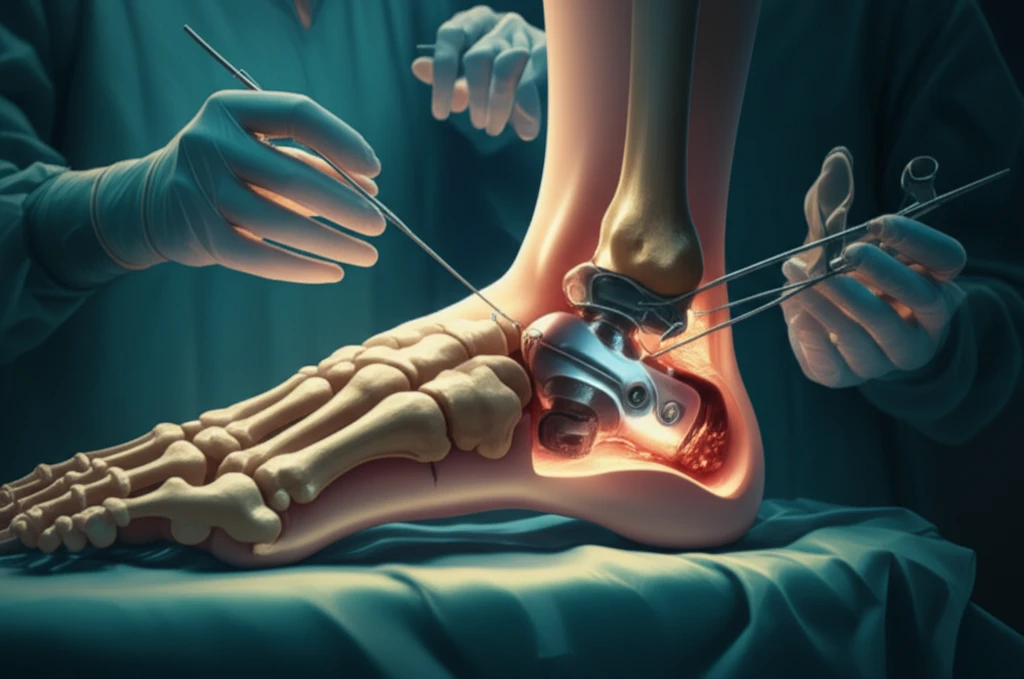
Illustration of a surgeon performing revision total ankle arthroplasty, highlighting the potential for healing and restored mobility.

Ankle Replacement Not Working? What You NEED to Know About Revision Total Ankle Arthroplasty

"Facing a failed ankle replacement can be daunting. This guide breaks down revision total ankle arthroplasty, offering clarity and hope."


Total ankle arthroplasty (TAA), or ankle replacement surgery, has become a popular treatment for severe ankle arthritis. It's designed to restore mobility and alleviate pain, but like any major surgery, it isn't always a perfect solution. Sometimes, an ankle replacement fails, leaving patients facing the prospect of a revision total ankle arthroplasty (RTAA).

The decision to undergo RTAA can feel overwhelming. You might be wondering why your initial surgery didn't work, what the revision process involves, and if it will truly provide lasting relief. This article aims to address those concerns, providing a clear and compassionate overview of RTAA. Our goal is to help you understand the complexities of this procedure, empowering you to make informed decisions about your care.

This guide delves into the key aspects of RTAA, from the reasons for failure and the surgical steps involved to the recovery process and potential outcomes. We'll also explore the critical role of experienced surgeons and the importance of setting realistic expectations. Remember, you're not alone, and knowledge is the first step towards regaining your quality of life.

Why Ankle Replacements Fail: Understanding the Root Causes

Illustration of a surgeon performing revision total ankle arthroplasty, highlighting the potential for healing and restored mobility.

Ankle replacements, while often successful, can fail for a variety of reasons. Identifying the cause of failure is the first and most crucial step in determining the best course of action for a revision. Several factors can contribute to an unsuccessful outcome. These issues can arise from problems with the initial surgery, the implant itself, or even the patient's health and lifestyle.

One of the most common reasons for failure is component malalignment, meaning the implants weren't positioned correctly during the original surgery. This can lead to uneven stress on the joint, accelerating wear and tear. Another issue is aseptic loosening, where the implant becomes detached from the bone due to the body's inflammatory response, often triggered by microscopic debris. Other causes include:

  • Infection: Periprosthetic joint infection (PJI) is a serious complication that can lead to implant failure.
  • Subsidence: The implant may shift or sink into the bone over time.
  • Component Fracture: Mechanical failure of the implant.
  • Wound Healing Issues: Problems with the incision or surrounding tissues.
  • Ligament Imbalance: Improper soft tissue balance.
  • Bone Loss: Insufficient bone to support the implant.
The complexity of RTAA often arises from the need to address multiple issues simultaneously. Successful revision requires a thorough assessment of the underlying causes of the initial failure. This includes detailed imaging, physical examination, and, in some cases, laboratory tests to determine the best approach.

Embarking on the Path to Recovery

RTAA is a complex procedure, but with the right preparation and support, you can increase your chances of a successful outcome. Remember, every step is a stride towards a more mobile and pain-free future. By understanding the challenges and possibilities, you're empowering yourself to make informed decisions and collaborate with your medical team. With dedication to rehabilitation and realistic expectations, you can look forward to a brighter, more active future.

About this Article -

This article was crafted using a human-AI hybrid and collaborative approach. AI assisted our team with initial drafting, research insights, identifying key questions, and image generation. Our human editors guided topic selection, defined the angle, structured the content, ensured factual accuracy and relevance, refined the tone, and conducted thorough editing to deliver helpful, high-quality information.See our About page for more information.

This article is based on research published under:

DOI-LINK: 10.1016/j.cpm.2017.05.010, Alternate LINK

Title: Revision Total Ankle Arthroplasty

Subject: Orthopedics and Sports Medicine

Journal: Clinics in Podiatric Medicine and Surgery

Publisher: Elsevier BV

Authors: Jerome K. Steck, John M. Schuberth, Jeffrey C. Christensen, Cynthia A. Luu

Published: 2017-10-01

Everything You Need To Know

1

What is revision total ankle arthroplasty (RTAA), and why might someone need it?

Revision total ankle arthroplasty (RTAA) is a surgical procedure performed to address a failed total ankle arthroplasty (TAA), also known as ankle replacement surgery. Someone might need RTAA if their initial TAA fails to provide relief from pain and restore mobility due to issues like component malalignment, aseptic loosening, infection (periprosthetic joint infection or PJI), subsidence, component fracture, wound healing issues, ligament imbalance, or bone loss.

2

What are some of the primary reasons why a total ankle arthroplasty (TAA) might fail, leading to the need for a revision?

A total ankle arthroplasty (TAA) can fail due to several reasons, with component malalignment and aseptic loosening being the most common. Component malalignment refers to the incorrect positioning of the implants during the initial surgery, leading to uneven stress and wear. Aseptic loosening involves the implant detaching from the bone due to the body's inflammatory response, often triggered by microscopic debris. Other reasons include infection (periprosthetic joint infection), subsidence (implant shifting), component fracture, wound healing issues, ligament imbalance, and bone loss.

3

What does the evaluation process involve when determining if revision total ankle arthroplasty (RTAA) is necessary?

The evaluation process for revision total ankle arthroplasty (RTAA) involves a thorough assessment to determine the underlying causes of the initial TAA failure. This includes detailed imaging techniques, such as X-rays or CT scans, to evaluate implant positioning and bone quality. A physical examination is conducted to assess range of motion, stability, and any signs of infection or soft tissue issues. In some cases, laboratory tests may be necessary to rule out infection or other systemic problems. This comprehensive evaluation helps determine the best approach for RTAA.

4

How does revision total ankle arthroplasty (RTAA) address the challenges posed by bone loss or infection?

When bone loss is present, revision total ankle arthroplasty (RTAA) may involve bone grafting to rebuild the deficient bone stock, providing a stable foundation for the new implant. In cases of infection (periprosthetic joint infection or PJI), a two-stage revision may be necessary. The first stage involves removing the infected implant, thoroughly cleaning the joint, and placing a temporary antibiotic spacer. After the infection is eradicated, the second stage involves implanting a new ankle replacement. Addressing these complications requires careful planning and specialized surgical techniques to ensure a successful outcome.

5

What role does rehabilitation play after undergoing revision total ankle arthroplasty (RTAA), and what can patients expect during the recovery process?

Rehabilitation is crucial after revision total ankle arthroplasty (RTAA) to regain strength, mobility, and function in the ankle. The recovery process typically involves a period of immobilization, followed by gradual weight-bearing and physical therapy. Physical therapy focuses on improving range of motion, reducing swelling, and strengthening the surrounding muscles. Patients can expect to gradually increase their activity level over several months, with the goal of returning to a more active and pain-free lifestyle. Adhering to the rehabilitation protocol and setting realistic expectations are essential for a successful recovery.

Newsletter Subscribe

Subscribe to get the latest articles and insights directly in your inbox.