
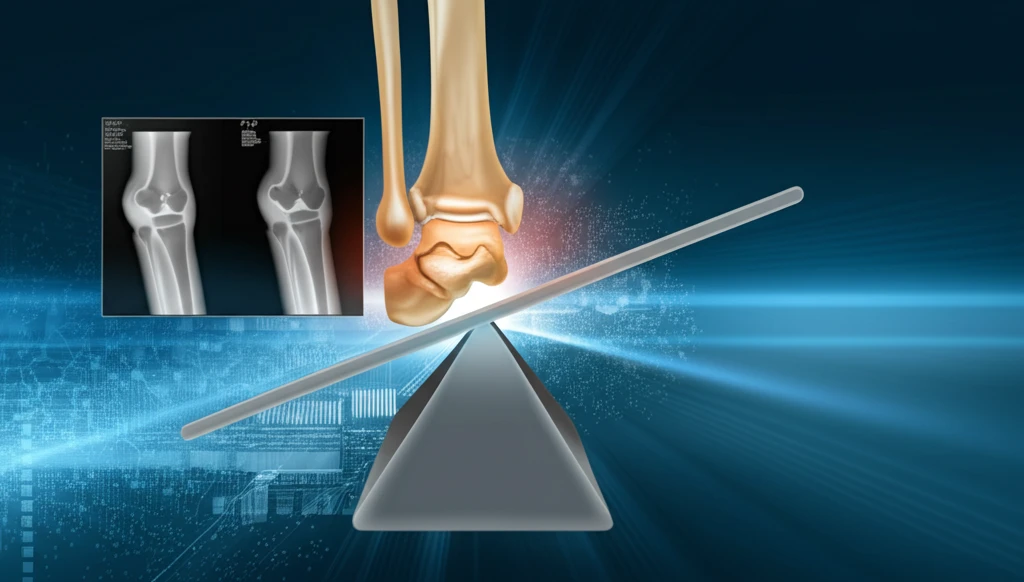
Balanced ankle joint after supramalleolar osteotomy, showcasing corrected alignment.

Ankle Osteoarthritis Breakthrough: Can Supramalleolar Osteotomy Really Correct Tibiotalar Tilt?

"A single-surgeon study reveals promising short-term outcomes for patients with asymmetric ankle osteoarthritis undergoing supramalleolar osteotomy, but questions remain for those with varus osteoarthritis."


Ankle osteoarthritis, a debilitating condition causing pain and limited mobility, often results from asymmetrical joint loading. Supramalleolar osteotomy (SMO) has emerged as a joint-preserving surgical option aimed at correcting lower limb deformities and redistributing weight evenly across the ankle joint. This procedure is particularly relevant for younger, active patients who wish to avoid or delay total ankle replacement.

The primary goal of SMO is to realign the ankle joint by making a precise cut in the tibia (the larger bone in the lower leg) just above the ankle. By doing so, surgeons can correct deformities like varus (bow-legged) or valgus (knock-kneed) alignment, which contribute to uneven wear and tear within the joint. The correction aims to restore a more normal mechanical axis, reducing pain and improving function.

While SMO has shown promise, one critical question remains: Can it effectively correct tibiotalar tilt, an angular deformity between the tibia and talus (the bone that forms the lower part of the ankle joint)? A recent study by Barg and Saltzman (2017) delves into this issue, evaluating the short-term clinical and radiographic outcomes of patients undergoing SMO performed by a single surgeon. Their findings shed light on the potential—and limitations—of this procedure in addressing tibiotalar tilt.

Decoding Supramalleolar Osteotomy: How It Works and Who Benefits?

Balanced ankle joint after supramalleolar osteotomy, showcasing corrected alignment.

The study included 16 patients with asymmetric ankle osteoarthritis and a concomitant supramalleolar deformity. The cohort comprised 7 patients with valgus deformity (corrected via medial closing wedge osteotomy) and 9 patients with varus deformity (corrected via medial opening wedge osteotomy). The average age of participants was 41.6 years, with a predominantly male representation (11 males, 5 females).

Researchers meticulously collected data on intraoperative and postoperative complications, as well as clinical and radiographic outcomes. The average follow-up period was 3.6 years. Clinical assessments included pain levels (using a Visual Analog Scale or VAS), functional ability (measured by range of motion and the American Orthopaedic Foot & Ankle Society or AOFAS hindfoot score), and quality of life (assessed via the SF-36 questionnaire). Radiographic evaluations focused on alignment measurements, such as the medial distal tibial angle, tibiotalar tilt, and calcaneal moment arm, alongside assessments of osteoarthritis severity in the tibiotalar joint.

  • Significant Pain Relief: Patients experienced a notable reduction in pain, dropping from an average of 5.8 to 2.4 on the VAS scale.
  • Improved Function: The AOFAS score, a measure of foot and ankle function, significantly increased from 36 to 84.
  • Enhanced Quality of Life: All categories of the SF-36 questionnaire demonstrated significant improvement.
The study revealed that while SMO led to significant improvements in tibiotalar tilt in both varus and valgus groups, the degree of correction differed. The varus group saw a reduction from 4.8 to 2.3 degrees, while the valgus group improved from 1.8 to 0.2 degrees. Notably, a statistically significant difference remained between the groups postoperatively (p=0.005). Clinical outcomes were comparable between both groups, although one patient with progressive ankle osteoarthritis ultimately required ankle arthrodesis (fusion).

The Future of Ankle Osteoarthritis Treatment: What Does This Mean for You?

The findings suggest that supramalleolar osteotomy can be an effective short-term solution for patients with asymmetric ankle osteoarthritis, offering significant clinical and radiographic improvement. However, the study also highlights that complete correction of tibiotalar tilt may not always be achievable, particularly in patients with varus osteoarthritis. Further research with longer follow-up periods and larger patient cohorts is needed to fully understand the long-term efficacy and limitations of SMO.

About this Article -

This article was crafted using a human-AI hybrid and collaborative approach. AI assisted our team with initial drafting, research insights, identifying key questions, and image generation. Our human editors guided topic selection, defined the angle, structured the content, ensured factual accuracy and relevance, refined the tone, and conducted thorough editing to deliver helpful, high-quality information.See our About page for more information.

This article is based on research published under:

DOI-LINK: 10.1177/2473011417s000111, Alternate LINK

Title: Single-Surgeon Experience With Supramalleolar Osteotomy

Subject: General Medicine

Journal: Foot & Ankle Orthopaedics

Publisher: SAGE Publications

Authors: Alexej Barg, Charles Saltzman

Published: 2017-09-01

Everything You Need To Know

1

What is supramalleolar osteotomy (SMO), and how does it help with ankle osteoarthritis?

Supramalleolar osteotomy (SMO) is a surgical procedure that aims to correct lower limb deformities and redistribute weight evenly across the ankle joint in patients with ankle osteoarthritis. It involves making a precise cut in the tibia, the larger bone in the lower leg, just above the ankle. This allows surgeons to correct alignment issues like varus (bow-legged) or valgus (knock-kneed) deformities. The primary goal is to restore a more normal mechanical axis, thereby reducing pain and improving function in the affected ankle.

2

What were the key findings regarding tibiotalar tilt correction in the study about SMO?

The study demonstrated that supramalleolar osteotomy can improve tibiotalar tilt, an angular deformity between the tibia and talus. The varus group (bow-legged) saw a reduction in tibiotalar tilt from 4.8 to 2.3 degrees, while the valgus group (knock-kneed) improved from 1.8 to 0.2 degrees. However, a statistically significant difference remained between the groups postoperatively, suggesting that the degree of correction may vary depending on the type of deformity.

3

What are the benefits of supramalleolar osteotomy as demonstrated in the study?

The study revealed significant improvements in patients undergoing supramalleolar osteotomy. Patients experienced a notable reduction in pain, measured using the Visual Analog Scale (VAS), dropping from an average of 5.8 to 2.4. Foot and ankle function, as measured by the AOFAS hindfoot score, increased significantly from 36 to 84. Moreover, all categories of the SF-36 questionnaire, which assesses quality of life, showed significant improvement, indicating a positive impact on the patients' overall well-being.

4

Who might be a good candidate for supramalleolar osteotomy, and what are its limitations?

Supramalleolar osteotomy is particularly relevant for younger, active patients with asymmetric ankle osteoarthritis who wish to avoid or delay total ankle replacement. However, it's not a perfect solution for all. One limitation is that complete correction of tibiotalar tilt may not always be achievable, especially in patients with varus osteoarthritis. While the study showed promising short-term results, the long-term efficacy and limitations require further investigation with longer follow-up periods and larger patient cohorts.

5

What are the specific clinical and radiographic outcomes measured in the study, and why are they important?

The study meticulously collected data on both clinical and radiographic outcomes. Clinical assessments included pain levels (using the Visual Analog Scale or VAS), functional ability (measured by range of motion and the American Orthopaedic Foot & Ankle Society or AOFAS hindfoot score), and quality of life (assessed via the SF-36 questionnaire). Radiographic evaluations focused on alignment measurements, such as the medial distal tibial angle, tibiotalar tilt, and calcaneal moment arm, alongside assessments of osteoarthritis severity in the tibiotalar joint. These measures are crucial for evaluating the effectiveness of supramalleolar osteotomy in terms of pain reduction, improved function, and overall patient well-being. They also help assess how well the procedure corrects underlying deformities that contribute to ankle osteoarthritis.

Newsletter Subscribe

Subscribe to get the latest articles and insights directly in your inbox.