
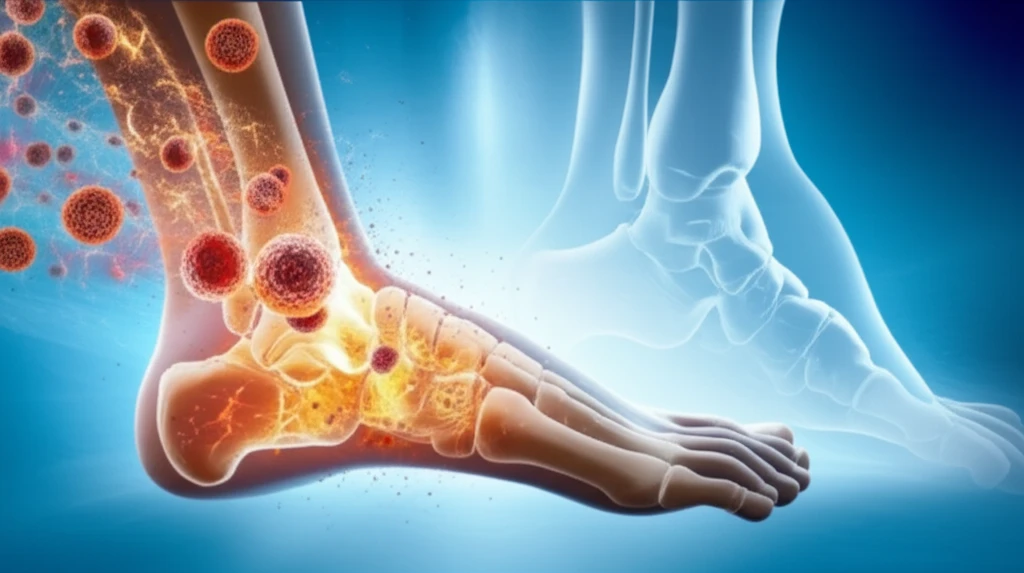
Fractured ankle joint with inflammatory cells being cleared by anti-inflammatory light.

Ankle Fracture Recovery: The Hidden Key to Preventing Long-Term Arthritis

"New research reveals how timing treatment can reduce your risk of post-traumatic osteoarthritis."


Ankle fractures are a common injury, especially among younger, active individuals. While many people recover well, up to 80% can develop post-traumatic osteoarthritis (PTOA) years or even decades later. This raises a critical question: why do some ankle fracture patients develop arthritis, while others don't?

The key may lie in the body's inflammatory response immediately following the fracture. Scientists are increasingly recognizing that the microenvironment within the joint changes dramatically during the initial days after the injury. These changes, influenced by the severity of the fracture and the presence of blood in the joint, can set the stage for long-term joint damage.

New research published in Foot & Ankle International sheds light on this critical window. The study, which analyzed synovial fluid from 54 ankle fracture patients, reveals distinct time-dependent shifts in the levels of inflammatory mediators. Understanding these changes opens the door for more effective, targeted interventions to prevent or delay the onset of PTOA.

What Happens Inside Your Ankle After a Fracture?

Fractured ankle joint with inflammatory cells being cleared by anti-inflammatory light.

Imagine your ankle joint as a delicate ecosystem. When a fracture occurs, this ecosystem is disrupted. Bone fragments, blood, and inflammatory cells flood the joint space, triggering a complex cascade of events. Researchers analyzed the fluid within the ankle joint (synovial fluid) at different time points after the fracture to track these changes.

Here's what they discovered:

  • The First 48 Hours: A surge of both pro-inflammatory (IL-12p70, IL-1β, IL-6) and anti-inflammatory cytokines (IL-10, IL-4) occurs. This is the body's initial attempt to respond to the injury. Levels of MMP-9 and sGAG are also elevated.
  • Days 3-9: Pro-inflammatory activity may persist and exposure to hemarthrosis intensifies this. Messengers and products of cartilage breakdown, including MMP-1, MMP-2, MMP-3, MMP-10, and CTX-II, begin to rise. This indicates that cartilage damage is underway.
  • After 10 Days: While pro- and anti-inflammatory cytokine levels decrease, mediators of cartilage breakdown remain elevated. This suggests that the catabolic (destructive) environment within the joint persists.
These findings reveal a critical takeaway: the ankle joint experiences significant inflammatory fluctuations in the days following a fracture. This environment shifts from an initial inflammatory response to a state of cartilage breakdown, highlighting a key window for potential therapeutic intervention.

How Can You Protect Your Ankle After a Fracture?

The research underscores the importance of early intervention to mitigate the inflammatory cascade and protect cartilage after an ankle fracture. While the study didn't directly investigate specific treatments, the findings suggest several potential strategies:

<ul><li><b>Early Joint Evacuation:</b> The researchers suggest that early evacuation of the joint space, perhaps through lavage or arthroscopy, could help reduce the inflammatory burden. This procedure would aim to remove blood and inflammatory mediators before they can cause significant damage.</li><li><b>Targeted Anti-inflammatory Therapies:</b> Identifying specific mediators that drive cartilage breakdown could lead to more effective, targeted therapies. For example, treatments that block IL-1β or MMPs might help protect cartilage during the critical 3- to 9-day window.</li><li><b>Supporting Anti-inflammatory Processes:</b> Therapies that boost the body's natural anti-inflammatory response, such as those involving IL-10 or IL-4, could also be beneficial, particularly in the initial days after the fracture.</li></ul>

If you've sustained an ankle fracture, discuss these findings with your orthopedic surgeon. By understanding the complex inflammatory processes that occur after a fracture, you can work together to develop a personalized treatment plan that minimizes your risk of developing long-term arthritis and maximizes your chances of a full and active recovery.

About this Article -

This article was crafted using a human-AI hybrid and collaborative approach. AI assisted our team with initial drafting, research insights, identifying key questions, and image generation. Our human editors guided topic selection, defined the angle, structured the content, ensured factual accuracy and relevance, refined the tone, and conducted thorough editing to deliver helpful, high-quality information.See our About page for more information.

This article is based on research published under:

DOI-LINK: 10.1177/1071100717728234, Alternate LINK

Title: Time-Dependent Effects On Synovial Fluid Composition During The Acute Phase Of Human Intra-Articular Ankle Fracture

Subject: Orthopedics and Sports Medicine

Journal: Foot & Ankle International

Publisher: SAGE Publications

Authors: Samuel B. Adams, Rachel M. Reilly, Janet L. Huebner, Virginia B. Kraus, Dana L. Nettles

Published: 2017-09-11

Everything You Need To Know

1

Why do ankle fractures often lead to arthritis?

Ankle fractures often lead to post-traumatic osteoarthritis (PTOA) because of the inflammatory response and subsequent cartilage breakdown within the ankle joint. This process is triggered by bone fragments, blood, and inflammatory cells flooding the joint space, creating an environment that can damage the cartilage over time. If not addressed promptly, this can cause PTOA years or even decades after the initial injury.

2

What happens in the first 48 hours after an ankle fracture?

The first 48 hours after an ankle fracture mark a crucial period due to the initial inflammatory response. The body releases both pro-inflammatory cytokines such as IL-12p70, IL-1β, and IL-6, and anti-inflammatory cytokines like IL-10 and IL-4 to address the injury. There's also an elevation in MMP-9 and sGAG. This initial surge sets the stage for the following days' events, impacting the long-term health of the ankle.

3

What is significant about days 3-9 after an ankle fracture?

Between days 3-9, following an ankle fracture, is a critical phase. This is when the cartilage within the ankle joint begins to break down. Messengers and products associated with cartilage degradation such as MMP-1, MMP-2, MMP-3, MMP-10, and CTX-II, increase, indicating cartilage damage. The presence of hemarthrosis intensifies these processes. This is a key window for intervention to reduce the risk of long-term damage.

4

What does this research tell us about treating ankle fractures?

The research highlights the importance of early intervention. Understanding the body's response to an ankle fracture, scientists can target specific interventions. While the study didn't investigate specific treatments, it suggests potential strategies to mitigate the inflammatory cascade and protect the cartilage. It emphasizes that reducing the impact of the initial inflammatory response is vital for preventing or delaying the onset of post-traumatic osteoarthritis.

5

Does this research mention any specific treatments for ankle fractures?

While this research focuses on the biological processes after an ankle fracture, it does not specify the treatments. However, it suggests the potential for targeted therapies. Such interventions might aim to reduce inflammation, protect cartilage, or promote healing within the joint. The goal would be to influence the inflammatory environment within the ankle joint in the critical window following a fracture, potentially decreasing the likelihood of developing post-traumatic osteoarthritis.

Newsletter Subscribe

Subscribe to get the latest articles and insights directly in your inbox.