
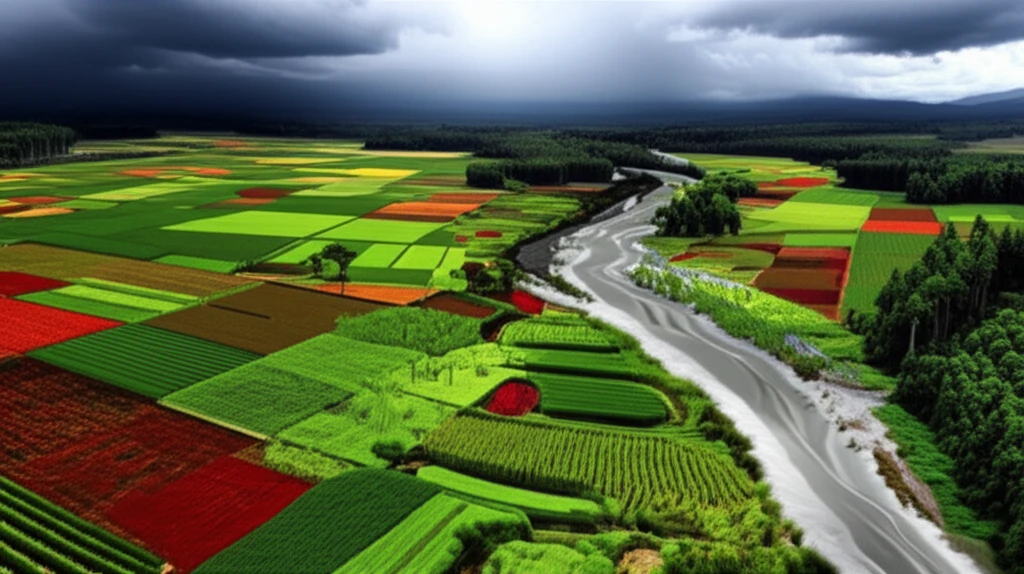
Andean river flowing through farmland and forests, showing the contrast of land use.

Andean River Secrets: How Land Use Shapes Aquatic Plant Life

"Dive into a groundbreaking study revealing the surprising impact of agriculture and deforestation on the delicate balance of Andean river ecosystems."


The small streams nestled within the breathtaking landscapes of the tropical Andes are often overlooked, yet they play a crucial role in maintaining ecological balance. These rivers, teeming with unique aquatic plant communities known as macrophytes, have been studied far less than their larger counterparts. Macrophytes are vital to these ecosystems, supporting algae, invertebrates, fish, and even terrestrial species, while also playing a key role in nutrient cycling and gas exchange.

A new study published in Acta Biológica Colombiana sheds light on the intricate relationship between land use and macrophyte communities in 18 small Andean rivers. Conducted in the coffee-growing region of Colombia, a landscape heavily impacted by human activities, the research examines how different land uses, such as cattle ranching and forestry, affect the composition, diversity, and overall structure of these essential plant communities.

This research seeks to understand how changing land practices impact aquatic ecosystems. It asks: How does land use impact the types of plant communities found in Andean streams?

Unveiling the River's Story: Land Use and Its Aquatic Impact

Andean river flowing through farmland and forests, showing the contrast of land use.

Researchers selected rivers based on the primary land use within their immediate watershed: cattle farming and both natural and planted forests. Sampling took place during two distinct climate periods in 2006—dry and wet seasons—to capture a comprehensive view of the ecological dynamics. The study focused on emergent, submerged, and floating macrophytes, excluding bryophytes, pteridophytes, and equisetales.

In each river, scientists measured several environmental variables, including:

  • pH levels: To assess the acidity or alkalinity of the water.
  • Conductivity: To measure the water's ability to conduct electrical current, indicating the presence of dissolved salts and minerals.
  • Temperature: Because the plants thrive in certain conditions.
  • Dissolved Oxygen: Indicates the health of the water, oxygen being critical.
  • Water Quality Tests: Various tests to measure alkalinity, biochemical oxygen demand (BOD), turbidity, and the presence of nutrients like silicates, phosphorus, and nitrogen.
  • Physical Characteristics: Measurements of channel width, water depth, flow velocity, canopy cover, and substrate type (e.g., fine sediment, rocky).
Statistical analyses, including Principal Component Analysis (PCA) and Canonical Correspondence Analysis (CCA), were employed to identify relationships between environmental variables and macrophyte community structure. These methods helped determine which factors most significantly influenced the distribution and abundance of macrophyte species.

Protecting Andean Rivers: What We Can Learn

This study underscores the urgent need for sustainable land management practices in the Andean region. By recognizing the profound impact of human activities on aquatic ecosystems, we can work towards preserving these vital habitats for future generations. Further research is needed to explore the long-term effects of climate change and pollution on Andean river ecosystems and to develop effective conservation strategies.

About this Article -

This article was crafted using a human-AI hybrid and collaborative approach. AI assisted our team with initial drafting, research insights, identifying key questions, and image generation. Our human editors guided topic selection, defined the angle, structured the content, ensured factual accuracy and relevance, refined the tone, and conducted thorough editing to deliver helpful, high-quality information.See our About page for more information.

Everything You Need To Know

1

What role do macrophytes play in the Andean river ecosystems?

Macrophytes are essential to the Andean river ecosystems, acting as the foundation for the food web. They provide habitat and support algae, invertebrates, fish, and even terrestrial species. They are crucial for nutrient cycling and gas exchange, contributing to the overall health and balance of these ecosystems.

2

How did the study assess the impact of land use on Andean rivers?

The study examined 18 small Andean rivers in the coffee-growing region of Colombia, focusing on areas with different land uses like cattle farming and forestry. Researchers measured several environmental variables, including pH levels, conductivity, temperature, dissolved oxygen, water quality tests (alkalinity, BOD, turbidity, nutrients), and physical characteristics (channel width, water depth, flow velocity, canopy cover, substrate type). These factors were analyzed to determine the impact of land use on macrophyte communities.

3

What specific land use practices were studied and how did they affect the rivers?

The research focused on the impact of cattle farming and both natural and planted forests on the composition, diversity, and structure of macrophyte communities in the Andean rivers. Land use changes can lead to altered water quality, changes in the types of macrophytes present, and a disruption of the ecological balance within these rivers.

4

What scientific methods were used to analyze the collected data on Andean river ecosystems?

The scientists utilized statistical analyses, including Principal Component Analysis (PCA) and Canonical Correspondence Analysis (CCA). These methods helped to identify the relationships between environmental variables, such as pH levels and water temperature, and the structure of macrophyte communities. They helped to determine which environmental factors most significantly influenced the distribution and abundance of macrophyte species within the rivers.

5

Why is it important to study and protect Andean river ecosystems and the macrophytes within them?

Studying Andean river ecosystems is vital because they are delicate environments crucial for ecological balance. Macrophytes support a wide range of life, from algae to terrestrial species, and play key roles in nutrient cycling and gas exchange. Understanding the impact of land use, such as cattle farming and forestry, on these ecosystems allows us to develop sustainable land management practices. Protecting these habitats ensures water quality and biodiversity, safeguarding them for future generations, and mitigating the long-term effects of climate change and pollution.

Newsletter Subscribe

Subscribe to get the latest articles and insights directly in your inbox.