
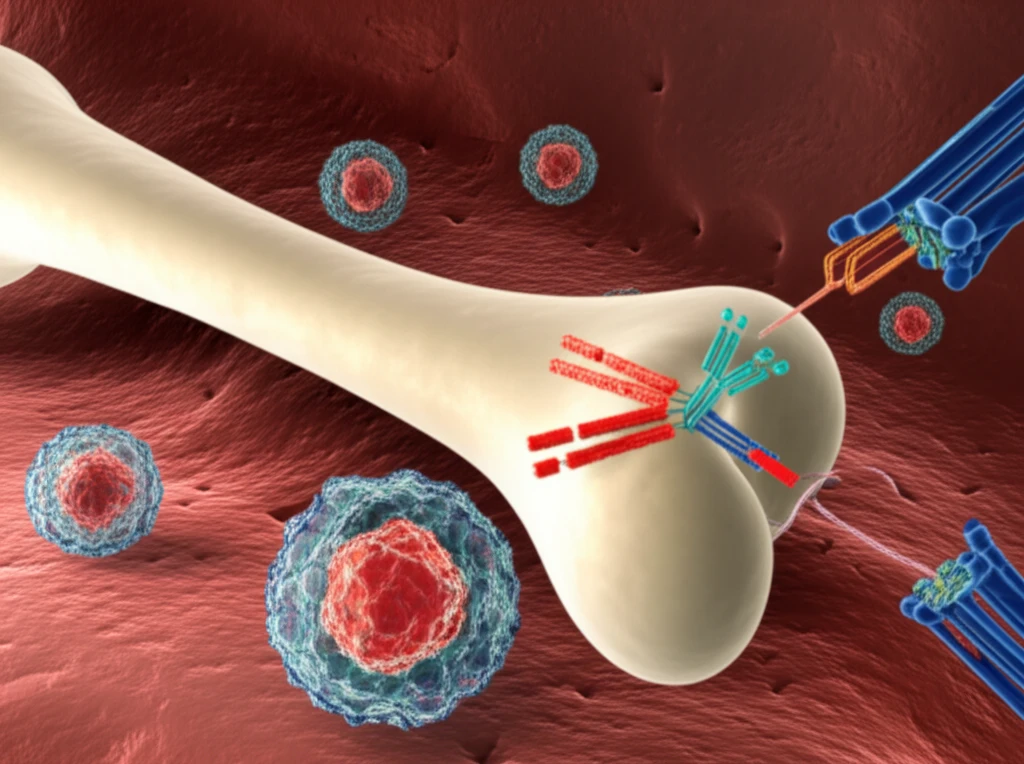
Illustration of immune cells fighting cancer cells in bone marrow.

AML Breakthrough: Can a New Antibody Construct Improve Treatment Outcomes?

"Research suggests a bispecific antibody targeting CD33 could enhance the fight against acute myeloid leukemia by attacking both cancer cells and immune-suppressing cells."


Acute myeloid leukemia (AML) remains a formidable challenge in adult oncology. Despite advancements in treatment, the five-year survival rate lingers below 30%, highlighting the urgent need for innovative therapeutic strategies. Recent research has begun to illuminate the critical role of immune evasion in AML progression and relapse, suggesting that harnessing the immune system could be key to improving patient outcomes.

Among the factors contributing to immune evasion, myeloid-derived suppressor cells (MDSCs) have emerged as significant players. These cells, characterized by their ability to suppress T-cell function, create an environment that shields leukemia cells from immune attack. The presence of MDSCs in AML patients has been linked to poorer responses to therapy and increased risk of relapse, making them an attractive target for novel interventions.

Now, a new study offers a promising approach to targeting MDSCs in AML. Researchers have investigated a CD33/CD3-bispecific antibody construct, which redirects T-cells to eliminate both CD33-expressing AML cells and MDSCs. This dual-targeting strategy holds the potential to overcome immune suppression and enhance the effectiveness of AML therapy. Let's delve into the details of this research and its implications for the future of AML treatment.

What are Myeloid-Derived Suppressor Cells (MDSCs) and Why Do They Matter in AML?

Illustration of immune cells fighting cancer cells in bone marrow.

MDSCs are a diverse population of immune cells that share the ability to suppress T-cell responses. In AML, these cells accumulate in the bone marrow and peripheral blood, creating an immunosuppressive environment that protects leukemia cells from immune attack. MDSCs achieve this suppression through various mechanisms, including the production of immunosuppressive molecules like indoleamine-2,3-dioxygenase (IDO) and arginase.

The presence of MDSCs in AML has been associated with several adverse outcomes:

  • Reduced response to chemotherapy
  • Increased risk of relapse
  • Impaired T-cell function
  • Suppression of anti-tumor immunity
Given their significant role in promoting immune evasion, MDSCs represent a compelling therapeutic target in AML. Strategies aimed at eliminating or neutralizing MDSCs could potentially restore immune function and improve the efficacy of AML therapy. With MDSCs being a key target, scientists have now created a bispecific antibody construct that can target CD33 markers on both cancer cells and MDSCs.

Future Implications for AML Treatment

The study's findings suggest that AMG 330 may offer a dual benefit in AML treatment by directly targeting leukemia cells and simultaneously eliminating immunosuppressive MDSCs. This approach could potentially overcome a significant barrier to effective immunotherapy in AML and improve patient outcomes. Additional research is needed to validate these findings in clinical trials and to explore the potential of combining AMG 330 with other immunotherapeutic strategies.

About this Article -

This article was crafted using a human-AI hybrid and collaborative approach. AI assisted our team with initial drafting, research insights, identifying key questions, and image generation. Our human editors guided topic selection, defined the angle, structured the content, ensured factual accuracy and relevance, refined the tone, and conducted thorough editing to deliver helpful, high-quality information.See our About page for more information.

Everything You Need To Know

1

What are Myeloid-Derived Suppressor Cells (MDSCs), and what role do they play in acute myeloid leukemia (AML)?

Myeloid-Derived Suppressor Cells, or MDSCs, are a group of immune cells that suppress T-cell responses. In acute myeloid leukemia (AML), MDSCs accumulate in the bone marrow and blood, creating an environment that protects leukemia cells from immune attack. They suppress the immune system by producing molecules like indoleamine-2,3-dioxygenase (IDO) and arginase. The presence of MDSCs in AML is associated with reduced response to chemotherapy, increased relapse risk, impaired T-cell function, and suppression of anti-tumor immunity. Because of this they are considered an important target for AML treatments.

2

What is a CD33/CD3-bispecific antibody construct, and how does it work to combat acute myeloid leukemia (AML)?

A CD33/CD3-bispecific antibody construct is a type of immunotherapy designed to redirect T-cells to eliminate cells expressing the CD33 marker. In the context of AML, it's designed to target both CD33-expressing AML cells and myeloid-derived suppressor cells (MDSCs). This approach aims to overcome immune suppression and enhance the effectiveness of AML therapy. The bispecific antibody construct could improve outcomes for AML patients by attacking both leukemia cells and immune-suppressing cells.

3

What is CD33, and why is it a target in acute myeloid leukemia (AML) therapy?

CD33 is a marker present on both acute myeloid leukemia (AML) cells and myeloid-derived suppressor cells (MDSCs). By targeting CD33 with a bispecific antibody construct, therapy can eliminate both the cancerous cells and the immune-suppressing cells that protect the cancer. By eliminating these cells this allows for a better response to therapy.

4

Why is there a need for innovative treatments in acute myeloid leukemia (AML)?

The five-year survival rate for acute myeloid leukemia (AML) is low, remaining below 30%. This is due to immune evasion in AML progression and relapse. Myeloid-derived suppressor cells (MDSCs) also contribute because they shield leukemia cells from immune attack and suppress T-cell function. Overcoming these factors is crucial for improving treatment outcomes and survival rates. The development of treatments like the CD33/CD3-bispecific antibody construct will hopefully improve the statistics.

5

Why is immunotherapy considered a promising approach for treating acute myeloid leukemia (AML)?

Immunotherapy in acute myeloid leukemia (AML) seeks to harness the patient's own immune system to fight the cancer. This approach is important because AML cells often evade detection and destruction by the immune system. Strategies such as using a CD33/CD3-bispecific antibody construct enhance the immune system's ability to target and eliminate both AML cells and myeloid-derived suppressor cells (MDSCs). Immunotherapy is an important aspect to improve patient outcomes.

Newsletter Subscribe

Subscribe to get the latest articles and insights directly in your inbox.