
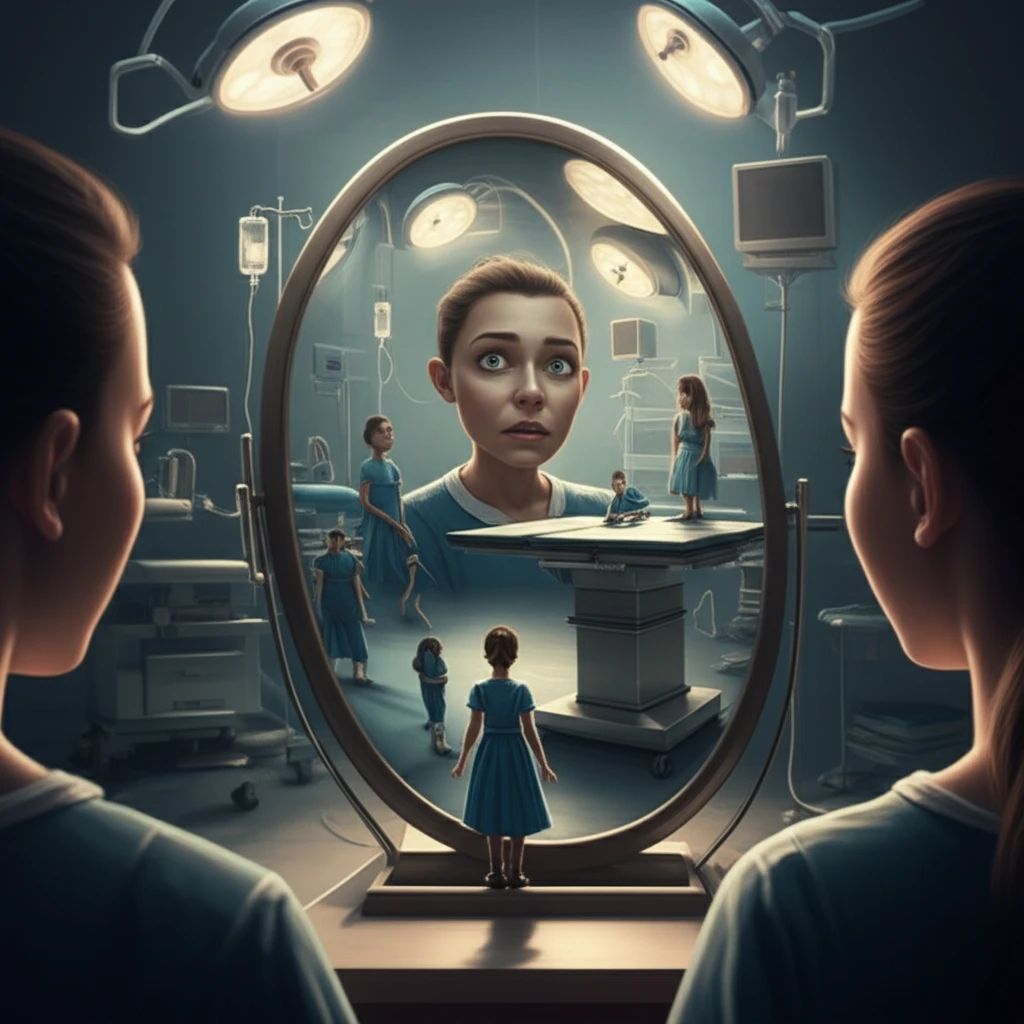
Alice in Wonderland Syndrome: When Reality Gets a Little Too "Curious"

"Discover how a ventriculoatrial shunt revision triggered a temporary case of Alice in Wonderland Syndrome, blurring the lines between perception and reality."
Visual misperceptions following neurosurgical procedures are rare, but intriguing. Alice in Wonderland Syndrome (AWS), typically linked to neurological and psychiatric conditions, involves distortions in perception, affecting how individuals see their own bodies and the world around them. This article explores a unique case where AWS emerged after a ventriculoatrial shunt revision, offering insights into the syndrome's potential triggers and the brain's complex visual pathways.
AWS is characterized by a range of perceptual distortions. Individuals may experience micropsia (objects appearing smaller than they are) or macropsia (objects appearing larger). Somesthetic hallucinations, where one feels their body is distorted in size, are also common. These symptoms can be unsettling, but it's important to remember they are a result of altered brain function, not a sign of psychosis.
While AWS has been associated with migraines, epilepsy, and even the Epstein-Barr virus, this article delves into a less common cause: surgical intervention. By examining this unusual case, we aim to shed light on the mechanisms behind AWS and expand our understanding of how medical procedures can impact perception.
The Case: A Post-Surgical Twist in Perception
Our patient, a 48-year-old male with a history of cerebrospinal fluid (CSF) diversion due to hardware failure, underwent a routine revision of his ventriculoatrial shunt. While previous revisions caused no psychological disturbances, this time was different. Shortly after the procedure, he began experiencing visual distortions characteristic of AWS.
- Symptoms: Macrosomatognosia (feeling of an enlarged body) and micropsia (seeing small heads on others).
- Cause: Post-operative, following a ventriculoatrial shunt revision.
- Patient Awareness: Aware that the perceptions were not real.
- Resolution: Symptoms resolved within approximately 12 hours.
Unlocking the Looking Glass: Implications and Future Directions
This case highlights the intricate relationship between brain surgery and perception. While visual disturbances following neurosurgery are not uncommon, AWS is a rarely reported phenomenon in this context. This suggests the condition may be more prevalent than previously thought but often goes unrecognized.
The manipulation of the parieto-occipital cortex, a region responsible for integrating visual and sensory information, appears to be a key factor in triggering AWS in this particular case. The inflammatory response resulting from the surgical intervention may have temporarily disrupted the normal functioning of this brain area, leading to the perceptual distortions.
Further research is needed to pinpoint the specific locations within the brain that, when affected, lead to AWS. Understanding the underlying mechanisms will help to better identify, manage, and potentially prevent this curious syndrome in the future. As with other patients with this self-limited syndrome, our patient's symptoms resolved without intervention.