
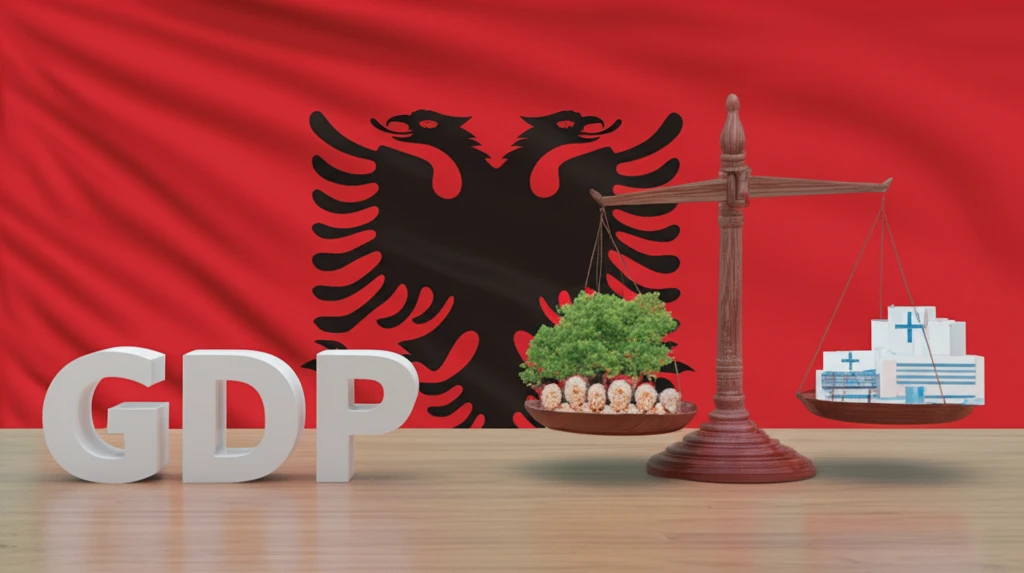
Albania's Quality of Life Conundrum: Are Official Numbers Painting a Real Picture?

"Dive into the challenges of measuring societal well-being in Albania, where economic indicators might not reflect the lived experiences of its citizens."
The concept of 'quality of life' is multifaceted, extending beyond simple economic metrics like GDP. For Albania, a nation undergoing significant transformation, understanding the true quality of life requires a critical examination of the indicators used and the challenges in obtaining accurate data.
Official statistics often paint an optimistic picture, but do these numbers truly reflect the everyday realities for Albanians? Factors such as access to healthcare, education, environmental quality, and social well-being play crucial roles but are often overshadowed by macroeconomic figures.
This article delves into the problems of defining and measuring quality of life in Albania, analyzing the reliability of current indicators and exploring the systemic issues that hinder accurate assessments. By understanding these challenges, we can better evaluate Albania's progress and identify areas needing urgent attention.
Official Figures vs. Composite Indices
Albania's Institute of Statistics reports inflation at 3.4% as of July 2026 and records ongoing economic growth in the first quarter of 2026. STATLAS places the country's GDP per capita at $28,221 with a life expectancy of 79.8 years, while its composite quality of life index scores 78.5 out of 100—ranking Albania 58th of 210 countries. Numbeo independently evaluates Albanian livability through indicators including purchasing power, safety, pollution, climate, and traffic. The divergence between robust macroeconomic figures and middling livability scores hints at the core tension underlying Albania's quality-of-life debate.
Measurement Methods and Their Blind Spots
Researchers studying quality of life in Albania have employed questionnaires combined with regression models—such as Binary or Tobit probabilistic approaches—to assess residents' perceptions in specific settings like contemporary buildings in Kruja. A 2013 study warned that GDP and GDP per capita, the most commonly used indicators, do not capture the full picture of quality of life in Albania. The methodological challenge is further acknowledged by academic efforts to refine accounting-based parameters for measuring quality of life. These limitations suggest that standard quantitative indicators alone may systematically misrepresent lived experience.
From Illyrians to Underdevelopment
Albania's recorded history stretches back to the Illyrians, an Indo-European people who inhabited the western Balkans from roughly the 10th century BCE. Over four centuries of foreign rule, Albanians maintained distinct cultural and social identities, a resilience that culminated in the 19th-century Albanian Renaissance. By the twentieth century, however, Albania remained one of the poorest and least developed nations in Europe, a characterization echoed by both educational references and IMF publications. This historical baseline of underdevelopment provides essential context for evaluating modern quality-of-life claims.
The GDP Illusion: Why Economic Growth Doesn't Always Mean Better Lives
While Albania has experienced economic growth in recent decades, with GDP per capita increasing, this growth doesn't automatically translate into an improved quality of life for all citizens. The distribution of wealth, access to essential services, and environmental factors all contribute to a person's overall well-being.
- Inaccurate Data: The accuracy of GDP figures is questionable due to inconsistencies in data collection and reporting, particularly in key sectors like agriculture and tourism.
- Uneven Distribution: Economic gains may not be distributed equitably across the population, leading to disparities in living standards.
- Neglect of Non-Economic Factors: GDP ignores crucial aspects of quality of life such as environmental quality, healthcare access, and social cohesion.
Growth Without Satisfaction
Eurofound's 2024 report on quality of life in the Western Balkans and Türkiye evaluates four key dimensions—health and well-being, overall life satisfaction, material living conditions, and perceived quality of society—across Albania and six neighboring countries. Separately, Numbeo's first-half-2025 index ranked Albania last among 37 European countries with a score of 104.1 points, driven largely by low purchasing power. The EBRD's Transition Report found that despite Albania recording one of the region's highest economic growth rates, reported life satisfaction has remained stagnant. This disconnect between macroeconomic performance and subjective well-being is a recurring theme across multiple independent assessments.
Corruption, Pessimism, and Measurement Gaps
A 2024 survey by Monitor magazine found that Albanians attribute stagnant quality of life primarily to two factors: approximately 36% pointed to high levels of corruption and an equal share cited the unsatisfactory economic situation. Numbeo's 2025 data corroborates this pessimism, placing Albania at the bottom of European quality-of-life rankings due to low purchasing power. Academic research has further highlighted the difficulty of defining quality of life through accounting metrics alone, arguing that the parameters used lack sufficient reliability. Together, these findings suggest that both statistical measurement and on-the-ground conditions present obstacles to improving Albanians' lived experience.
Regional Parallels and Open Questions
Albania's quality-of-life challenge is not unique in the Western Balkans, though its specific combination of rapid GDP growth and stagnant satisfaction appears particularly pronounced. Countries in the region generally face similar structural constraints—limited public services, uneven infrastructure, and reliance on remittances—that complicate direct quality-of-life comparisons. Without dedicated cross-national source material for this analysis, definitive comparative claims remain speculative. Further research using standardized regional datasets would be needed to determine whether Albania's experience is an outlier or part of a broader pattern.
Moving Towards Genuine Progress: A Call for Reliable Data and Inclusive Development
Improving the quality of life in Albania requires a shift in focus from solely pursuing economic growth to prioritizing comprehensive well-being. This necessitates establishing independent bodies to collect and analyze data, ensuring accurate and reliable indicators that reflect the lived experiences of all Albanians. By addressing these challenges, Albania can pave the way for genuine progress and a brighter future for its citizens.
Where Growth Meets Its Limits
The available evidence suggests a persistent gap between Albania's improving economic indicators and the quality of life as experienced by its residents. Expert assessments, from Eurofound to the EBRD, converge on the view that growth alone has not translated into commensurate gains in well-being. Whether this reflects measurement failure, structural inequality, or simply the time lag inherent in development remains an open question. A more holistic approach to tracking progress—one that moves beyond GDP—appears increasingly necessary.
Toward More Honest Metrics
Albania's path toward improving quality of life likely depends on addressing the structural issues—corruption, low purchasing power, and public-service gaps—that survey respondents and international bodies have repeatedly identified. Future research could benefit from longitudinal studies tracking individual well-being alongside macroeconomic trends, as well as greater integration of subjective satisfaction data into policy frameworks. The country's EU accession process may serve as both a catalyst for reform and a benchmark for measuring progress. Ultimately, aligning official statistics with lived reality will require not just better data, but better governance.
The Limits of Development Indices
Albania's quality-of-life conundrum reflects a broader global challenge: economic development metrics often fail to capture the multidimensional nature of human well-being. Issues such as environmental quality, social trust, institutional integrity, and access to healthcare are difficult to quantify but profoundly shape daily life. For countries in transition, these systemic challenges are compounded by legacies of underdevelopment and incomplete institutional reform. Recognizing these limitations is a first step toward building more honest and effective policy frameworks.
Lived Experience vs. Statistical Averages
Behind every quality-of-life index is the lived experience of individuals navigating Albania's economic and social landscape. Surveys consistently show that citizens perceive their situation through the lens of corruption, employment prospects, and access to services—factors that statistical averages can obscure. When official numbers diverge from personal experience, public trust in institutions erodes, further complicating efforts at reform. Ultimately, the true measure of Albania's progress will be found not in datasets, but in the tangible improvements people feel in their daily lives.