
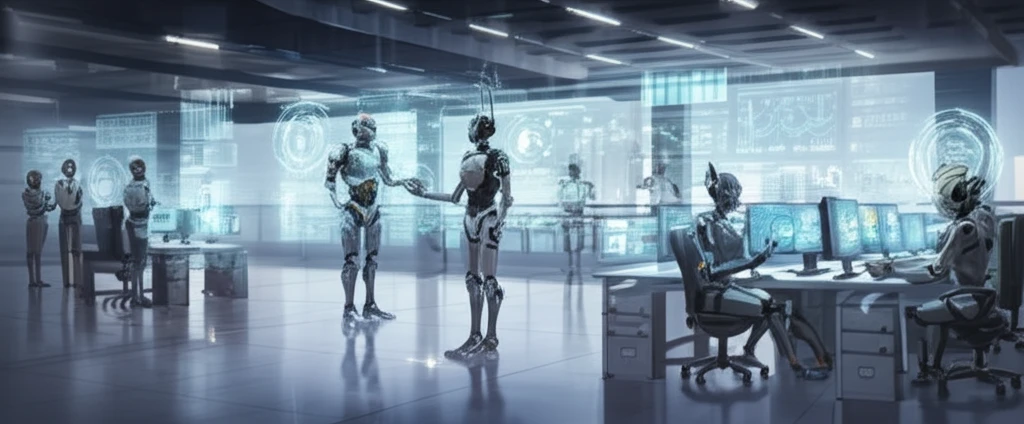
Futuristic customer service center with AI bots assisting human agents

AI Customer Service: How LLMs are Revolutionizing Tech Support

"Discover how Large Language Models are transforming technical customer service, making it faster, more efficient, and personalized for the modern consumer."


In today's fast-paced world, providing reliable and responsive technical customer service (TCS) is a significant challenge for many companies. Customers expect immediate solutions, and businesses struggle to meet these demands due to skilled labor shortages and overwhelming amounts of information. However, a new wave of technology is poised to revolutionize TCS: Large Language Models (LLMs).

LLMs, such as OpenAI's GPT-4, are set to transform TCS by offering efficient and personalized support. These AI models can handle high volumes of customer interactions, significantly reducing the need for extensive human resources and providing substantial cost savings. This shift marks a new era in customer service, where AI-driven solutions enhance both the customer and agent experience.

This article delves into the potential of LLMs in automating cognitive tasks within TCS, examining real-world applications and future possibilities. Discover how LLMs are not just a theoretical concept but a practical solution that can redefine how companies approach technical support.

The Cognitive Revolution: Automating Tasks with LLMs

Futuristic customer service center with AI bots assisting human agents

LLMs are proving to be invaluable tools in automating various cognitive tasks that were once exclusively performed by human agents. An analysis of current academic literature reveals five key areas where LLMs are making a significant impact:

Each of these capabilities contributes to a more streamlined, efficient, and cost-effective technical customer service operation. By automating these tasks, businesses can free up human agents to focus on more complex issues, enhancing overall service quality.

  • Translation and Correction: LLMs can translate text between languages or different communication styles, making it easier to understand and respond to diverse customer inquiries.
  • Summarization: LLMs can quickly summarize extensive text, allowing agents to grasp the critical points of customer interactions or incident reports efficiently.
  • Content Generation: LLMs can generate a wide range of content, from emails and social media posts to detailed blog articles, ensuring consistent and informative communication.
  • Question Answering: LLMs can provide accurate answers to customer questions by tapping into internal knowledge or external contextual data, offering quick and reliable support.
  • Reasoning: LLMs can perform complex reasoning, helping to solve intricate problems by applying logic and evidence to reach well-supported conclusions.
While lower-level cognitive tasks can be effectively automated with current LLMs like GPT-4, more advanced tasks such as complex reasoning require sophisticated technological approaches like Retrieval-Augmented Generation (RAG) or fine-tuning. These advancements are crucial for unlocking the full potential of AI in customer service.

Looking Ahead: The Future of AI in Technical Customer Service

The journey of LLMs in technical customer service is just beginning. While current applications show great promise, ongoing research and development are essential to overcome limitations and validate the applicability of LLMs across diverse domains. As AI technology continues to evolve, we can anticipate even more innovative solutions that will redefine the boundaries of customer interaction and support.

About this Article -

This article was crafted using a human-AI hybrid and collaborative approach. AI assisted our team with initial drafting, research insights, identifying key questions, and image generation. Our human editors guided topic selection, defined the angle, structured the content, ensured factual accuracy and relevance, refined the tone, and conducted thorough editing to deliver helpful, high-quality information.See our About page for more information.

This article is based on research published under:

DOI-LINK: https://doi.org/10.48550/arXiv.2405.09161,

Title: Exploring The Potential Of Large Language Models For Automation In Technical Customer Service

Subject: econ.gn q-fin.ec

Authors: Jochen Wulf, Juerg Meierhofer

Published: 15-05-2024

Everything You Need To Know

1

How are Large Language Models (LLMs) revolutionizing technical customer service?

Large Language Models (LLMs), such as GPT-4, are transforming technical customer service (TCS) by automating cognitive tasks, enhancing efficiency, and personalizing support. LLMs can handle high volumes of customer interactions, reducing the need for human resources, and offering substantial cost savings. This shift marks a new era where AI-driven solutions improve both the customer and agent experience. The automation includes translation, summarization, content generation, question answering, and reasoning, leading to a more streamlined and efficient TCS operation.

2

What specific cognitive tasks can Large Language Models (LLMs) automate in technical customer service (TCS)?

LLMs can automate several key cognitive tasks within TCS. These include translation and correction of text between languages or communication styles, summarization of extensive information, generation of various content formats like emails and blog articles, accurate question answering, and complex reasoning to solve intricate problems. These capabilities collectively contribute to a more efficient and cost-effective customer service operation, freeing up human agents to handle more complex issues.

3

What are the benefits of using Large Language Models (LLMs) for translation and correction in technical customer service (TCS)?

LLMs can translate text between languages or different communication styles, enabling technical customer service (TCS) to understand and respond to diverse customer inquiries effectively. This capability is crucial for supporting a global customer base and providing personalized support tailored to the customer's preferred language or communication style. By accurately translating and correcting text, LLMs ensure clear, concise, and culturally appropriate communication, leading to higher customer satisfaction.

4

How do advancements like Retrieval-Augmented Generation (RAG) and fine-tuning impact the capabilities of Large Language Models (LLMs) in customer service?

Retrieval-Augmented Generation (RAG) and fine-tuning are sophisticated technological approaches that enhance the ability of Large Language Models (LLMs) to handle more complex tasks, particularly those involving reasoning. While current LLMs like GPT-4 can automate lower-level cognitive functions, RAG and fine-tuning are essential for LLMs to perform advanced tasks that require intricate problem-solving and nuanced understanding. These advancements are crucial for unlocking the full potential of AI in customer service, allowing for more comprehensive and accurate support.

5

What is the future outlook for the integration of Large Language Models (LLMs) in technical customer service (TCS)?

The integration of Large Language Models (LLMs) in technical customer service (TCS) is still in its early stages, promising a future filled with innovation. Ongoing research and development are crucial to overcoming limitations and validating the applicability of LLMs across diverse domains. As AI technology continues to evolve, we can expect even more innovative solutions that will redefine customer interaction and support. The potential for LLMs to enhance efficiency, personalize customer experiences, and reduce costs suggests a bright future for AI in technical support.

Newsletter Subscribe

Subscribe to get the latest articles and insights directly in your inbox.