
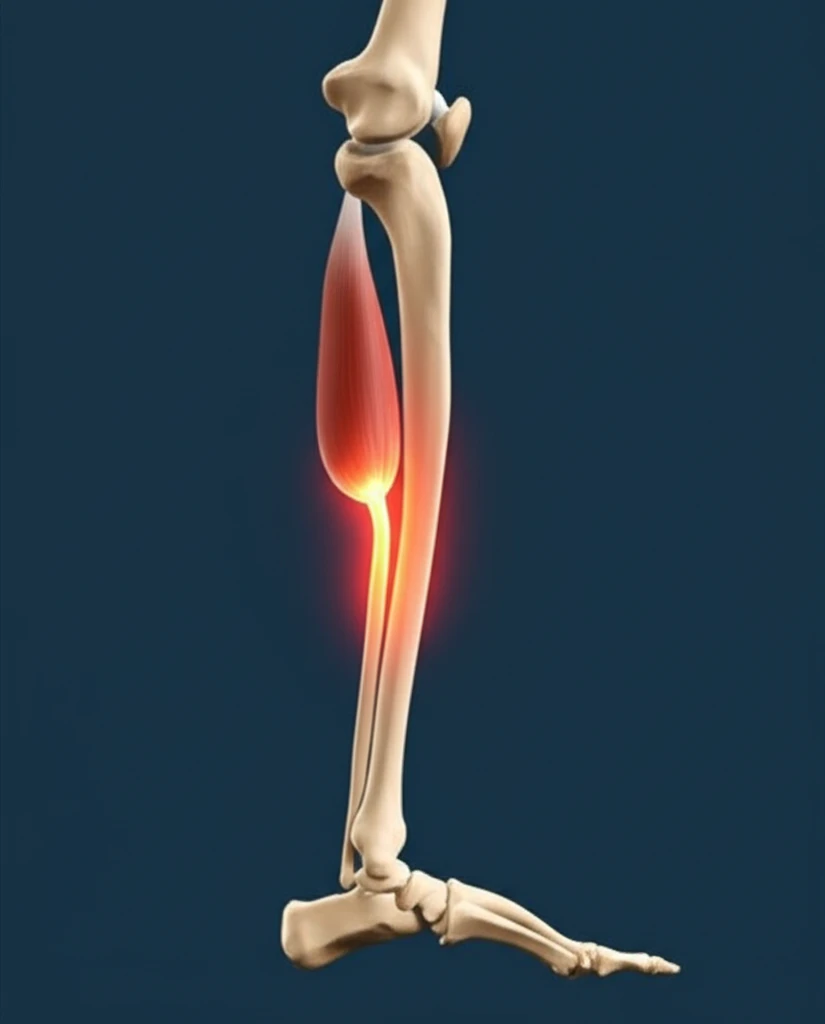
Achilles Tendon Woes? How Geometry Might Be Your Saving Grace

"New research reveals that tendon thickening, often seen in Achilles tendinopathy, could be a beneficial adaptation to protect against stress."
Achilles tendinopathy, a common injury affecting athletes and non-athletes alike, is characterized by pain, stiffness, and impaired function of the Achilles tendon. It's a frustrating condition, and while various treatments exist, understanding the underlying mechanics of the injured tendon is crucial for effective management.
Traditionally, researchers have focused on the material properties of the tendon, noting that tendinopathy often leads to reduced stiffness and changes in tissue composition. However, emerging evidence suggests that the tendon's geometry – its unique shape and size – plays a more significant role than previously thought. This is especially intriguing because one of the hallmarks of Achilles tendinopathy is tendon thickening, where the cross-sectional area of the tendon increases.
A recent study published in the Journal of Biomechanics delves into this interplay between geometry and material properties, offering new insights into how the Achilles tendon adapts to tendinopathy. Using subject-specific finite element analysis, researchers investigated how altered geometry and material properties affect stress distribution within tendinopathic tendons compared to healthy ones. The findings challenge conventional wisdom and offer a reassuring perspective on the body's ability to compensate for injury.
Tendon Geometry: A Surprising Protector?
The study, led by Vickie B. Shim and colleagues, compared eight participants with Achilles tendinopathy to eight healthy controls. Using three-dimensional freehand ultrasound, they meticulously imaged the Achilles tendons of both groups at rest and during sub-maximal contractions. These images were then used to create detailed, subject-specific finite element models, allowing the researchers to analyze stress distribution within each individual's tendon.
- Tendon Thickening: The resting cross-sectional area of the free tendon was, on average, 31% greater in the tendinopathic group compared to the healthy group. This confirms the well-established observation of tendon thickening in tendinopathy.
- Reduced Stiffness: As expected, the Young's modulus (a measure of stiffness) was significantly lower (53%) in the tendinopathic tendons compared to the healthy ones. This indicates a reduction in the tendon's ability to resist deformation.
- Lower Stress: Surprisingly, despite the reduced stiffness, the tendinopathic tendons experienced 24% less stress under the same sub-maximal loading conditions compared to the healthy tendons.
Personalized Rehab: The Future of Tendon Care?
This study highlights the importance of considering individual tendon geometry in the management of Achilles tendinopathy. Generic rehabilitation exercises may not be optimal for all patients, as the stress experienced by the tendon will vary depending on its unique shape and size. Personalized training programs that account for individual tendon characteristics may be more effective in promoting positive tissue adaptation and preventing re-injury. By understanding the interplay between geometry and material properties, clinicians can better tailor interventions to optimize tendon health and function.