
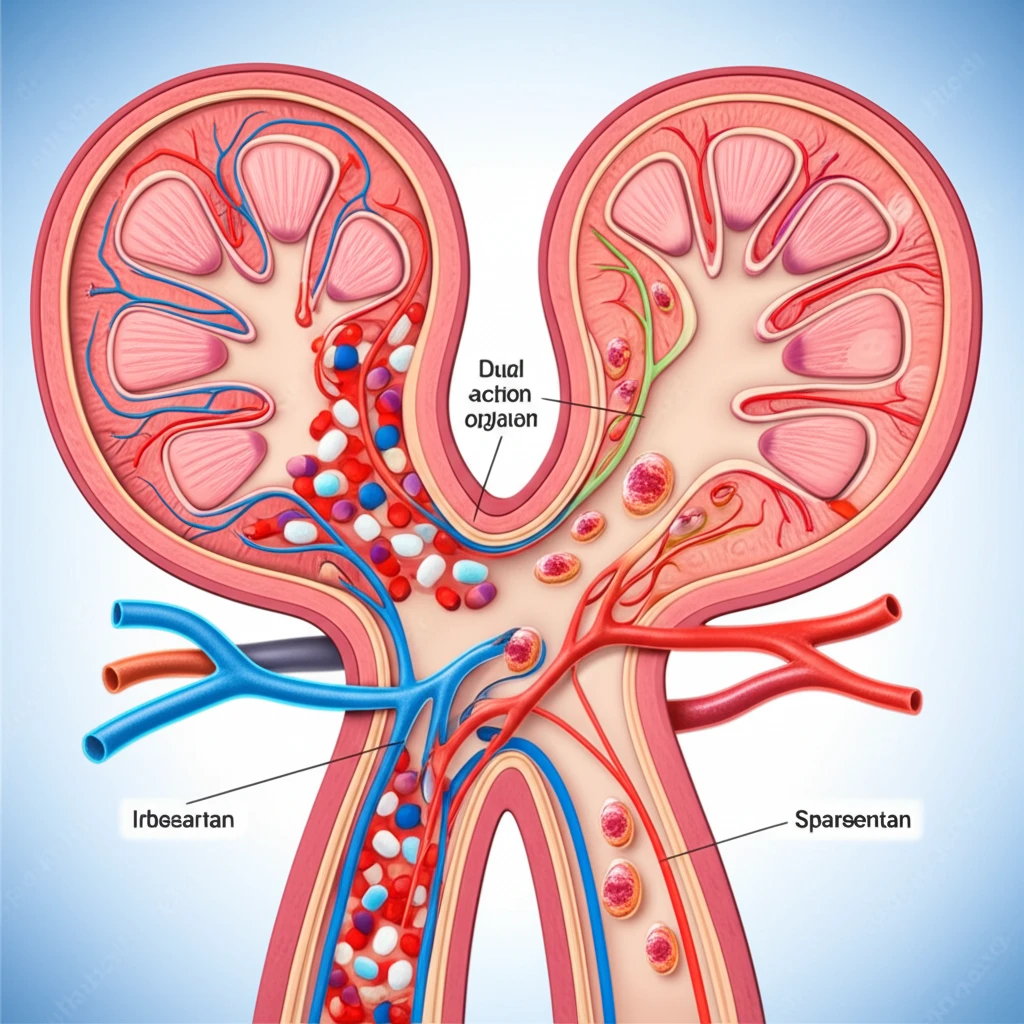
Illustration of Sparsentan clearing pathways in a kidney for FSGS treatment.

A New Hope for FSGS: Can Sparsentan Offer Better Results?

"DUET Study Reveals Promising Results for Sparsentan in Treating Primary FSGS, Offering a Potential Breakthrough for Patients."


Focal Segmental Glomerulosclerosis (FSGS) is a challenging kidney disease characterized by scarring in the kidney's filtering units. This scarring leads to proteinuria, where protein leaks into the urine, and can eventually lead to kidney failure. Primary FSGS, in particular, has no identifiable cause, making it difficult to treat effectively. Current treatments often involve managing symptoms and slowing disease progression.

Traditional treatments for primary FSGS include corticosteroids and other immune-modulating agents, often combined with renin-angiotensin system inhibitors (RASIs). However, these treatments can have significant side effects, leaving many patients with an unmet need for more effective and well-tolerated options. This is why researchers are constantly seeking new therapies to combat FSGS and protect kidney function.

The DUET study aimed to evaluate the efficacy and safety of sparsentan, a dual endothelin type A (ETA) and angiotensin II type 1 (AT1) receptor antagonist, compared to irbesartan, an angiotensin II type 1 receptor antagonist, in patients with primary FSGS. Sparsentan's dual-action approach targets two pathways involved in kidney damage, potentially offering a more comprehensive treatment strategy.

Sparsentan's Dual Action: A More Effective Approach to Reducing Proteinuria?

Illustration of Sparsentan clearing pathways in a kidney for FSGS treatment.

The DUET study was a Phase 2, randomized, double-blind, active-controlled trial. This means patients were randomly assigned to receive either sparsentan or irbesartan, and neither the patients nor the researchers knew which treatment each patient was receiving until the study was completed. This design helps to minimize bias and ensure the results are reliable.

Researchers enrolled 109 patients aged 8-75 years with biopsy-proven FSGS and a certain level of protein in their urine. Participants received either sparsentan (200, 400, or 800 mg/day) or irbesartan (300 mg/day) for 8 weeks, followed by an open-label period where all patients received sparsentan. The primary goal was to measure the reduction in proteinuria (UP/C ratio) at week 8.

  • Greater Proteinuria Reduction: Patients treated with sparsentan experienced a significantly greater reduction in proteinuria compared to those treated with irbesartan.
  • FSGS Partial Remission: A higher proportion of sparsentan-treated patients achieved FSGS partial remission, meaning their proteinuria levels decreased significantly.
  • Blood Pressure Control: Sparsentan effectively reduced blood pressure, while irbesartan did not demonstrate the same effect.
  • Stable Kidney Function: Both treatments maintained stable kidney function (eGFR), indicating they did not negatively impact kidney health.
The study also found that sparsentan was generally safe and well-tolerated. While some patients experienced hypotension and edema, these side effects did not lead to study withdrawals. Overall, the adverse event profile was similar between the two treatment groups.

Looking Ahead: Sparsentan's Potential and Future Research

The DUET study provides compelling evidence that sparsentan may offer a more effective treatment option for patients with primary FSGS. Its dual-action mechanism, targeting both endothelin and angiotensin II receptors, appears to be more effective at reducing proteinuria than traditional RASI therapy alone.

While these results are promising, it's important to remember that this was a Phase 2 study. Further research is needed to confirm these findings in larger, longer-term trials. The ongoing open-label treatment period of the DUET study and the Phase 3 DUPLEX study will provide valuable insights into the long-term effects of sparsentan on kidney function and overall patient outcomes.

If future studies confirm sparsentan's efficacy and safety, it could represent a significant advance in the management of FSGS, offering patients a new hope for preserving kidney function and improving their quality of life.

About this Article -

This article was crafted using a human-AI hybrid and collaborative approach. AI assisted our team with initial drafting, research insights, identifying key questions, and image generation. Our human editors guided topic selection, defined the angle, structured the content, ensured factual accuracy and relevance, refined the tone, and conducted thorough editing to deliver helpful, high-quality information.See our About page for more information.

This article is based on research published under:

DOI-LINK: 10.1681/asn.2018010091, Alternate LINK

Title: Duet: A Phase 2 Study Evaluating The Efficacy And Safety Of Sparsentan In Patients With Fsgs

Subject: Nephrology

Journal: Journal of the American Society of Nephrology

Publisher: American Society of Nephrology (ASN)

Authors: Howard Trachtman, Peter Nelson, Sharon Adler, Kirk N. Campbell, Abanti Chaudhuri, Vimal Kumar Derebail, Giovanni Gambaro, Loreto Gesualdo, Debbie S. Gipson, Jonathan Hogan, Kenneth Lieberman, Brad Marder, Kevin Edward Meyers, Esmat Mustafa, Jai Radhakrishnan, Tarak Srivastava, Miganush Stepanians, Vladimír Tesar, Olga Zhdanova, Radko Komers

Published: 2018-10-25

Everything You Need To Know

1

What exactly is Primary Focal Segmental Glomerulosclerosis (FSGS), and why is it such a concern?

Primary Focal Segmental Glomerulosclerosis (FSGS) is a kidney disease characterized by scarring in the kidney's filtering units, leading to proteinuria and potentially kidney failure. This disease has no identifiable cause making it difficult to treat effectively. Its significance lies in the damage it inflicts on the kidneys, impairing their ability to filter blood and remove waste products. This can lead to a decline in kidney function and potentially end-stage renal disease, necessitating dialysis or a kidney transplant.

2

What was the DUET study about and what were the key findings?

The DUET study compared the effectiveness of sparsentan to irbesartan in treating Primary FSGS. Sparsentan, a dual endothelin type A (ETA) and angiotensin II type 1 (AT1) receptor antagonist, was compared to irbesartan, an angiotensin II type 1 receptor antagonist. The trial design was a Phase 2, randomized, double-blind, active-controlled trial. The importance of the study is providing evidence that sparsentan may offer a more effective treatment option. The implications are that it provides a potential breakthrough for patients, offering the possibility of a more comprehensive and effective approach to managing the disease.

3

What is sparsentan, and why is its dual-action mechanism important?

Sparsentan is a dual endothelin type A (ETA) and angiotensin II type 1 (AT1) receptor antagonist. This dual-action targets two pathways involved in kidney damage, potentially offering a more comprehensive treatment strategy than single-target approaches. The significance is that it tackles FSGS from multiple angles, potentially leading to better results in terms of reducing proteinuria and slowing disease progression. This approach suggests that Sparsentan may offer a more effective treatment compared to traditional single-target therapies.

4

How did sparsentan compare to irbesartan in terms of reducing proteinuria and achieving remission?

In the DUET study, patients treated with sparsentan experienced a significantly greater reduction in proteinuria compared to those treated with irbesartan. Additionally, a higher proportion of patients achieved FSGS partial remission, which means their proteinuria levels decreased significantly. The findings indicate that sparsentan is more effective than irbesartan in controlling the disease. This is crucial because reduced proteinuria is a key goal in managing FSGS, as it indicates a slowdown in the progression of kidney damage. The implications suggest an improved prognosis for individuals receiving Sparsentan.

5

What were the safety and tolerability results of sparsentan in the DUET study, and what does that mean for patients?

The DUET study found that both sparsentan and irbesartan maintained stable kidney function (eGFR). This means that both treatments did not negatively impact kidney health. Sparsentan was generally safe and well-tolerated in the study. While some patients experienced side effects like hypotension and edema, these did not lead to study withdrawals. This demonstrates that sparsentan does not seem to negatively affect kidney function while providing other benefits. This is very important as it means that the treatment is unlikely to worsen the kidney disease. The implications of both of these mean that sparsentan is a promising candidate for the treatment of Primary FSGS.

Newsletter Subscribe

Subscribe to get the latest articles and insights directly in your inbox.