
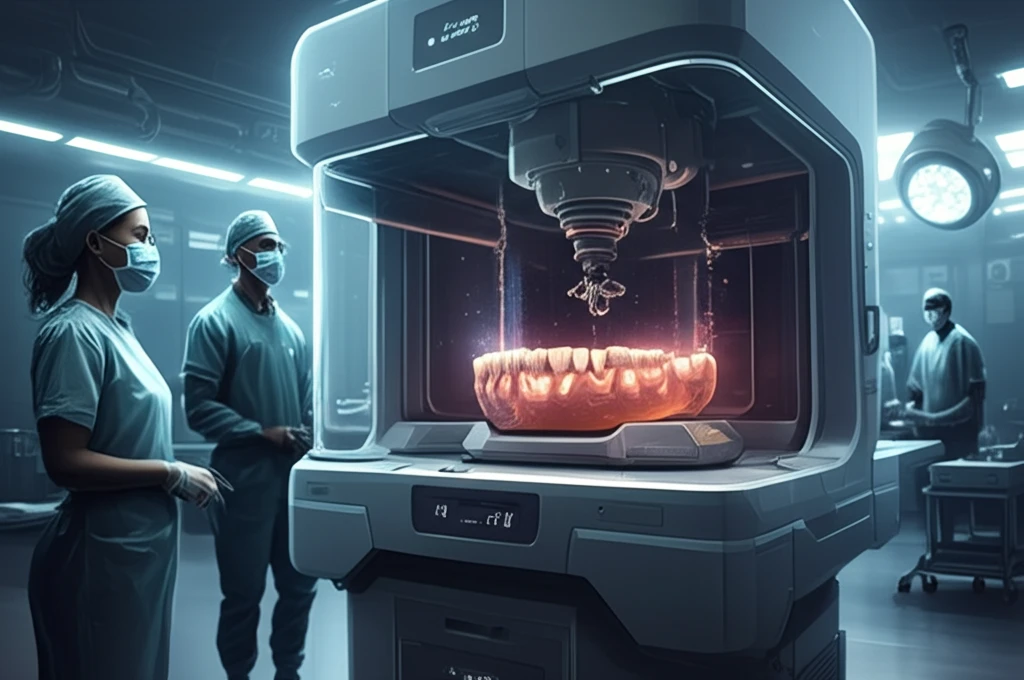
3D Printing: Revolutionizing Oral and Maxillofacial Surgery?

"Discover how 3D printing is reshaping tissue regeneration and surgical outcomes in oral and maxillofacial procedures."
Imagine a world where surgical procedures are less invasive, more precise, and lead to quicker recoveries. In oral and maxillofacial surgery, this vision is rapidly becoming a reality thanks to the advent of 3D printing. This cutting-edge technology is not just a futuristic dream; it's a tangible tool transforming how surgeons approach complex reconstructions and tissue regeneration.
The ultimate aim of any surgery is to improve both form and function while minimizing post-operative issues. Recent years have seen exciting technological leaps in oral and maxillofacial surgery, and 3D printing stands out as a particularly promising area. Its potential in regenerative medicine is especially noteworthy, offering new solutions for creating biological alternatives to traditional grafts, implants, and prostheses.
At the heart of tissue engineering are scaffolds—structures that guide the growth of stem cells in three dimensions. These scaffolds need to be strong, interconnected, and have controlled porosity. While existing 3D scaffolds have shown promise, they haven't always been ideal for clinical use. This article delves into the exciting advancements in rapid prototyping techniques and their role in designing and creating synthetic scaffolds for tissue engineering, as well as the emerging field of 'bioprinting.'
Statistics and Market Data
Statistical databases tracking 3D printing now aggregate hundreds of data points, with aggregators such as Gitnux reporting that figures are drawn from peer-reviewed journals, government agencies, and professional bodies with disclosed methodology and sample sizes. Market.us describes 3D printing—also known as additive manufacturing—as having "revolutionized how we create and design objects," thanks to its ability to transform digital designs into tangible prototypes and functional products. Statista similarly curates a compact summary of key figures on additive manufacturing and 3D printing. Beginner-oriented guides further distill the topic into essential statistics for newcomers to the field.
The Standard Method and Its Known Limits
3D printing (additive manufacturing) works by sending a digital file to a machine that stacks layers of material to assemble a product, and this layering approach has well-documented limits. Current printers are restricted in the size of the objects they can produce, and the surface finish and structural properties of printed parts can sometimes be inferior to those produced by traditional methods. Print outcomes also depend on settings such as infill pattern, which crush tests have shown behave differently under stress. Researchers in reconstructive surgery have identified slow material refill between layers as another major limitation and are testing acoustic vibration to accelerate the process. The same technology is also being explored as a potential tool to help address the U.S. affordable housing shortage, which the National Low Income Housing Coalition estimates at more than 7 million homes.
A Short History of an Emerging Technology
Over roughly a decade, 3D printing has moved from novelty to industrial tool. Alstom, for example, has grown its additive manufacturing offering since 2016 and now prints almost 40,000 parts per year, citing faster delivery and reduced costs. The technology's expansion parallels the broader digitalization of printing: Kornit Digital, founded in 2002 when the textile printing industry was still completely analog, traces its growth through four generations of digital innovation. Hobbyist projects illustrate the grassroots side of that history—one builder spent months producing a 3D-printed shell for a Macintosh Plus that looks for all intents and purposes like the 1986 original. Looking further out, advocates have long envisioned using 3D printing to build locally made houses and produce food for a sustainable Martian colony.
The Rise of 3D Printing in Surgery
Three-dimensional printing, also known as rapid prototyping, first emerged in the 1980s. Since then, it has undergone significant evolution, with scientists continually refining its uses, materials, and accuracy. With increasing attention from the scientific community, recent studies have highlighted the feasibility of 3D-printed tissues and organs and their application in various clinical scenarios.
- Enhancing perioperative form
- Facilitating faster recovery of function
- Minimizing operative and post-operative morbidity
Biomedical and Materials Research
Biomedical 3D printing is one of the most active research fronts. ASME notes that unlike traditional printing of plastics and metal—where the finished part is the end result—with bioprinting "it's just the beginning," since printed structures still need to develop into living tissue. Reviews of 3D-printed organs report that while researchers have long been generating human cells in laboratories, the capability of printing whole organs would take that to a whole new level. In materials research, University of California, Berkeley engineers collaborating with scientists at the Albert Ludwig University of Freiburg have developed a method to print glass microstructures using a resin containing nanoparticles of glass surrounded by a light-sensitive binder liquid. On the consumer side, industry observers have been analyzing how Bambu Lab came to dominate 3D printing within about three years of releasing its first printer.
Reliability and Practical Limitations
Despite the enthusiasm, practical reliability remains a genuine concern. Users report that environmental conditions influence print quality—one researcher noted that after a 3D printer was moved to an office kept at a constant 18–20 °C, PLA warping problems disappeared, though he could not say whether that was due to the environment or his increased familiarity with the settings. Build-volume limits are another constraint, prompting research into scalable, modular 3D printing platforms that support variable build volumes without extensive redesign. The basic concept itself is a topic of debate, with the technology described as a process of stacking layers of plastic, resins, ceramics, metal, or other materials and its real industrial impact still contested. Even so, proponents point to life-saving medical applications as evidence of the technology's value.
Printing Versus the Alternatives
Choosing between 3D printing and alternatives usually depends on the specific part and its intended use. Companies weighing 3D printing against injection molding emphasize that every part is unique and that a variety of factors determine whether printing makes sense technically and economically. Even within the 3D printing world there are meaningful choices at every level: AI text-to-3D tools differ in output, with Meshy generating textured meshes for game engines and augmented reality while Automatic3D produces watertight STL files intended for 3D printing. Hardware comparisons are equally common, such as size comparisons of Bambu Lab printers like the A1 versus the A1 Mini to match a model to a user's needs. General comparison platforms even devote entire categories to side-by-side specification comparisons.
Looking Ahead: The Future of Bioprinting
The goal of tissue engineering is to create functional tissues and organs for regenerative therapies and, ultimately, organ transplantation and replacement. While the journey has been marked by trial and error, 3D bioprinting offers a clearer path forward. Researchers are continually refining techniques to ensure that fabricated tissues are as similar as possible to natural tissues, integrating seamlessly and functioning effectively within the human body. The future of bioprinting holds immense promise for revolutionizing how we approach medical treatments and patient care. With ongoing research and innovation, the possibilities are endless.
From Skepticism to Scale
Expert opinion on 3D printing is strikingly polarized. As The New York Times framed the question when it interviewed Hod Lipson, a Cornell engineering professor regarded as one of the nation's top 3D printing experts, the technology could either save the world, bring in the apocalypse, or amount to little more than a gadget that spits out cheap plastic trinkets. Other researchers are working to make the technology more scalable, with one thesis exploring cooperative 3D printing using robots to improve scalability. The ecosystem around the technology has also matured into a full commercial chain—platforms now offer digital model libraries, AI tools, and practical education meant to help users learn, create, print, and sell.
Frontiers in Medicine, Construction, and Materials
Forward-looking coverage of 3D printing converges on several frontiers. In medicine, the prospect of 3D-printed human hearts is under active discussion, with the World Health Organization noting that cardiovascular disease is the leading cause of death worldwide, accounting for approximately 15% of all deaths. In construction, many architectural firms are adopting 3D printing as their preferred technique because it lowers the risk of errors and saves on time. Material development is also advancing, and analysts see a growing market for high-temperature 3D printing plastics segmented by type, application, end-user industry, distribution channel, and geography. Singularity Hub sums up the trajectory, arguing that major international breakthroughs in additive manufacturing are accelerating these trends and giving rise to new convergent applications.
Beyond Engineering: Food and Biomedicine
3D printing's reach now extends well beyond engineering into domains like food and medicine. In food, the concept captured attention in 2014 when 3D Systems showcased the ChefJet at International CES, leaving audiences with a mixture of awe and confusion. In biomedical engineering, current medical uses fall into several broad categories: tissue and organ fabrication; creating prosthetics, implants, and anatomical models; and pharmaceutical research concerning drug discovery, delivery, and dosage. Together these applications illustrate both the breadth of the technology and the systemic challenges of moving it from demonstration to routine use.
Printing That Touches People's Lives
Real-world impact is where 3D printing meets people directly. In education, for instance, one educator helped his students apply their 3D printing knowledge to make a real-world impact on their peers and classmates. The technology also carries health considerations: studies have found that some 3D printers emit toxic particles, raising questions about safe use in homes, schools, and workplaces. On the industrial side, companies such as Metamorph 3D Print specialize in advanced metal 3D printer technologies and tailored printing services for industrial needs, showing how far the human-driven ecosystem has scaled.