
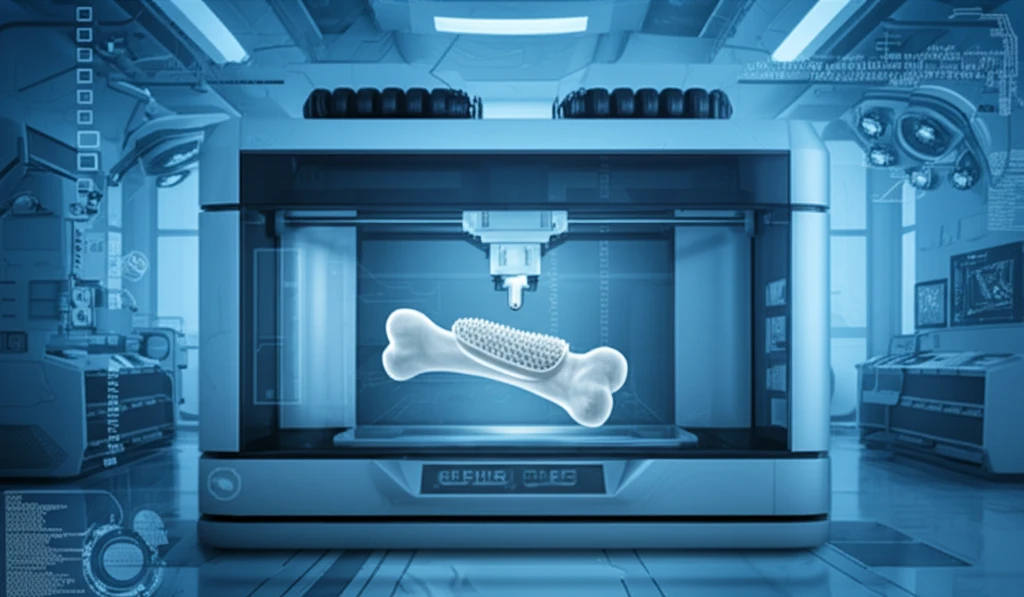
3D Printing Bone Implants: A New Frontier in Biomedical Engineering

"Exploring the mechanical and morphological properties of Polyamide 12 composite for potential biomedical implants using injection molding and desktop 3D printing."
The field of bone regeneration has seen remarkable advancements, driven by the need to address bone loss resulting from traumatic injuries, non-traumatic events, and various medical conditions. Replacing lost bone substance is crucial for restoring function and improving patient quality of life. While materials like titanium, polymethyl methacrylate (PMMA), and polyetheretherketone (PEEK) have been widely used, a groundbreaking technology is emerging: 3D printing.
3D printing, also known as additive manufacturing, is rapidly transforming the landscape of biomedical implants. This innovative technique allows for the creation of customized implants tailored to a patient's specific anatomy, offering numerous advantages over conventional methods. These benefits include enhanced aesthetic outcomes, reduced surgical time, minimized blood loss, and a decreased risk of infection.
Traditionally, the high costs associated with 3D printing limited its accessibility to large corporations and specialized research institutions. However, the advent of desktop, open-source 3D printers has democratized this technology, making it available to a wider audience at affordable prices. One such technique, fused filament fabrication (FFF), derived from Fused Deposition Modeling (FDM), has gained prominence. While initially used for creating spare parts and consumer products, 3D printing is now making significant strides in healthcare.
The Growing 3D Content Ecosystem
The infrastructure supporting 3D design and fabrication has expanded considerably. Sketchfab reports a community of over one million creators and describes itself as the world's largest platform for publishing, sharing, and discovering 3D content across web, mobile, AR, and VR. Cults3d positions itself as the leading independent website for 3D printer files, supporting applications ranging from 3D printing and CNC machining to laser cutting and electronics. Wikipedia maintains dedicated articles on both 3D and 3D modeling, reflecting broad recognition of these technologies. This growing ecosystem of platforms, communities, and shared model libraries provides the digital foundation upon which specialized applications such as biomedical implant design are built.
General-Purpose 3D Model Repositories
3D Warehouse, operated by SketchUp, offers a searchable library of pre-made 3D models designed to integrate seamlessly with SketchUp software. This repository-based approach allows designers to start from existing geometry rather than building models from scratch. However, such general-purpose repositories are oriented toward architecture, product design, and visualization rather than biomedical applications requiring specialized materials and precision tolerances. The availability of widely accessible model libraries underscores both the maturity of general 3D design tooling and the gap that exists for purpose-built biomedical repositories.
Origins of 3D Bioprinting
The application of 3D printing to biomedical contexts builds on several decades of additive manufacturing development that began in the 1980s. Early efforts focused on rapid prototyping for industrial design before researchers began exploring biocompatible materials suitable for medical use. The intersection of 3D printing with regenerative medicine and tissue engineering emerged as a distinct area of investigation more recently. While no single milestone defines the field, the progression from industrial prototyping to patient-specific implant design represents a notable shift in both capability and ambition.
Current Research Landscape
Ongoing research into 3D printed bone implants is examining a range of biocompatible materials and structural designs. Investigators are exploring how lattice architectures and controlled porosity may influence osseointegration and mechanical performance. Reviews in the field have noted both encouraging preclinical results and the difficulty of translating these findings into routine clinical use. The pace of publication suggests active scientific interest, though definitive long-term clinical comparisons remain limited.
Persistent Challenges
Enthusiasm for 3D printed implants is tempered by several unresolved challenges. Regulatory frameworks for custom medical devices are complex and inconsistent across jurisdictions, complicating the path to clinical adoption. Long-term performance data for 3D printed bone implants remain sparse, making direct comparison with established conventional implants difficult. Manufacturing reproducibility and quality assurance for patient-specific devices continue to be areas of concern.
Conventional vs. 3D Printed Implants
Comparing 3D printed bone implants with traditionally manufactured alternatives involves trade-offs across multiple dimensions. Conventional implants benefit from extensive clinical validation and standardized production processes, whereas 3D printed versions offer geometric customization that traditional methods cannot easily replicate. Cost comparisons are complicated by the expense of specialized printing equipment, post-processing requirements, and the patient-specific nature of custom devices. The relative advantages likely depend on clinical context, anatomical complexity, and available manufacturing infrastructure.
Expert Views on Progress
Experts broadly acknowledge that 3D printing holds significant promise for bone implant applications while cautioning that considerable work remains. The capacity to produce patient-specific geometries with tailored porosity is recognized as a meaningful advance over standardized implants. At the same time, researchers emphasize the need for rigorous clinical evidence before these technologies can be widely adopted. Interdisciplinary collaboration across engineering, materials science, and clinical medicine is considered essential for continued progress.
Next-Generation Bioprinting
Emerging directions in 3D bioprinting suggest a future in which implants may incorporate living cells and bioactive factors to actively promote tissue regeneration. Multi-material printing techniques could enable constructs with spatially varying mechanical properties that more closely approximate natural bone. Integration with computational design tools and advanced imaging may further personalize implant planning on a per-patient basis. These possibilities remain largely in the research phase but point toward increasingly sophisticated biomedical devices.
Barriers to Widespread Adoption
Adoption of 3D printed bone implants faces systemic barriers that extend beyond technical feasibility. Healthcare systems must develop infrastructure for point-of-care manufacturing and the specialized expertise needed for design validation and quality control. Health economics analyses and reimbursement policies must demonstrate sufficient value to justify higher upfront costs associated with custom devices. International regulatory alignment could also accelerate access across different healthcare environments.
Impact on Patients and Clinicians
For patients, the core promise of 3D printed bone implants lies in improved anatomical fit and potentially fewer surgical complications. Early clinical experience has indicated benefits in certain cases, though comprehensive outcome data remain limited. Surgeons and clinical teams must also adapt by acquiring new competencies in digital workflows and device oversight. Ultimately, the real-world impact of these technologies will be measured by their ability to deliver tangible improvements in patient recovery and quality of life.
What are the Benefits of Polyamide 12 Composite in 3D-Printed Bone Implants?
Researchers have focused on polyamide (PA), specifically Polyamide 12, due to its excellent biocompatibility with human tissue and favorable mechanical properties. To further enhance its biological and mechanical characteristics, researchers have incorporated zirconium dioxide (ZrO2) and hydroxyapatite (HA) as fillers. This composite material aims to mimic the natural properties of bone, promoting better integration and long-term performance.
- Material Preparation: Polyamide 12 was compounded with 20 wt% filler loading of zirconium dioxide (ZrO2) and hydroxyapatite (HA).
- Filament Creation: The composite was then extruded into filaments with a diameter of 1.75±0.1 mm using a desktop filament extruder.
- 3D Printing Process: The filament was used in a desktop 3D printer (Makerbot 2X) to create tensile and impact specimens based on virtual 3D models designed in SolidWorks.
- Injection Molding: For comparison, specimens were also prepared using injection molding.
The Future of 3D Printing in Bone Implants
While the mechanical properties of the 3D-printed parts were lower than those of the injection-molded parts, the study highlighted the immense potential of 3D printing for creating customized 3D objects. This capability opens up exciting possibilities for biomedical applications, particularly in the design and fabrication of personalized bone implants. Further improvements in printing parameters, such as layer height, infill percentage, and printing speed, could lead to enhanced material properties and wider adoption of 3D printing in the biomedical field. As technology advances, 3D-printed bone implants hold the promise of transforming bone regeneration, offering tailored solutions that improve patient outcomes and revolutionize healthcare.