
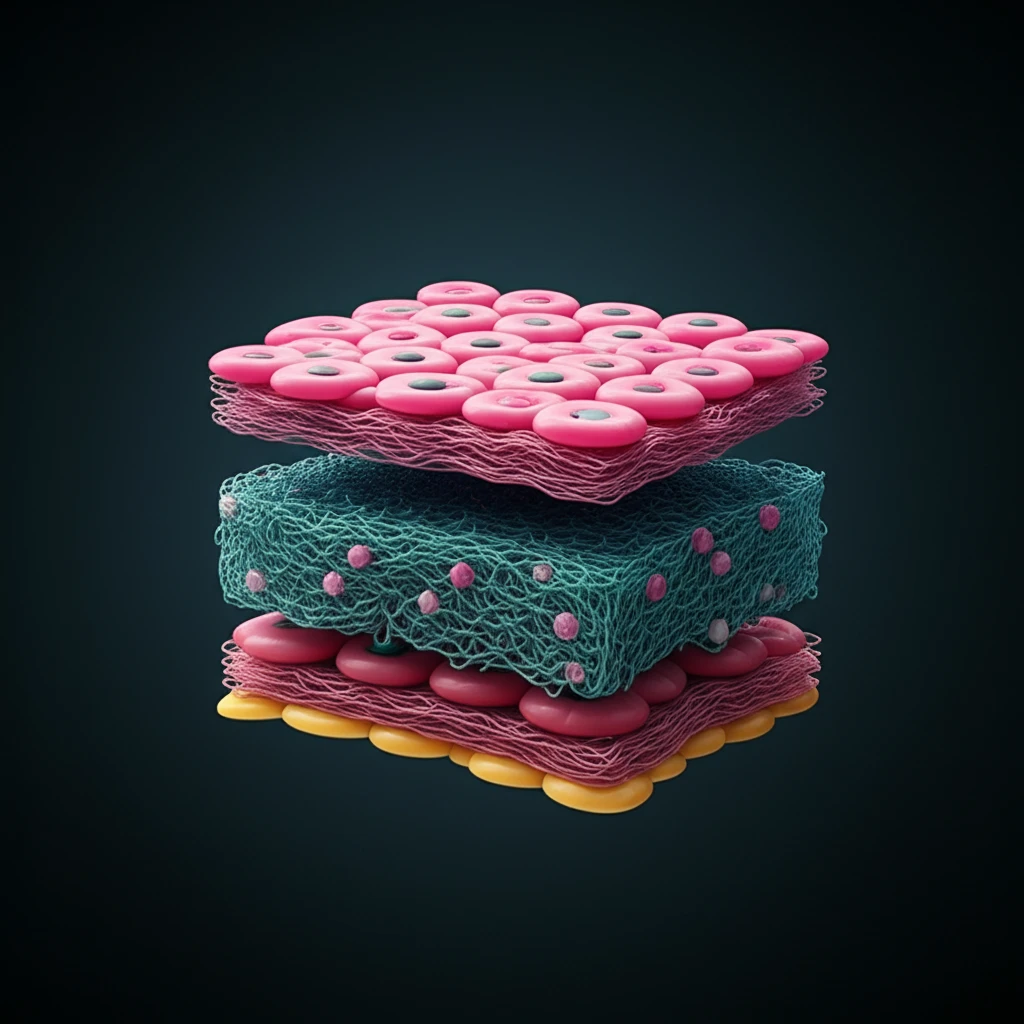
3D bioprinted breast cancer model representing personalized medicine.

3D Bioprinting: Revolutionizing Breast Cancer Drug Resistance Studies

"Discover how scientists are using 3D bioprinting to create more realistic breast cancer models for better drug screening and personalized medicine."


Breast cancer is a complex disease influenced by its surrounding environment, known as the microenvironment. This microenvironment includes various cells like immune cells, endothelial cells, cancer-associated fibroblasts (CAFs), and adipose-derived mesenchymal stem cells (ADMSCs). Understanding how these components interact is crucial for developing effective treatments.

Traditional two-dimensional (2D) cell cultures have limitations in replicating the complexity of the in vivo tumor environment. As a result, three-dimensional (3D) models are gaining traction, offering a more accurate representation of cell-cell and cell-matrix interactions. Among these, 3D bioprinting stands out as a promising technique to assemble living cells and biomaterials into custom-designed constructs.

Recent research published in ACS Biomaterials Science & Engineering explores the use of 3D bioprinting to create breast cancer models for drug resistance studies. This innovative approach allows scientists to investigate the effects of ADMSCs on breast cancer cells in a more realistic setting, potentially leading to better drug screening and personalized medicine strategies.

3D Bioprinting Breast Cancer Models: A Step-by-Step Look

3D bioprinted breast cancer model representing personalized medicine.

The study utilized 3D bioprinting to construct models with breast cancer cells (21PT, HER2+) in the middle and ADMSCs surrounding them, mimicking the in vivo structure of a tumor. These constructs were created using dual hydrogel-based bioinks, allowing for precise placement of different cell types.

The researchers compared these 3D bioprinted constructs to traditional 2D cultures and evaluated their response to doxorubicin (DOX), a common chemotherapy drug. The results revealed significant differences in drug resistance between the two models:

  • Reduced Apoptosis: The percentage of cleaved Caspase-3 positive cells, indicating apoptosis (cell death), was significantly lower in the 3D bioprinted constructs with ADMSCs compared to cancer cells alone, especially at low DOX doses.
  • ADMSC Thickness Matters: Increasing the thickness of the ADMSC layer further enhanced drug resistance, suggesting that ADMSCs provide a protective effect to cancer cells.
  • LOX Involvement: Both ADMSCs and 21PT cells expressed lysyl oxidase (LOX), an enzyme involved in collagen cross-linking and known to play a role in cancer progression. Inhibition of LOX enhanced DOX sensitivity.
These findings highlight the importance of the tumor microenvironment in drug response and demonstrate the potential of 3D bioprinting to create more predictive models for drug screening.

The Future of Cancer Research: 3D Bioprinting and Personalized Medicine

This study underscores the potential of 3D bioprinting to revolutionize cancer research by creating more realistic and predictive tumor models. By incorporating key components of the tumor microenvironment, such as ADMSCs, these models can better mimic the complex interactions that influence drug response.

Furthermore, the ability to control parameters like ADMSC layer thickness allows researchers to investigate the impact of obesity and other microenvironmental factors on drug resistance. The identification of LOX as a potential target to enhance drug sensitivity opens new avenues for therapeutic intervention.

As 3D bioprinting technology advances, it promises to play an increasingly important role in personalized medicine, enabling the development of tailored cancer treatments based on the unique characteristics of individual tumors and their microenvironment.

About this Article -

This article was crafted using a human-AI hybrid and collaborative approach. AI assisted our team with initial drafting, research insights, identifying key questions, and image generation. Our human editors guided topic selection, defined the angle, structured the content, ensured factual accuracy and relevance, refined the tone, and conducted thorough editing to deliver helpful, high-quality information.See our About page for more information.

This article is based on research published under:

DOI-LINK: 10.1021/acsbiomaterials.8b01277, Alternate LINK

Title: 3D Bioprinting Of Breast Cancer Models For Drug Resistance Study

Subject: Biomedical Engineering

Journal: ACS Biomaterials Science & Engineering

Publisher: American Chemical Society (ACS)

Authors: Ying Wang, Wen Shi, Mitchell Kuss, Sameer Mirza, Dianjun Qi, Alexey Krasnoslobodtsev, Jiping Zeng, Hamid Band, Vimla Band, Bin Duan

Published: 2018-11-15

Everything You Need To Know

1

What is 3D bioprinting and why is it important in this context?

3D bioprinting is a technology used to create three-dimensional models of biological structures, in this case, breast cancer models. These models are constructed by precisely layering cells and biomaterials to mimic the complex environment of a tumor. It is important because traditional 2D cell cultures fail to accurately represent the in vivo conditions, hindering the effectiveness of drug screening. Using 3D bioprinting allows for a more accurate representation of cell-cell and cell-matrix interactions within the tumor microenvironment, which is crucial for studying drug resistance and developing effective treatments.

2

What is the tumor microenvironment and why is it significant?

The microenvironment in breast cancer refers to the complex surroundings of the cancer cells, including various cell types like immune cells, endothelial cells, cancer-associated fibroblasts (CAFs), and adipose-derived mesenchymal stem cells (ADMSCs). These components interact with each other and with the cancer cells, influencing the behavior of the tumor, including its response to drugs. Understanding the microenvironment is critical because it plays a significant role in drug resistance. By incorporating elements of the microenvironment, such as ADMSCs, 3D bioprinted models can better mimic the complex interactions that influence drug response.

3

Who or what are ADMSCs and why are they important?

ADMSCs, or adipose-derived mesenchymal stem cells, are a type of cell found in the tumor microenvironment. In the context of breast cancer, ADMSCs have been shown to interact with cancer cells and influence their response to drugs. Studies using 3D bioprinting have demonstrated that ADMSCs can enhance drug resistance in breast cancer cells, as seen in the reduced apoptosis when doxorubicin (DOX) was administered. The presence and behavior of ADMSCs are significant because they highlight the complexity of the tumor microenvironment and the need for more realistic models to study drug effects.

4

What is doxorubicin (DOX) and what was its role in the study?

Doxorubicin (DOX) is a common chemotherapy drug used to treat various types of cancer, including breast cancer. The study mentioned in the context used DOX to test the effectiveness of the 3D bioprinted breast cancer models. The results showed that the 3D models, which included ADMSCs, exhibited different responses to DOX compared to traditional 2D cell cultures. Specifically, the 3D models showed reduced apoptosis (cell death) when exposed to DOX, indicating increased drug resistance. This finding underscores the importance of using more realistic models for drug screening.

5

What is LOX and why is it relevant to the study's findings?

LOX, or lysyl oxidase, is an enzyme involved in collagen cross-linking and is known to play a role in cancer progression. The research found that both ADMSCs and 21PT cells (breast cancer cells) expressed LOX. Inhibition of LOX enhanced the sensitivity of cancer cells to doxorubicin (DOX). This suggests that LOX contributes to drug resistance in breast cancer cells. Understanding the role of LOX and other factors within the tumor microenvironment is crucial for developing effective cancer therapies that can overcome drug resistance and improve patient outcomes.

Newsletter Subscribe

Subscribe to get the latest articles and insights directly in your inbox.