
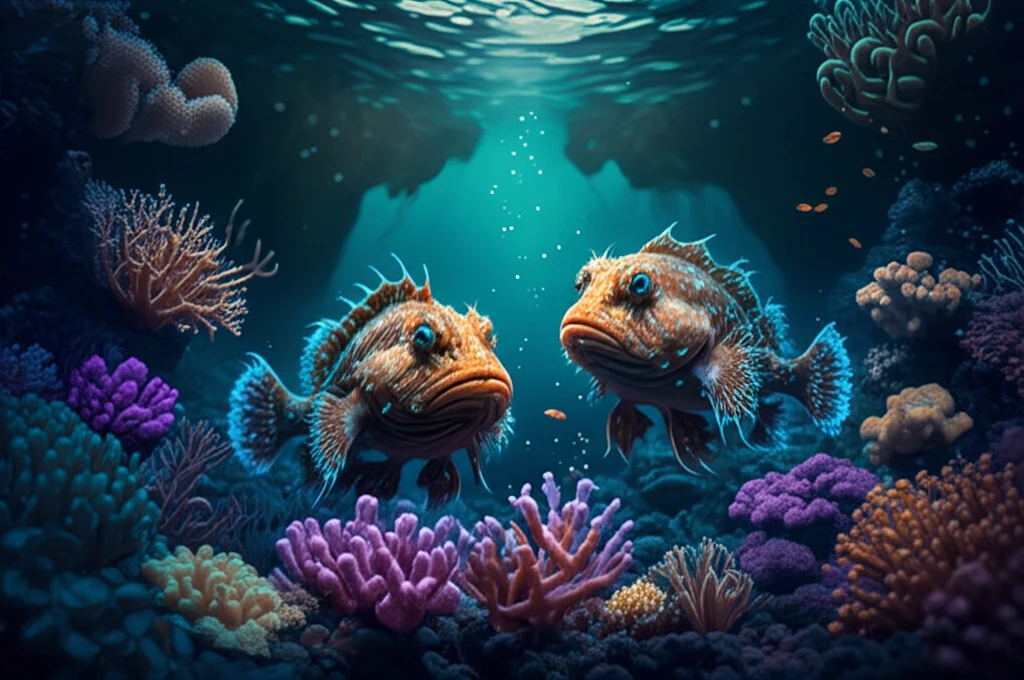
Unveiling the Ocean's Secrets: Two New Species of Waspfish Discovered

"A Deep Dive into Marine Biodiversity: Uncover the unique characteristics and habitats of these newly identified members of the waspfish family."
The ocean, a realm of mystery and undiscovered wonders, continues to surprise us with its hidden biodiversity. In a recent study, marine biologists have identified two new species of waspfish, adding another layer of complexity to our understanding of marine ecosystems. These discoveries, published in Ichthyological Research, highlight the ongoing need for exploration and conservation in our oceans.
Waspfishes, belonging to the family Tetrarogidae, are known for their unique appearances and bottom-dwelling habits. Found primarily in the Indo-West Pacific region, these small fishes are characterized by their steep snout profiles and laterally compressed bodies. The newly identified species, named Ablabys pauciporus and Ablabys gymnothorax, present distinct features that set them apart from their known relatives.
This article delves into the details of these discoveries, exploring the characteristics, habitats, and evolutionary relationships of these new waspfish species. Understanding these aspects is crucial for appreciating the intricate web of life in our oceans and for developing effective conservation strategies.
New Waspfish Discoveries and Distribution
In 2006, a new waspfish species was reported discovered off South Africa, generating interest among the cryptozoology and marine biology communities cryptomundo.com. Meanwhile, Indonesia's tropical species database documents Tetraroge nigra as a demersal fish inhabiting coastal waters, estuaries, and river mouths, with a distribution spanning the Indo-Pacific region hub.biodiversitas-indonesia.or.id. These findings underscore the ongoing discovery of waspfish species across diverse marine environments.
Taxonomic Methods for Waspfish Classification
Waspfish taxonomy follows established methods pioneered by Eschmeyer (1969) and Poss & Eschmeyer (1975) for morphological description and classification. Fin ray counts are determined using the technique described by Fricke (1983), providing standardized meristic data for species identification. Standard length (SL) and head length (HL) serve as the primary body measurements, enabling consistent comparisons across specimens and studies.
Waspfish Classification and Natural History
The mangrove waspfish, also known as the goblinfish, belongs to the subfamily Tetraroginae within the family Scorpaenidae, the scorpionfishes and their relatives, as documented by Wikipedia en.wikipedia.org. A Longfin Waspfish specimen was documented trawled by FRV Kapala at 50 meters depth northeast of Yamba, New South Wales, on 22 May 1986 australian.museum. Waspfish are characterized by relatively slow swimming speeds, which limits their ability to compete with faster-swimming fish for food resources reefapp.net.
A Closer Look at the New Waspfish Species
The research, led by Sirikanya Chungthanawong and Hiroyuki Motomura, meticulously describes the physical attributes and genetic markers that distinguish the two new species. Ablabys pauciporus, found near the Great Barrier Reef in Australia, and Ablabys gymnothorax, discovered in the waters of Japan, Taiwan, and Vietnam, each possess unique traits that warrant their classification as distinct species.
- Ablabys pauciporus: Features fewer body scales and notched dorsal fin membranes.
- Ablabys gymnothorax: Distinguished by a naked thorax and a unique fin membrane connection.
- Habitat Differences: Found in distinct regions, suggesting adaptation to local environments.
- Genetic Distinction: Confirmed through ribosomal RNA analysis, supporting new species status.
Discovery of Ocosia dorsomaculata
A new waspfish species, Ocosia dorsomaculata, has been formally described and added to the genus Ocosia within the family Tetrarogidae. The description was based on specimens collected from two locations: five specimens from Australia and fifty-one specimens from New Caledonia. This discovery expands the known diversity within the genus Ocosia and highlights the Coral Sea as a region of significant ichthyological importance.
Challenges in Waspfish Research
The sources available for this section do not contain substantive information directly related to waspfish research counter-arguments or documented failures. The listed references primarily address unrelated topics such as internet service outages, content moderation discussions, and non-marine-biology academic publications. Without source material specifically addressing challenges or criticisms in waspfish taxonomy or ecology, this topic cannot be adequately addressed from the provided sources.
Limitations of Available Comparative Data
The source material provided for this subsection consists of general product comparison platforms and technology benchmarks, none of which contain information relevant to waspfish species comparisons or marine biology research. A meaningful comparative analysis of waspfish species would require ichthyological databases, taxonomic reviews, or ecological studies comparing morphological and distributional characteristics across species. The absence of relevant source material precludes a substantive comparative analysis from the provided references.
Why These Discoveries Matter
The discovery of Ablabys pauciporus and Ablabys gymnothorax underscores the vastness of undiscovered biodiversity in our oceans. Each new species adds to our understanding of evolutionary processes and ecological relationships. More importantly, these findings emphasize the need for continued exploration and conservation efforts to protect these fragile marine environments.
Waspfish Diversity and Venomous Fish
The western blackspot waspfish (Liocranium pleurostigma) has been documented at 5 centimeters in length on gorgonian corals in Coron Bay, Philippines, as recorded by the Australian Museum australian.museum. The pygmy red rooster waspfish is recognized for its striking red coloration and distinctive spiny dorsal fin, and is described as a peaceful small species that contributes to marine biodiversity saltwaterfish.com. Waspfish are among a broader group of venomous fish species that possess potent defensive mechanisms, as noted in live science reporting on marine venomous species livescience.com.
Knowledge Gaps in Waspfish Research
The wispy waspfish (Paracentropogon longispinis) has been documented in Hong Kong waters, where it is characterized by a distinctive V-shaped notch between its dorsal spines, as recorded by the 114E HK Reef Fish Survey 114ehkreeffish.org. However, detailed population assessments and long-term monitoring data for this and other waspfish species remain limited. Further research is needed to better understand population trends, habitat requirements, and conservation status of waspfish species throughout the Indo-Pacific region.
Defensive Mechanisms in Scorpaenoid Fishes
Research from the University of Kansas describes the discovery of a switchblade-like defensive system in stonefishes that has prompted a redrawn family tree within the Scorpaenidae group news.ku.edu. The wispy waspfish (Paracentropogon longispinis) possesses a lachrymal saber visible in lateral view, while the orangebanded stingfish (Choridactylus multibarbus) features fingerlike pectoral-fin rays, both representing specialized morphological adaptations within scorpaenoid fishes. These discoveries highlight the ongoing refinement of classification systems as new anatomical features are identified and understood.
Limitations of Available Human-Impact Data
The source material provided for this subsection does not contain substantive information about human interactions with waspfish or the real-world impact of waspfish discoveries on communities, fisheries, or conservation efforts. The listed references address topics unrelated to marine biology or ichthyological research. Without relevant source material addressing human dimensions of waspfish science, this topic cannot be adequately addressed from the provided references.